

- About Us
- Information
-

The Author ensures that the research has been conducted responsibly and ethically with adherence to all relevant regulations. read more..
- For Authors
- For Reviewer
- Manuscript Guidelines
- Membership
- Publication Ethics
-
- Journals
- Reprints
- e-Books
- Videos
- Policies
- Contact Us
 COVID-19
- Submissions



Full Text
Aspects in Mining & Mineral Science
A New Design for Improving the Lubrication Performance of an Engine Using Microtextures
Vanchuong Vu and Vanliem Nguyen*
Faculty of Automotive Engineering Technology, Dai Nam University, Vietnam
*Corresponding author:Vanliem Nguyen, Faculty of Automotive Engineering Technology, Dai Nam University, Hanoi, Vietnam
Submission: October 15, 2026: Published: October 26, 2026

ISSN 2578-0255Volume15 Issue 4
Abstract
The lubrication performance of the crankpin bearing in an engine is greatly affected by the friction force generated by the oil film and solid asperity contact between the crankpin surface and bearing surface. To improve the lubrication performance of the crankpin bearing, the oil film pressure and oil film thickness in the elastic hydrodynamic lubrication region of the crankpin bearing need to be enhanced. Thus, based on the hydrodynamic lubrication model of the crankpin bearing, this study proposes and designs the microtextures on the bearing surface to enhance the oil film thickness. The study results showed that under the various external loads of the crankpin bearing at a speed of 2000r/min of the engine simulated, the maximum values of the friction force, asperity contact force, and friction coefficient of the crankpin bearing are significantly reduced by 27.1%, 46.2%, and 51.4% compared to without microtextures, respectively. Besides, the lubrication performance of the crankpin bearing with microtextures using the distribution density of 12×6 is better than that of microtextures using the distribution density of 6×6 and 18×6. Thus, the crankpin bearing with microtextures of 12×6 should be designed to further improve the lubrication performance of the engine.
Keywords:Crankpin bearing; Microtextures; Lubrication performance; Friction; Engine
Introduction
In the working process of engines, the friction generated in the bearings (crankpin bearing and crankshaft bearing) significantly affects the engine’s power loss. Thus, studying the lubrication of the engine’s crankpin bearings to ameliorate the lubrication performance of engines was a topic of interest to many researchers. Based on the initial design parameters of the crankpin bearing, the effect of the design parameters, including the bearing radius, bearing width, gap of the crankpin bearing, and surface roughness of the crankpin bearing, was studied to improve the lubrication performance of the engine [1-6]. Additionally, the design parameters of the crankpin bearing were optimized for enhancing the lubrication performance. By using the genetic algorithm to optimize these parameters, the lubrication performance of the engine has been significantly improved [7-9]. However, the studies indicated that at the elastic hydrodynamic lubrication region of the crankpin bearing with its minimum oil film thickness below 10mm, solid asperity contact between the crankpin surface and bearing surface generated the friction force and asperity contact force. These two forces greatly affected the crankpin bearing’s lubrication. To solve this issue, the hydrodynamic lubrication mode in the crankpin bearing needs to be enhanced. This means that the oil film pressure and oil film thickness at the elastic hydrodynamic lubrication region need to be increased. However, using only the optimized parameters of the crankpin bearing, it is difficult to improve both the oil film pressure and oil film thickness.
In the lubrication of the non-slip surface of friction pairs, to the oil film pressure and oil film thickness, the microtextures added on the surfaces of non-slip friction pairs [10-14], the research results indicated that both the oil film pressure and oil film thickness have been enhanced and the lubrication performance of the friction pairs has been improved [10-15], thus, these microtextures can also be applied to the surfaces of the crankpin bearing to improve the lubrication performance. However, this issue has not been studied yet. To elucidate the above issues, based on the hydrodynamic lubrication model and the optimal parameters of the crankpin bearing [6,9] and the parameters of microtexture of friction pairs [15], the microtextures are then proposed and designed on the bearing surface to improve the lubrication performance of the crankpin bearing. Enhancing the oil film pressure and oil film thickness and reducing the friction force, asperity contact force, and friction coefficient to improve the lubrication of the crankpin bearing in an engine are the objective functions of this study.
Lubrication Model of CB Using Micro-Textures
CB’s lubrication model
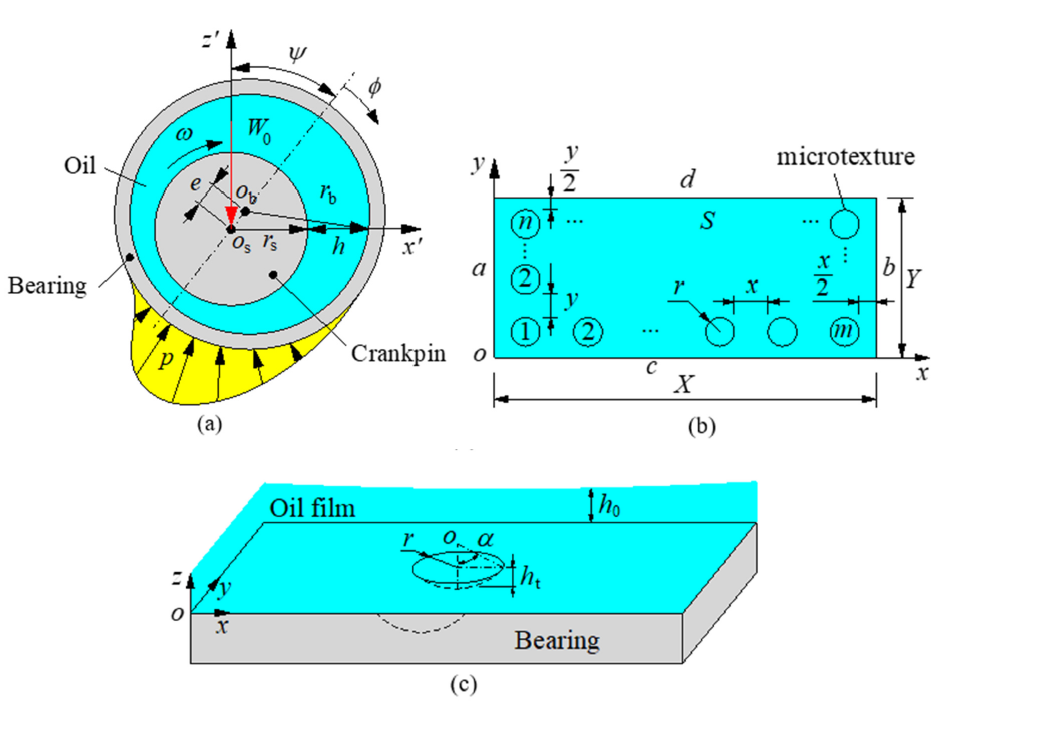
In order to assess the lubrication performance of the crankpin bearing added by the microtexture on the bearing surface, a hydrodynamic lubrication model of the crankpin bearing is built in (Figure 1a). In addition, to simplify for designing the microtexture on the bearing surface, a model of the bearing surface built in the Cartesian counterpart [16] is also established in (Figure 1b) for designing the microtexture and improving the oil film pressure and thickness. The depth of all the textures is assumed to be the same, and the distance between each texture designed on the bearing surface is equidistant in both the x- and y-directions. The structure and parameters of the microtextures are shown in (Figure 1c). Where ω, φ, and ψ are the angular velocity, angular coordinate, and attitude angle of the crankpin in the bearing; e is the eccentricity between the shaft and bearing centers; r is the radius of a microtexture; S is the area of the bearing surface; x and y are the distances between two microtextures; X and Y are the length and width of the bearing surface; and ht is the depth of the microtexture; a and b are the number of microtextures in the directions of x and y. Due to the radius of the crankpin being smaller than the radius of the bearing, the small gap C and an eccentricity ratio e exit between the bearing and crankpin; thus, the oil film thickness is calculated by h0=C(1+e×cosφ/C). With the depth of microtexture designed on the bearing surface in (Figure 1b & 1c), the oil lubrication is then added in these microtextures; thus, the actual oil film thickness in the crankpin bearing is calculated by:

Figure 1:(a) Lubrication model of the crankpin bearing; (b) Design of microtextures on bearing surface; (c) structure of a microtexture.
To determine the shape and the depth of microtextures designed, the mathematical equations of the microtextures are presented below.
Design of micro-textures on CB’s surface
Based on the structure of the designed microtexture, as shown in (Figure 1b & 1c), the dimensions or distances between the microtextures in the directions of x and y are calculated as:
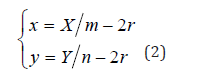
Therefore, the depth equation and the shape equation of microtexture on the bearing surface are written as:
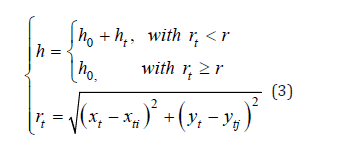
where xti and yti are the center coordinates of microtexture in the direction of x and y; and ht is the depth of microtextures. These parameters can be calculated by:
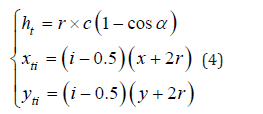
By combining Equations (2-4), the depth equation and shape equation of the microtexture are calculated for the simulation.
Application of Reynolds Equations
The Reynolds equation was applied to compute the oil film pressure (p) and oil film thickness (h) of journal bearings in the hydrodynamic lubrication condition [5,17]. With the hydrodynamic lubrication of the crankpin bearing, the Reynolds equation is also applied to calculate the oil film pressure and oil film thickness. In the working process of the crankpin bearing, the load W0 acting on the crankpin changes and affects the lubrication of the crankpin bearing, besides, the microtexture designed on the bearing surface also affects the lubrication of the crankpin bearing. To calculate the lubrication equation of the crankpin bearing according to the Reynolds equation, some assumptions of the model need to be given as follows: (1) the inertia of the oil flow and the velocity of the oil film in the centripetal motion are very small, (2) the density and dynamic viscosity of the oil film are unaltered during the working process of the crankpin bearing, and (3) the bearing surface is fixed while the crankpin surface is moved on the bearing surface with a velocity of u=rb ×ω in the direction of x. Thus, a general form of the Reynolds equation of the crankpin bearing lubrication is written by [6,9,15]:
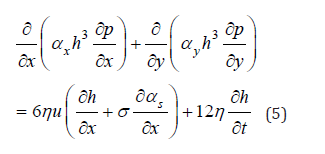
With X’=x/X, Y’=y/Y, γ=X/Y, H=h/C, P=p/p0, Λ=6hωY2 /p0C2, Γ=12hωY2/t0p0C2, T=t/t0, and Δ=σ/C, the dimensionless form of the Reynolds equation of the crankpin bearing lubrication is rewritten as follows:
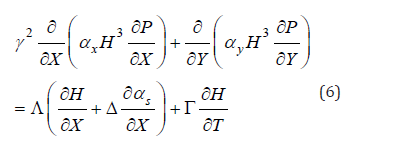
where as and (ax, ay) are factors of the pressure and shear flows; p0=101325Pa is the atmospheric pressure.
To calculate the oil film pressure and oil film thickness the boundary conditions of the crankpin bearing lubrication model are defined as follows: (1) the inlet and outlet pressures and the boundary pressures of the crankpin bearing at a, b, c, and d in the same (Figure 1c) are defined by the same atmospheric pressure of p0; (2) the maximum thickness of the oil film at φ=0o are the inlet oil film at a and outlet oil film at b in (Figure 1c); (3) the oil film thickness always exists and distributes over the bearing surface; and (4) the pressure in the cavitation region of the crankpin bearing is calculated by pc=ps with p£ps and pc=p with p>ps (ps is the saturation pressure). Therefore, the pressure at φ=0 and φ=360 is the oil film pressure; and the pressure at x=0 and x=B is zero. Based on these boundary conditions, both the oil film pressure and oil film thickness of the crankpin bearing could be computed.
Evaluation Indexes of Lubrication Performance
Due to the effect of the load W0, thus, the load bearing capacity of the crankpin bearing generated by the oil film pressure defined by W=W0+Wa must balance with W0 to ensure the normal working condition of the crankpin bearing. This means that the oil film pressure needs to be increased to enhance the load bearing capacity W0 of the oil film. Concurrently, the solid asperity contact pressure of the Elastic Hydrodynamic Lubrication (EHL) region needs to be decreased to reduce the Friction Force (Ff) and the asperity contact force Wa of the elastic hydrodynamic lubrication region of the crankpin bearing [5,9]. Because both the load bearing capacity of the crankpin bearing W and the friction force Ff of the crankpin bearing are strongly affected by both the oil film pressure and oil film thickness [3], thus, the microtextures are designed on the bearing surface to enhance both the oil film pressure and oil film thickness. To evaluate the lubrication performance of the crankpin bearing using the microtexture, the indexes of the increase of the oil film pressure p and reduction of the friction force Ff, asperity contact force Wa, and friction coefficient μ are selected as objective functions of this study. These indexes are determined as follows.
Index of oil film pressure distribution (p)
The oil film pressure distribution on the bearing surface is determined in Equation (5).
Index of friction force (Ff)
In the working process of the crankpin bearing, the generated friction force in the crankpin bearing includes the friction of the moving oil film in the hydrodynamic lubrication region and the friction of the solid contact in the elastic hydrodynamic lubrication region. This friction force was written by [8]:

where ta is the asperity contact stress and τ is the interfacial shear stress on the surfaces of the crankpin bearing.
Index of asperity contact force (Wa)
When the oil film thickness is lower than 10mm, there exists an elastic hydrodynamic lubrication region of the crankpin bearing [5], thus, the asperity contact force of the crankpin bearing was calculated by [9,17]:

where the asperity contact pressure of pa was calculated by

Index of friction coefficient (μ)
Based on the calculated results of the friction force in Equation (7) and the load bearing capacity of the crankpin bearing W=W0, the friction coefficient μ of the crankpin bearing was expressed by [5]:
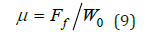
The indexes in Equations (5, 7-9) are then used to evaluate the lubrication performance of the crankpin bearing using the microtextures.
Simulation and Discussion
Computation of structure of microtextures
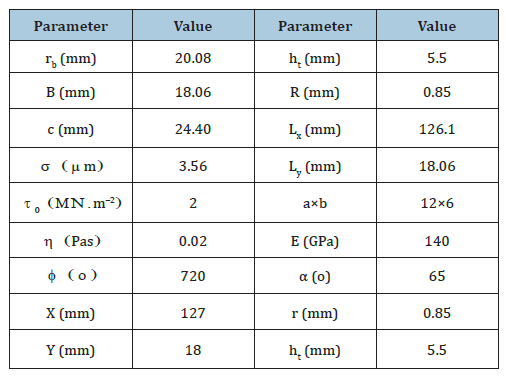
In order to compute the microtextures designed on the bearing surface as well as evaluate its performance in ameliorating the lubrication of the crankpin bearing, based on the design parameters of the crankpin bearing in Ref. [6,9] and the optimal parameters of microtexture in Ref. [15], as listed in (Table 1), these parameters are then simulated under the effect of the load W0 acting on the crankpin at a speed of 2000sr/min in (Figure 2). Based on the input parameters, lubrication equations, and microtexture equations calculated, MATLAB software is then applied to calculate the objective functions. From the simulated result, the distribution of microtexture with a´b=12×6 designed on the crankpin bearing is shown in Figure 3. This distribution is then applied to compute the oil film pressure and oil film thickness of the crankpin bearing and analyze its lubrication performance. Based on the input parameters, lubrication equations, and microtexture equations calculated, MATLAB software is then applied to calculate the objective functions. From the simulated result, the distribution of microtexture with a´b=12×6 designed on the crankpin bearing is shown in Figure 3. This distribution is then applied to compute the oil film pressure and oil film thickness of the crankpin bearing and analyze its lubrication performance.
Figure 2:The data of W0 acting on the crankpin.
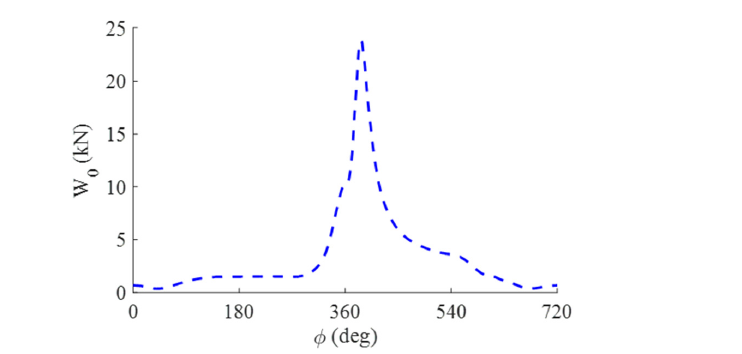
Figure 3:Distribution of microtextures on the bearing surface.
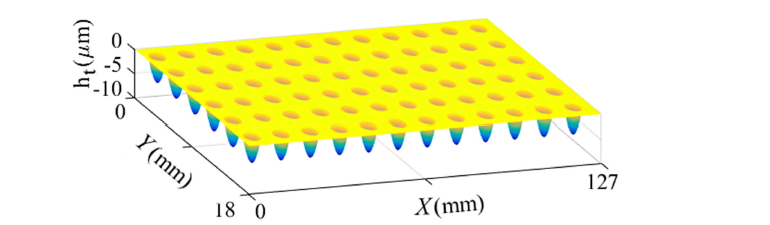
Table 1:The simulation parameters of the crankpin bearing and microtexture
Discussion
With the microtexture designed by the depth of 5.5mm on the bearing surface, the oil film thickness of the crankpin bearing is simulated and plotted in Figure 4. From the result in (Figure 4), we can see that in the range of the circumferential coordinate from 198o to 212o, the oil film thickness h is lower than the safe oil film thickness in Ref. [5], this is the elastic hydrodynamic lubrication region of the crankpin bearing. This is due to the effect of the maximum load of W0 in (Figure 2) acting on the crankpin at the combustion cycle of the engine. Thus, the eccentricity between the bearing and crankpin is increased, and the oil film thickness is decreased. In this elastic hydrodynamic lubrication region, both the friction force and asperity contact force of the crankpin bearing can be increased. Therefore, microtextures need to be designed and added to the bearing surface to increase the oil film pressure and oil film thickness in this region to ameliorate the lubrication performance of the crankpin bearing.
Figure 4:Oil film thickness of crankpin bearing without microtextures and using microtextures.
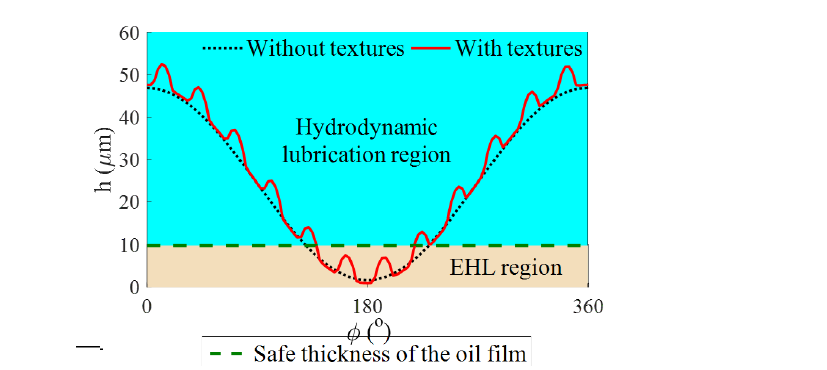
With the microtextures designed on the bearing surface, Figure 4 indicates that the oil film thickness of the crankpin bearing is significantly increased compared to without microtextures, especially at the elastic hydrodynamic lubrication region. With the increase of the oil film thickness in the crankpin bearing, the oil film pressure distributed on the bearing surface of the initial structure and using microtextures have been shown in Figure 5a & 5b. Observing Figure 5a & 5b, we can see that the maximum oil film pressure without microtextures is 190MPa, while the maximum oil film pressure with microtextures is 220MPa. This maximum oil film pressure is increased by 13.6%. This result is similar to the result of microtextuers designed in the journal bearings [13]. Because the oil film pressure is increased by using the microtextures, thus, both the friction force and asperity contact force could be reduced to improve the lubrication performance of the crankpin bearing. To clarify this issue, based on the simulated results of the oil film thickness and oil film pressure of the crankpin bearing in Figure 4 & 5, the friction force, asperity contact force, and friction coefficient of the crankpin bearing are computed and presented in (Figure 6a- 6c), respectively.
Figure 5:Oil film pressure distribution on the bearing surface: (a) without microtextures, and (b) using microtextures.
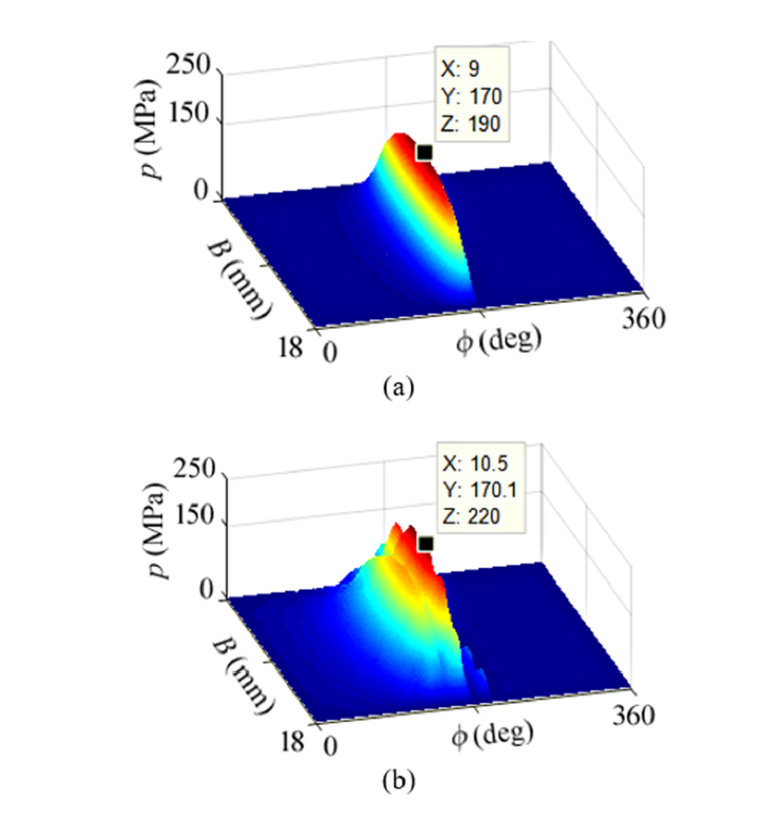
Figure 6:(a) Friction force; (b) asperity contact force; and (c) friction coefficient of the crankpin bearing.
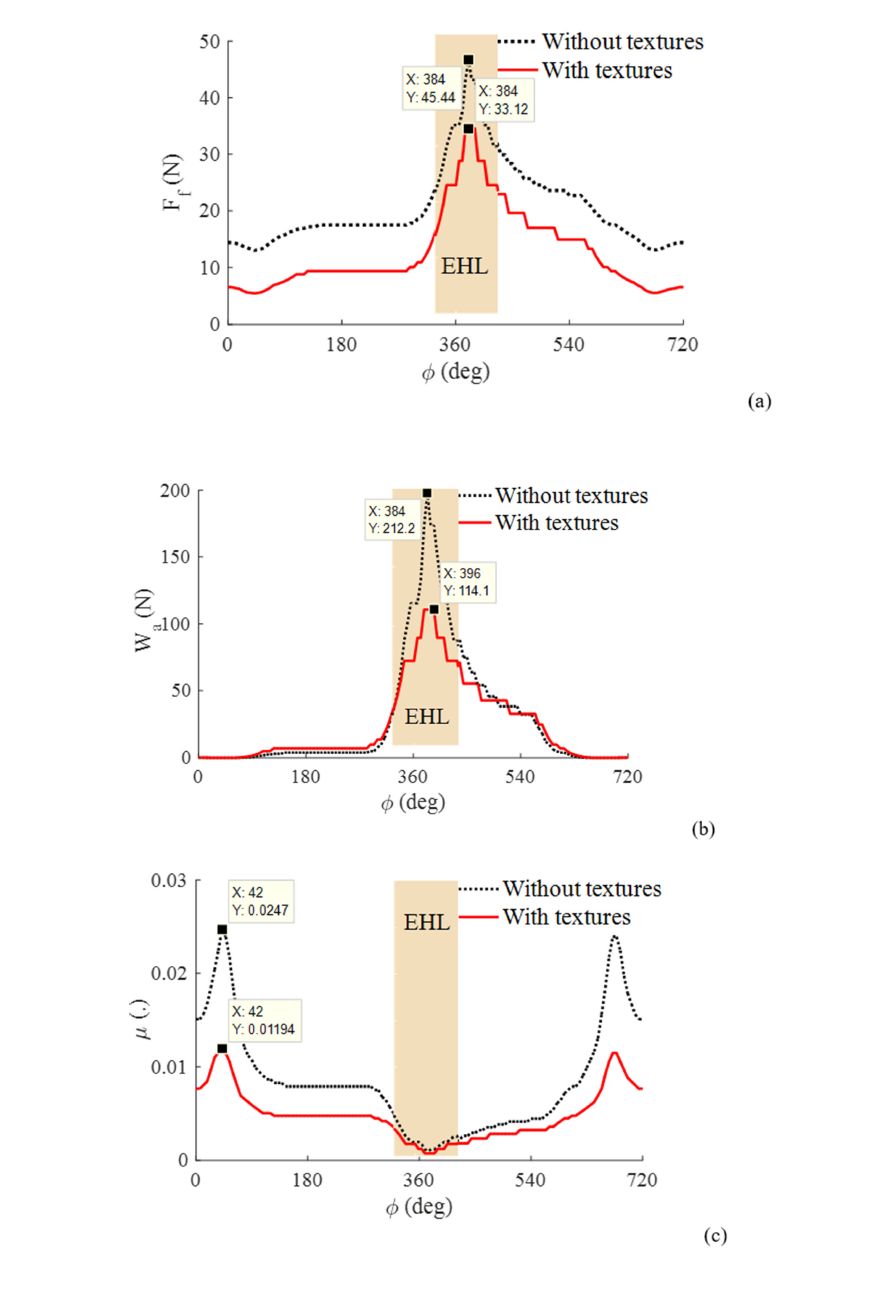
The results indicate that under the effect of the load W0, both the friction force and the asperity contact force reach the maximum values at the elastic hydrodynamic lubrication region. These results are similar to those in Refs. [6,16,18]. By adding microtextures on the bearing surface, the friction force, asperity contact force, and friction coefficient of the crankpin bearing are significantly reduced compared to without the microtextures, especially, these maximum values are strongly reduced by 27.1%, 46.2%, and 51.4% compared to without microtextures, respectively. This effectiveness is achieved because the lubricating oil film thickness is increased due to the addition of microtextures on the bearing surface. Therefore, the lubrication mode of the crankpin bearing is primarily hydrodynamic lubrication. From these obtained results, we can see that the indexes of the friction force, asperity contact force, and friction coefficient of the crankpin bearing are significantly reduced; thus, the lubrication performance is ameliorated by using the microtextures. However, this result was achieved through a design of microtextures at a distribution density of 12×6. The change of the distribution density of the microtextures on the bearing surface can affect the study result. Therefore, two different distribution densities of 6×6 and 18×6 are designed on the bearing surface and simulated to analyze the effect of their density on the lubrication performance of the crankpin bearing. The distribution results of the microtextures of 6×6 and 18×6 are simulated and plotted in Figure 7a & 7b. From these distribution results, their oil film pressures are also simulated and shown in Figure 8a & 8b.
Figure 7:(a) Distribution density of 6×6 and (b) distribution density of 18×6.
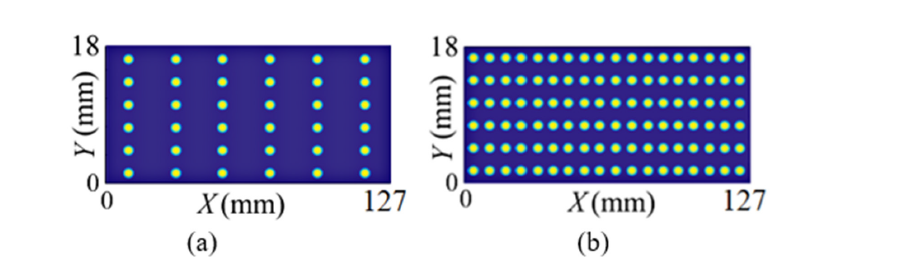
Figure 8:(a) Oil film pressure distribution at density of 6×6 and (b) at density of 18×6.
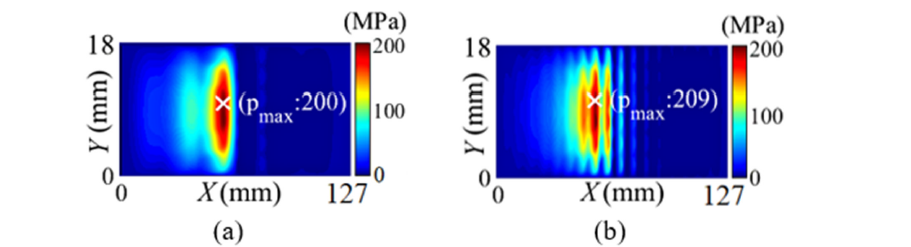
Comparison with the distribution results of the microtextures of 12×6, when the distribution density of microtextures decreases at 6×6 or increases at 18×6, the maximum oil film pressure of the crankpin bearing always reduces. This can be explained as follows: (1) With the used microtextures of 6×6, the distribution density of microtextures at a=6 in the direction x is less than half the distribution density of the microstructures at a=12, thereby, the solid contact region between two surfaces of the crankpin bearing can be substantially increased, thus, the oil film pressure reduces while the friction force and asperity contact force increase. Thus, the lubrication performance of the crankpin bearing using the microtextures of 6×6 is lower than that of microtextures of 12×6. (2) With the used microtextures of 18×6, the distribution density of microtextures at a=18 in the direction x is higher than that of the distribution density of the microstructures at a=12, thereby, the vacuum pressure within the microtextures can rise and reduce the oil film pressure. As a result, the indexes of the friction force and asperity contact force increase, thus, the lubrication performance of the crankpin bearing using the microtextures of 18×6 is also lower than that of microtextures of 12×6. Based on the above analysis results, the microtextures of 12×6, should be designed to improve the lubrication performance of the crankpin bearing.
Conclusion
By designing the microtextures on the bearing surface of the crankpin bearing, the oil film pressure and oil film thickness in the crankpin bearing are significantly increased compared to without microtextures; as a result, the maximum values of the friction force, asperity contact force, and friction coefficient of the crankpin bearing are significantly reduced by 27.1%, 46.2%, and 51.4% compared to without microtextures, respectively. Thus, the lubrication performance of the crankpin bearing is improved. With the different distribution densities of microtextures of 6×6, of 18×6, and of 18×6 applied, the lubrication performance of the crankpin bearing with microtextures of 12×6 is better than that of microtextures at 6×6 and 18×6. Besides, the contact between the crankpin surface and bearing surface always generates a friction force. This friction force increases the frictional power loss and decreases the durability of engines. Thus, by designing microtextures on the bearing surface could contribute to reducing the frictional power loss and increasing the durability of the engine.
Acknowledgement
The authors wish to thank the Dai Nam University for supporting this work.
Data Availability
The datasets generated during and/or analyzed during the current study are available from the corresponding author on reasonable request.
References
- Liu K, Xie YB, Gui CL (1998) A Comprehensive study of the friction and dynamic motion of the piston assembly. Proc Inst Mech Eng Part J: J Eng Tribol 212(3): 221-226.
- Guzzomi AL, Hesterman DC, Stone BJ (2008) Variable inertia effects of an engine including piston friction and a crank or gudgeon pin offset. J Auto Eng 222(3): 397-414.
- Wang X, Zhang J, Dong H (2011) Analysis of bearing lubrication under dynamic loading considering micropolar and cavitating effects. Tribol Int 44 (9): 1071-1075.
- Meng X, Ning L, Xie Y, Victor W (2012) Effects of the connecting-rod-related design parameters on the piston dynamics and the skirt-liner lubrication. Proc Inst Mech Eng PartD: J Automob Eng 227(6): 885-898.
- Zhao B, Dai X, Zhang Z, Bai Xie Y, Zhang (2016) A new numerical method for piston dynamics and lubrication analysis. Tribol Int 94: 395-408.
- Hoang T, Nguyen V, Pham V (2026) Effect of CB’s design parameters on reducing the friction loss and improving the tribological performance of engine. Aspects in Mining & Mineral Science 15(3): 1928-1934.
- Fesanghary M, Khonsari M (2012) Topological and shape optimization of thrust bearings for enhanced load-carrying capacity. Tribol Int 53: 12-21.
- Nguyen V, Zhang J (2021) Research on the effect of crankpin bearing speed and dimension on improving engine power. Journal of Southeast University 3: 1-9.
- Nguyen V, Wu Z, Vanquynh L (2020) Optimization of crankpin bearing lubrication under dynamic loading considering effect of micro asperity contact. Ind Lubricat Tribol 72(10): 1173-1179.
- Kovalchenko A, Ajayi O, Erdemir A, George F, Izhak E (2005) The effect of laser surface texturing on transitions in lubrication regimes during unidirectional sliding contact. Tribol Int 38(3): 219-225.
- Tomanik E, Profito FJ, Zachariadis DC (2013) Modelling the hydrodynamic support of cylinder bore and piston rings with laser textured surfaces. Tribol Int 59: 90-96.
- Etsion I (2013) Modeling of surface texturing in hydrodynamic lubrication. Friction 1(3): 195-209.
- Gropper D, Wang L, Harvey J (2016) Hydrodynamic lubrication of textured surfaces: A review of modeling techniques and key findings. Tribol Int 94: 509-529.
- Zhang H, Hua M, Zhong G, Zhang D, Wang C, et al. (2017) Optimization of texture shape based on genetic algorithm under unidirectional sliding. Tribol Int 115: 222-232.
- Jiao R, Nguyen V, Le V, Vancuong B (2019) Optimal design of micro-dimples on crankpin bearing surface for improving engine’s lubrication and friction. Ind Lubricat Tribol 73(1): 52-59.
- Martan J, Moskal D, Smeták L, Honner M (2020) Performance and accuracy of the shifted laser surface texturing method. Micromachines 11(5): 520.
- Zhang H, Zhang P, Meng H (2014) Boundary slip surface design for high speed water lubricated. Tribol Int 79: 32-14.
- Hua W, Nguyen V, Le V (2021) Analysis of dimensions of surface textures on lubrication and friction of an engine. SAE Inter J Eng 3: 1-10.
© 2026 Vanliem Nguyen. This is an open access article distributed under the terms of the Creative Commons Attribution License , which permits unrestricted use, distribution, and build upon your work non-commercially.
Editor In Chief






.jpg)































Signup for Newsletter

Quick Links
 Editorial Board Registrations
 Submit your Article
 Best Paper of the Volume
 Reprints
 Refer a Friend
 Advertise With Us
Our Recent Edition




Top Editors




.jpg)

















.bmp)
.jpg)
.png)
.jpg)













.jpg)






.png)

.png)




.png)




Financial Support

Sponsors

Latest e-Books

Latest Video

 a Creative Commons Attribution 4.0 International License. Based on a work at www.crimsonpublishers.com.
Best viewed in

 | Above IE 9.0 version