
- About Us
- Information
-

The Author ensures that the research has been conducted responsibly and ethically with adherence to all relevant regulations. read more..
- For Authors
- For Reviewer
- Manuscript Guidelines
- Membership
- Publication Ethics
-
- Journals
- Reprints
- e-Books
- Videos
- Policies
- Contact Us
 COVID-19
- Submissions



Full Text
Aspects in Mining & Mineral Science
Serpentinite Rocks of Uzbekistan: A Promising Raw Material for Refractories
Eminov AA, Kadyrova ZR* and Kazakova MN
Institute of General and Inorganic Chemistry, Academy of Sciences of the Republic of Uzbekistan, Tashkent
*Corresponding author:Kadyrova ZR, Institute of General and Inorganic Chemistry, Academy of Sciences of the Republic of Uzbekistan, Tashkent
Submission: October 09, 2026: Published: October 21, 2026
ISSN 2578-0255Volume15 Issue 4
Opinion
The modern development of ferrous and non-ferrous metallurgy, the chemical industry, as well as the production of ceramic, glass, and construction materials imposes increasingly stringent requirements on the quality and service life of refractory products. Under exposure to high temperatures, aggressive slags, and severe thermal shocks, refractories must exhibit high refractoriness, thermal shock resistance, corrosion resistance, and slag resistance. According to their chemical-mineralogical nature, refractory materials are classified as acidic (silica-based), basic (magnesia-based), neutral (alumina-, chromite-based, etc.), and special materials (carbon-, zirconia-containing) [1]. The selection of a specific refractory type is determined by slag composition and basicity, the temperature-time regime of the process, and the nature of thermo-mechanical loads. When operating with basic slags at high temperatures, MgO-containing refractories are of particular importance due to their enhanced slag resistance and property stability [2].
Raw materials for the production of forsterite refractories include olivine-bearing rocks, serpentinites, dunites, talc, and other magnesia-silicate rocks [3]. Among them, serpentinites are considered one of the most promising feedstocks; they are hydrated magnesium silicates with the general composition (Mg, Fe)3 Si2 O5(OH)4. In terms of crystal structure, serpentine-group minerals are complex layered formations built by alternating octahedral and tetrahedral sheets. The serpentine group comprises three main varieties-chrysotile, lizardite, and antigorite-which differ in crystal lattice type and particle morphology, and these differences largely determine their practical applications [4-6]. Until now, the needs of industrial enterprises of the Republic for refractory materials have been met through supplies from foreign countries.
This paper presents the results of determining the potential of serpentinite rocks from several deposits in the Republic of Uzbekistan for the production of refractory materials. Serpentinite is a green and greenish-gray metamorphic rock composed of serpentine (H2 Mg3 Si2 O9), antigorite, and chrysotile. It may also contain small amounts of chromium spinelide, magnetite, brucite, magnesium carbonates, talc, chlorite, and other minerals. The rock’s hardness ranges from 2.5 to 4.0 on the Mohs scale. The serpentinites of the Arvaten deposit are located in the Gallyaaral district of the Jizzakh region, in the Northern Nurata mountains. Depending on the location, the serpentinite deposit ranges in color from dark green to black, or less commonly, greenish-gray and gray. The rocks are overlain by quartzite and, in part, diabase minerals. Estimated reserves of serpentinite minerals at the Arvaten deposit, based on geological data, amount to 1,363,700 cubic m3.
The serpentinites of the Kutchinsk deposit are located in the Zirabulak Mountains of the Samarkand region of Uzbekistan [7,8]. The rocks of this deposit are gray and greenish-gray in color. The largest rock occurrence is located at the eastern end of the deposit, a mound shaped like an equilateral triangle measuring 200 meters and approximately 30-35 meters high. In terms of mineralogical phase composition, the groundmass consists of serpentine (80- 90% by weight) and trace ore minerals (approximately 7-8% by weight). In addition, a small amount of amphibole is occasionally encountered. The Sultan Uvays serpentinite deposit is located in the Sultan Uvays Mountains of the Beruni district of the Republic of Karakalpakstan and ranges in color from light to dark green [9,10]. The Sultan Uvays deposit’s serpentinite reserves are estimated at 5.0 million tons. The mineralogical composition is dominated by serpentine minerals, with minor amounts of quartz and other minerals, the contents of which are very low.
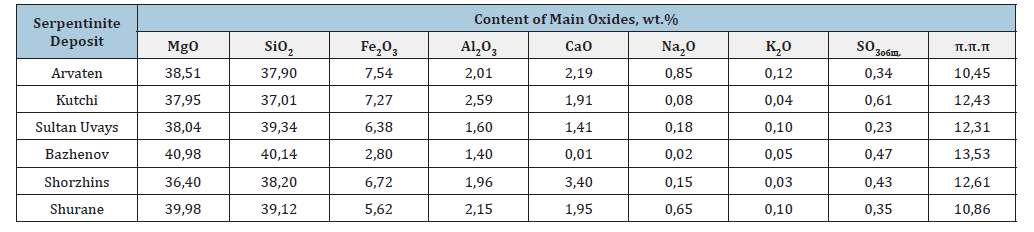
The results of chemical composition determinations for the studied and imported (for comparison) serpentinite rocks are presented in Table 1. As can be seen from (Table 1), the amounts of the main rock-forming components-magnesium, aluminum, and iron oxides-of the domestic serpentinites are relatively close to those of the Shorzha (Armenia) and Shuran (Kyrgyzstan) serpentinites, but differ slightly from those of the Bazhenov (Russia). It should be noted that forsterite refractories (MgSiO4) occupy a special place among high-temperature refractory materials and products. They have specific characteristics and chemical and mineralogical compositions, and their structure corresponds to magnesia-silicate refractories.
Table 1:Results of chemical analysis of domestic serpentinites and their comparison with imported ones.
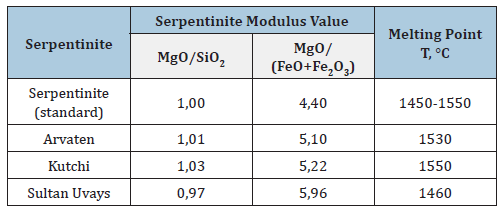
Furthermore, the quality of natural magnesia raw materials for the production of magnesia, particularly forsterite, refractories are also additionally assessed by the modulus values: magnesiasilicate MgO/SiO2 and magnesia-ferrous MgO/(FeO+Fe2 O3) (Table 2). The obtained results of the study showed that the chemical and mineralogical composition, as well as the values of the MgO/SiO2 and MgO/Fe2 O3 modules, have similar values compared to imported serpentinites, which are currently widely used for the production of magnesia refractory materials.
Table 2:Serpentinite modulus values and melting points.
Among these, the most promising are the serpentinites of the Arvaten deposit; they are fine-grained, massive rocks ranging in color from gray to greenish-gray. At the contact zone with schists within the deposit, serpentinite rocks grading into talc are observed in places. The total thickness of this altered zone does not exceed 8-10m on the northern side and 5-7m on the southern side. The process of talc formation diminishes over time, resulting instead in the foliation (schistosity) of the serpentinite rocks. In the center of the northern part of the Arvaten deposit, a contact between serpentinite and vein quartz-reaching a thickness of up to 1.5m-is observed; notably, talc formation in the serpentinite is minimal at this contact. Several areas within the deposit contain rocks that appear dark gray but are classified as serpentinites. Rocks containing feldspar grains (up to 5-7mm in size) exhibit color variations ranging from red to pale pink. According to geological studies [11,12], virtually all rocks in the deposit-including diabases and amphibole-epidote schists-are suitable as raw materials for stone casting.
The serpentinites of the Arvaten deposit consist primarily of the mineral serpentine (80-90wt.%) and ore minerals (7-8wt.%), along with minor amounts of amphiboles. The rock exhibits a blastoporphyritic, heterogeneous structure with transverse or cross-fiber textures. The serpentine mineral itself occurs in several morphological varieties, specifically fine-fibrous, platy, and disseminated forms. In all these varieties, the serpentine grains are elongated, differing in size and mutual orientation. Small amounts of fine-grained magnetite occur within the serpentine aggregates; this magnetite is associated with the formation of the magnesian mineral olivine in the parent rock. The ore minerals form somewhat rounded, elongated, and discontinuous grains or chains, as well as dust-like inclusions that often mirror the outlines of the primary mineral. The rock is transected by discontinuous micro-fractures that are not always clearly discernible. Iron hydroxides are typically associated with a system of minute, discontinuous quartz microveinlets.
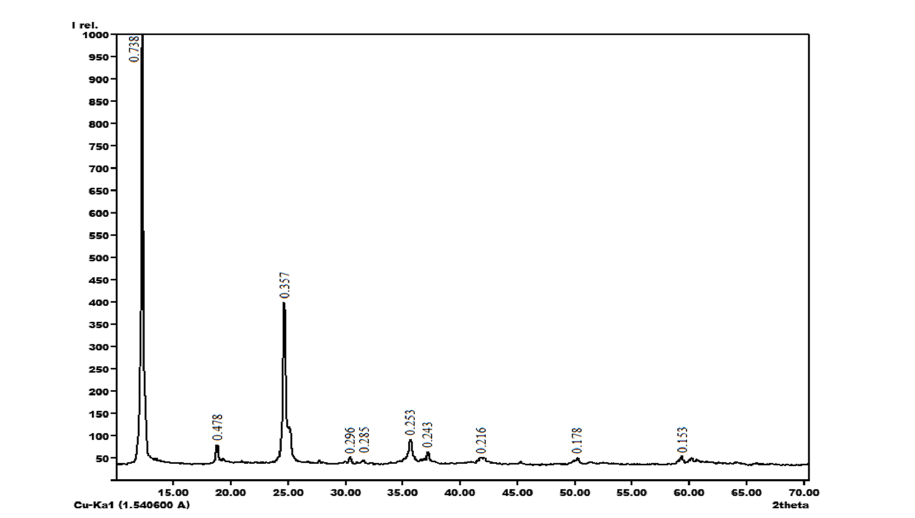
The mineralogical composition of the studied Arvaten serpentinite samples was determined using X-ray phase analysis; the results are presented in the Figure 1. The X-ray diffraction patterns reveal peaks corresponding to the rock-forming minerals of the serpentinite-specifically serpentine (up to 85wt.%)-with d-spacings of 0.738, 0.478, 0.357, 0.285, and 0.253. 0.243; 0.216nm), as well as fine-grained magnetite (d=0.478; 0.296; 0.253; 0.243nm). In addition, quartz, chlorite, and talc are present as minor minerals. Melting point determinations for the serpentinite samples yielded values ranging from 1260 to 1275 °C; this melting temperature range is likely attributable to the material composition-specifically, the heterogeneity of the original natural mineral rock.
Figure 1:X-ray diffraction pattern of an Arvaten serpentinite sample.
Conclusion
Thus, the results of determining the chemical and mineralogical composition, MgO/SiO2 and MgO/Fe2O3 total modulus values, and the morphology of serpentinite minerals from the Arvatin, Kutchin, and Sultan-Uvai deposits in Uzbekistan demonstrate that they can be used in both unprocessed and processed forms to produce magnesite refractory materials with forsterite and magnesioferrite compositions. Furthermore, given the potential and favorable infrastructure of the aforementioned serpentinite deposits, they can be recommended as the primary natural magnesite raw material for the production of magnesia-silicate refractory materials for various functional purposes.
References
- Kashcheev ID, Zeslyanoy KG (2022) Refractory production: A textbook for universities. (4th edn), Stereotyped. Saint Petersburg: Lan, Russia p. 344.
- Surendranathan AO (2014) An introduction to ceramics and refractories. CRC Press, Boca Raton, USA, p. 510.
- Sembiring S, Riyanto A, Simanjuntak W, Situmeang R (2017) Ratio on the forsterite (Mg2SiO4) precursors characteristics derived from amorphous rice husk silica. Oriental Journal of Chemistry 33: 1828-1836.
- Gualtieri AF, Giacobbe C, Viti C (2012) The dehydroxylation of serpentine group minerals. American Mineralogist 97(4): 666-680.
- Candela PA, Crummett WP, Earnest DJ, Frank MR, Wylie AG (2007) Low-pressure decomposition of chrysotile as a function of time and temperature. American Mineralogist 92(10): 1704-1713.
- Nemat S, Ramezani A, Emami SM (2019) Recycling of waste serpentine for the production of forsterite refractories: The effects of various parameters on the sintering behavior. Journal of the Australian Ceramic Society 55: 425-431.
- Kadyrova ZR, Bugaenko VA, Eminov AA (2018) Magnesia-based refractory raw materials and prospects for their use. Novye Ogneupory 5: 10-13.
- Kadyrova ZR, Eminov AA, Pirmatov RK (2019) Promising raw material resources in Uzbekistan for the production of refractory materials. Novye Ogneupory, Russia 7: 8-11.
- Toreniyazov MA, Eminov AA, Kazakova MN, Pardaev TU (2023) Chemical and mineralogical composition and structure of serpentinites from the Arvaten deposit. Uzbek Chemical Journal 6: 31-37.
- Toreniyazov MA, Eminov AA, Pardaev TU, Voronkov NA (2025) Assessment of the suitability of serpentinite from the Sultan-Uvays deposit for producing magnesial refractories. New Refractories 2: 3-6.
- Asabaev DK, Badalov FA, Ergashov AM (2022) Assessment of the mineral resource potential of magnesian rocks and prospects for their rational use in Western Uzbekistan (Southern Tien Shan). Innovative, Educational, Natural and Social Sciences, 2(11): 259-265.
- Asabaev DK, Khamidov RA, Badalov FA (2022) Magnesian mineral raw materials: general information, formation conditions, and industrial quality requirements. Geology and Mineral Resources, Tashkent 1: 55-63.
© 2026 Kadyrova ZR. This is an open access article distributed under the terms of the Creative Commons Attribution License , which permits unrestricted use, distribution, and build upon your work non-commercially.
Editor In Chief






.jpg)































Signup for Newsletter

Quick Links
 Editorial Board Registrations
 Submit your Article
 Best Paper of the Volume
 Reprints
 Refer a Friend
 Advertise With Us
Our Recent Edition



Top Editors




.jpg)

















.bmp)
.jpg)
.png)
.jpg)













.jpg)






.png)

.png)




.png)




Financial Support

Sponsors

Latest e-Books

Latest Video