

- About Us
- Information
-

The Author ensures that the research has been conducted responsibly and ethically with adherence to all relevant regulations. read more..
- For Authors
- For Reviewer
- Manuscript Guidelines
- Membership
- Publication Ethics
-
- Journals
- Reprints
- e-Books
- Videos
- Policies
- Contact Us
 COVID-19
- Submissions



Full Text
Aspects in Mining & Mineral Science
Effect of CB’s Design Parameters on Reducing the Friction Loss and Improving the Tribological Performance of Engine
Trandang Hoang, Vanliem Nguyen* and Vantruong Pham
Faculty of Automotive Engineering Technology, Dai Nam University, Vietnam
*Corresponding author:Vanliem Nguyen, Faculty of Automotive Engineering Technology, Dai Nam University, Hanoi, Vietnam
Submission: July 31, 2026: Published: September 29, 2026

ISSN 2578-0255Volume15 Issue 3
Abstract
Design parameters of the CB (crankpin bearing), including c,rb, rs, and B (radial clearance, bearing radius, shaft radius, and width) can affect lubrication-friction in the engine, thus, friction loss can be increased, and tribological performance can be reduced. To clarify this issue, an integrated framework combining slider-crank dynamics and crankpin-bearing mixed lubrication analysis is established to evaluate in detail under various changes of c, rb, rs, and B based on the Reynolds equation and MATLAB software. The p, F, and μ (oil pressures, force of friction, and friction-coefficients) of CB are selected as evaluating indexes. The study shows that all design parameters of CB greatly affect the friction loss and tribological performance of the engine. To improve the tribological performance of the engine, the optimal ranges of 2025c≤≤ μm, 1520rb≤≤ mm, and 1520B≤≤ mm should be selected in the engine design process. These ranges are proposed based on numerical trend analysis rather than formal optimization.
Keywords:Crankpin bearing; Tribological performance; Friction loss; Slider-crank mechanism
Introduction
Reducing fuel consumption and improving environmental pollution were important goals in engine design. One of the causes of fuel consumption was high friction generated during engine operation. Therefore, it reduces tribological performance and increases fuel consumption and environmental pollution. Accordingly, to improve the tribological performance, the structures in the internal combustion engine have been researched and optimized. With the Slider-Crank Mechanism (SCM) of the engine, the piston inertial force and the eccentricity of the cylinder-crankshaft have been studied to limit the interaction force between the cylinder and piston [1-3]. The friction force generated in the joints of the SCM was also researched and analyzed for improving tribological performance [4]. The result showed that tribological performance was significantly reduced by the friction of SCM and piston-cylinder generated. To improve this friction, the lubrication methods of the SCM and piston-cylinder was researched and developed [3,4-6], especially the lubrication in the crankshaft bearings and crankpin bearings. The results indicated that the generated friction force in the SCM was greatly reduced when lubrication in CB is ensured. However, with the structure of CB designed, lubricating CB was very difficult, while the friction generated in CB was very large [7,8].
Moreover, during engine operation, the combustion gas pressure in the piston-cylinder acting on the SCM and CB changes both direction and intensity. Accordingly, the SCM’s structural durability and CB’s lubrication ability are greatly affected. In the lubricating journal-bearings, the lubricating efficiency mainly depends on their radial gap [9-11]. With CB, the radial gap is defined by c=rb−rs (rb is the bearing radius and rs is the shaft radius). This radial clearance depends not only on the force applied by SCM but also on the designed radius of CB. Whether this radial clearance is large or small can affect the friction loss and tribological performance of the engine. Accordingly, it needs to be evaluated in detail based on the actual conditions of the engine. Additionally, the friction generated in the journal bearing or CB not only depends on the radial clearance of the journal bearing but also on the contact area between the bearing surface and shaft surface [6-8,12]. Therefore, the effect of the width (B) of CB on the tribological performance of the engine also needs to be evaluated in detail.
To evaluate in detail the effect of c, rb, rs, and B of CB on the tribological performance of the engine, an integrated framework combining slider-crank dynamics and crankpin-bearing mixed lubrication analysis is established to evaluate lubrication-friction properties in CB comprehensively. In contrast to previous studies that only considered the lubrication and friction of the oil film on the CB lubrication, this study completely analyzes the influence of CB’s design parameters on all the friction loss and tribological performance of the engine. Various parameters of c, rb, rs, and B are simulated to explain their influence on the tribological performance of the engine.
Method
Dynamic SCM model
The SCM’s dynamic force is calculated using its dynamic model, as shown in (Figure 1). According to the calculated results in Refs [6,13], the acceleration of the piston can be written as:
Figure 1:SCM’s dynamic model.
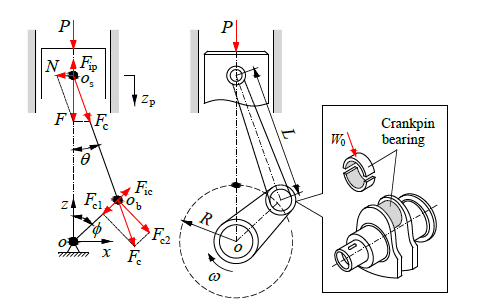

It is defined that mb and ms are mass of the connecting rod at os and ob, and λ=R/L. Thus, the inertial force at o1 of piston and the connecting rod force are expressed as:
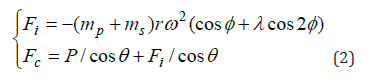
Under the impaction of P (gas pressure) and Fc, forces acting on the crankshaft can be expressed by:
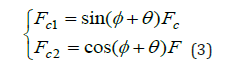
With the force of the connecting rod’s centrifugal inertial calculated by Fic = −mb rω2 , the acting force on the crankpin bearings has been written by:

Changes in force W0 are then used to analyze the tribological properties of CB.
Crankpin bearing lubrication model
With dynamic force W0 impacting the crankshaft and the crankshaft rotating with the same angular velocity ω , a model of a journal bearing consisting of the shaft subjected to W0 and rotating with ω is modeled in (Figure 2a) to analyze CB’s lubrication-friction of the crankpin bearing. The Cartesian counterpart of this model is also constructed in (Figure 2b), [14].
Figure 2:(a) Lubrication model of crankpin bearing; (b) its Cartesian counterpart.
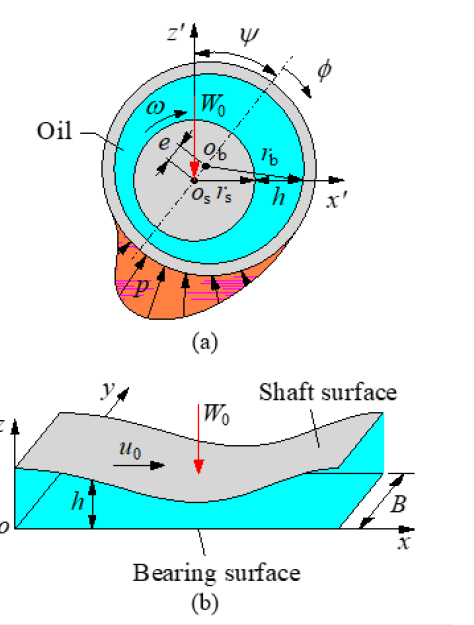
In (Figure 2), u0=wrb refers to the relative sliding velocity, ψ is the angular coordinate, ϕ is the angular coordinate, h and p are thickness and pressure of oil film. h is computed as [7]:

where ε = e/c are the ratio between the radial clearance e and c.
According to the Cartesian counterpart model, the bearing does not move in either x- and y-direction, the shaft only moves in x-direction under some speed u0. Thus, the velocity boundary conditions on the bearing can be expressed by:
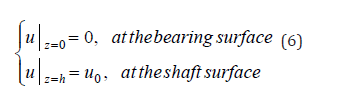
The CB lubrication equation can be conveniently solved by assuming that lubricant density and viscosity are constant in the working process. In practical conditions, however, surface of the crankpin and bearing are randomly oriented. Thus, the pressure- flow factors of ϕx and ϕy reflect the surface roughness resistance to flow of lubricant [13], and a factor ϕs of additional flow attributed to these two factors [15] may be employed to determine the expected volumetric flow.
Based on the research results in Refs [13,16], Reynolds equation of the lubrication model in (Figure 2) is presented as:

Thus, the dimensionless equation obtained from Equation (7) is written as:


Equation (8) can be solved by determining the boundary conditions of the oil film pressure. With the thickness of the oil film distributes on CB, inlet and outlet of the lubricant is located at point at which the maximum film thickness corresponds to 0° and 360° of ϕ. The atmospheric pressure is ambient, inlet, and outlet pressures for computational domain; and given as follows:

Evaluation index of engine power
Under the impact of W0, the load capacity of CB has been calculated as [16]:

where pac is the asperity-contact pressure between surfaces of CB.
For CB to work stably, W must be balanced with W0, this means that W=W0. However, W depends on both the values of p and pac. Therefore, to ensure the lubrication and load capacity of CB, p needs to be increased.
Besides, due to the influence of CB’s τis and τac (interfacial shear stress and asperity contact stress) determined by τis=τ1 +τ2 and τ ac =τ 0 + μ0 pac , the F (friction force) and μ (friction coefficient) of CB are computed as follows [16]:
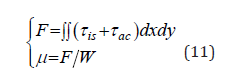
The p, F, and μ were selected as evaluation indices to analyze the friction loss and tribological performance of the engine. Thus, increasing p and reducing F and μ could be defined as objective functions.
Result and Discussion
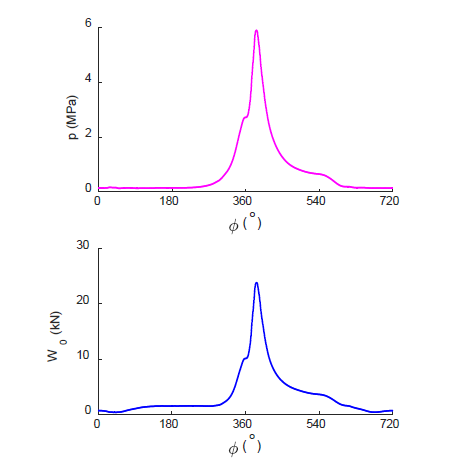
Based on the parameters listed in (Table 1) and the experimental data of the combustion-gas pressure in (Figure 3a), the W0 calculated at a crankshaft speed of 2000rpm is indicated in (Figure 3b), [4,13]. These input values are applied to highlight effect of c, rb, rs, and B on the friction loss and tribological performance of engine.
Table 1:Simulation parameters of SCM and crankpin bearing.
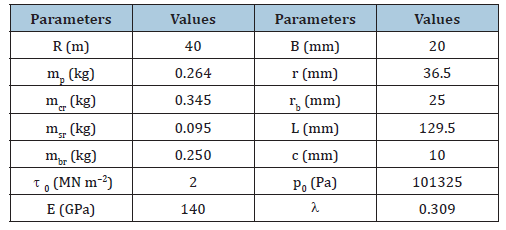
Figure 3:(a) Experimental data of the combustion gas pressure; (b) acting force on the crankpin bearing.
Effect of radial clearance c
The effect of different radial clearances of c (5, 10, 15, 20, 25 μm) is simulated. The distribution results of p and shear stress on CB at c=10μm are given in (Figure 4). Research shows that the highest pressures of the oil film are mainly distributed from 90° to 180° of the circumferential coordinates, and max p=88.8MPa occurs at 158° when the bearing width is B/2. The shear stress is uniformly distributed along the bearing width but changes remarkably over the circumferential coordinates evaluated and peaks at 178°.
Figure 4:(a) Pressure distribution of the oil film; (b) shear stress distribution of the oil film.
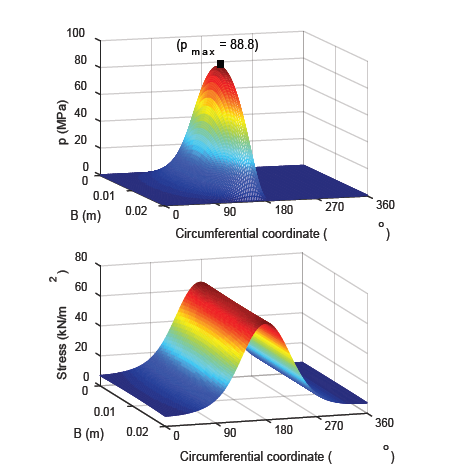
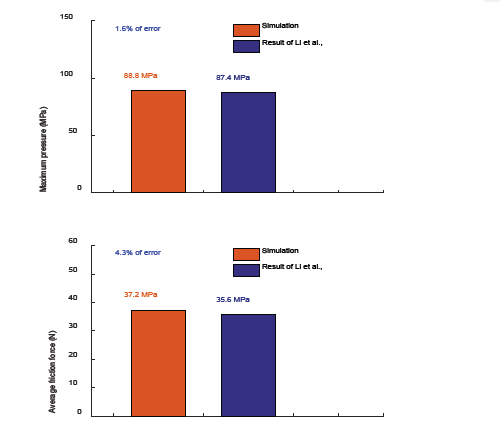
To validate the research results and the accuracy of the mathematical model, based on the results of p and τ obtained in (Figure 4), the maximum pressure and the average friction force are calculated and compared with the results of Li et al. [17] in Reference [17], as shown in Figure 5a & 5b. The numerical simulation results of the maximum pressure of the oil and the average friction force of the CB in this study deviate from the research results of Li et al. [17] by 1.6% and 4.3%, respectively. This result indicates that the mathematical model of CB is highly reliable and can be used to assess the influence of parameters on the friction loss and tribological performance of the engine.
Figure 5:(a) Maximum pressure of the oil film; (b) average friction force of CB.
Under changes in the radial clearance c, both p and obtained at a bearing width of B/2 are illustrated in (Figure 6). (Figure 6a) presents that p is greatly increased by increasing c. This is because the oil film thickness increases as the clearance between the bearing and the shaft increases. Thus, the solid contact pressure between the two surfaces decreases, causing the oil film pressure to rise. Conversely, the oil film shear stress in (Figure 6b) increases when c is reduced because asperity-contacts of the bearing and shaft increases, which, in turn, increases F. The simulation results of F and μ is shown in Figure 7a & 7b to clarify the effect of the various radial clearances on the friction loss of CB.
Figure 6:: (a) Pressure of the oil film at B/2; (b) shear stress of the oil film at B/2.
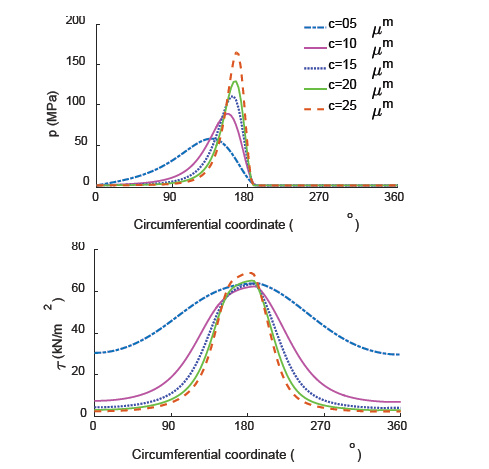
Figure 7:(a) Friction force of CB; (b) friction coefficient of CB.
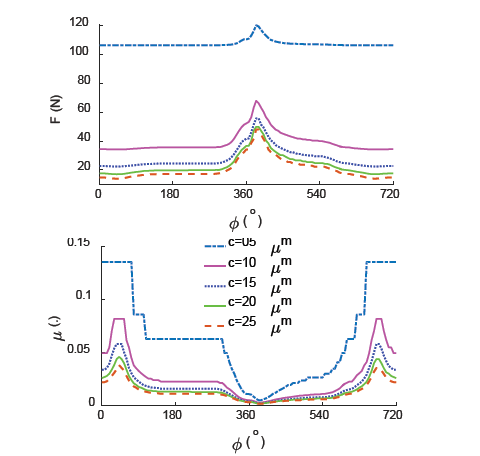
Figure 7 indicates that both F and μ markedly decrease with increasing c, especially at 25μm of c. The friction loss of CB is thus reduced, and the tribological performance of the engine is increased. The above results imply that larger radial clearance could effectively reduce friction and increase lubrication. However, an excessively large radial clearance can cause the eccentricity of the shaft and bearing to fluctuate greatly, causing the collision of the shaft and bearing. As the radial clearance gradually increases, the reduction in friction coefficient becomes very limited. Thus, according to the simulation and analysis results, the optimal radial clearance range providing both anti-friction and anti-impact properties simultaneously is 20 ≤ c ≤ 25 .
Effect of bearing radius rb
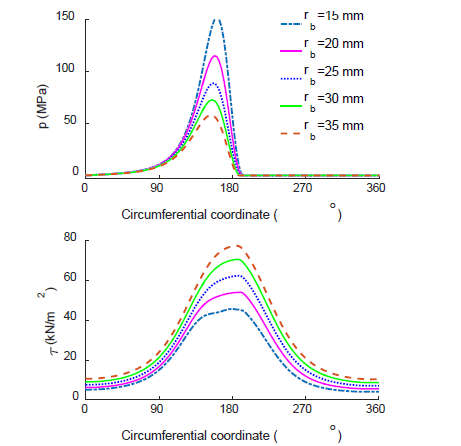
In order to evaluate the effect of rb on the tribological performance of the engine, the various values of rb (15, 20, 25, 30, and 35mm) have been computed, respectively. Simulation results of p and τ at B/2 are plotted in Figure 8. The results show that the oil film pressure decreases, whereas the shear stress increases as rb gradually increases from rb=15-35mm. This means that lubrication in CB is decreased when increase rb.
Figure 8:(a) Friction force of CB; (b) friction coefficient of CB.
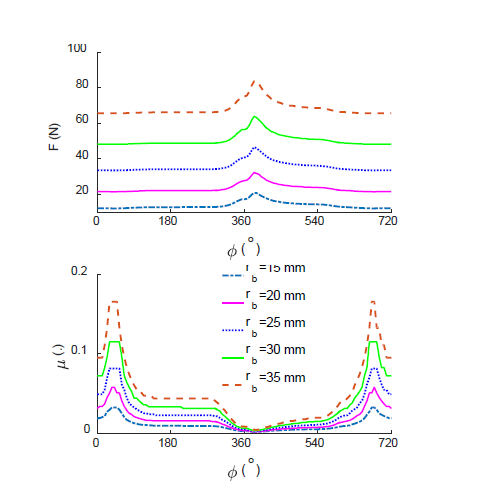
Calculation results of friction force and friction coefficient in the crankpin bearing are plotted in Figure 9a & 9b based on the results in (Figure 8b). With an increase rb, both F and μ in CB are also increased. This finding may be attributed to increases in u0=ωrb and contact area affecting shear stress and friction resistance. Therefore, increasing the rb not only reduces lubrication of CB but also increases F as well as μ in CB. As a result, the tribological performance of the engine is greatly reduced. Thus, according to the simulation and analysis results, the optimal bearing radius range for reducing friction loss and improving the tribological performance is 15 ≤ rb ≤ 20 mm.
Figure 9:(a) Friction force of CB; (b) friction coefficient of CB.
Effect of bearing width B
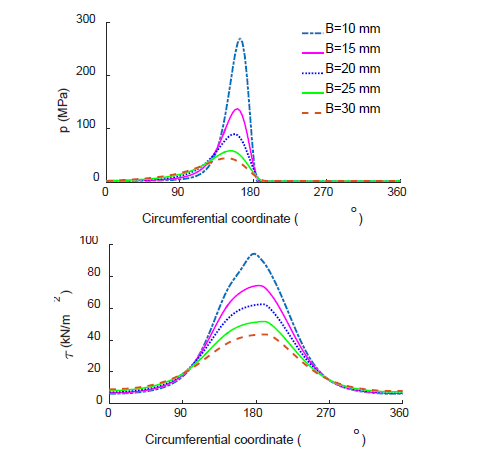
Under the change of the bearing width B, (Figure 10) demonstrates the influence of B=10,15,20,25,30mm on p and τ. B affects greatly the tribological performance of the engine. When B is reduced, both p and τ are strongly increased, and vice versa. This means that lubrication performance improves as the bearing width B decreases.
Figure 10:(a) Pressure of the oil film at B/2; (b) shear stress of the oil film at B/2.
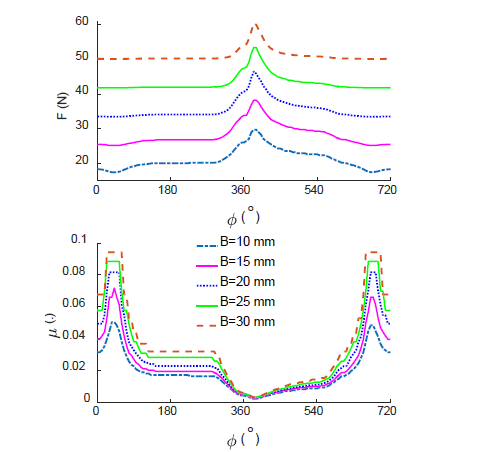
Besides, calculation results of the force and coefficient of friction in CB at various values of B are also plotted in Figure 11. Contrary to the calculation results of shear stress distributions presented in (Figure 10b), when increase of the B, both F and μ in CB are strongly increased and vice versa. This is due to the contact-area of the surfaces in the journal bearing being increased; thus, both F and μ increase. Although smaller widths reduce friction, structural reliability and wear resistance can be reduced. Therefore, to improve tribological performance and ensure structural reliability and wear resistance, the optimal bearing width range should be 15 ≤ B ≤ 20 mm.
Figure 11:(a) Friction force; (b) friction coefficient of CB.
Conclusion
With the radial clearance c changed, the p increases while the F is reduced with increasing radial clearance of the crankpin bearing. Thus, lubrication-friction properties in journal bearing are significantly improved. However, an excessively large radial clearance can cause the eccentricity of the shaft and bearing to fluctuate, thereby causing a collision between the bearing and shaft. Results reveal that the optimal radial clearance range providing anti-friction and anti-impact properties simultaneously is 20 ≤ c ≤ 25 μm.
With the bearing radius rb changed, the oil film pressure is strongly reduced while F and μ in crankpin bearing are strongly increased when increase of bearing radius rb. Thus, the tribological performance is greatly reduced. According to the simulation and analysis results, the optimal bearing radius range providing both the lubrication and friction properties simultaneously is 15 ≤ rb ≤ 20 mm. When the bearing width B is changed, the oil film pressure is strongly increased, while F and μ in the crankpin bearing are strongly reduced when reduction of bearing width B. According to the simulation and analysis results, the optimal bearing width range providing both the lubrication and friction properties simultaneously is 15 ≤ B ≤ 20mm. The above optimal ranges are proposed based on numerical trend analysis rather than formal optimization.
The proposed study in this paper could not only analyze lubrication- friction properties in dynamic bearings but also inform the design of crankpin bearings and optimize design parameters to enhance the tribological performance of the engine. However, during CB’s operation, the lubricant temperature increases due to friction between the bearing and shaft. This significantly reduces the quality of lubricating oil as well as the lubrication efficiency of the bearing and shaft. However, these problems are assumed to be unchanged during bearing and shaft operation. This is the limitation of this study. Therefore, these issues will be studied in the next work.
Acknowledgment
The authors wish to thank the Dai Nam University for supporting this work.
Data Availability
The datasets generated during and/or analyzed during the current study are available from the corresponding author on reasonable request.
References
- Meng X, Ning L, Xie Y, Wong VW (2013) Effects of the connecting-rod-related design parameters on the piston dynamics and the skirt-liner lubrication. Part D: Journal of Automobile Engineering 227(6): 885-898.
- Li Y, Chen G, Sun D, Gao Y, Wang K (2016) Dynamic analysis and optimization design of a planar slider-crank mechanism with flexible components and two clearance joints. Mechanism and Machine Theory 99: 37-57.
- He Z, Gong W, Xie W, Zhang J, Guichang Z, et al. (2016) NVH and reliability analyses of the engine with different interaction models between the crankshaft and bearing. Applied Acoustics 101: 185-200.
- Zhao B, Dai X, Zhang Z, Xie Y (2016) A new numerical method for piston dynamics and lubrication analysis. Tribology International 94: 395-408.
- Daniel G, Cavalca K (2011) Analysis of the dynamics of a slider-crank mechanism with hydrodynamic lubrication in the connecting rod-slider joint clearance. Mechanism and Machine Theory 46(10): 1434-1452.
- Jiao R, Le V, Nguyen V, Bui V (2021) Optimal design of micro-dimples on crankpin bearing surface for improving engine's lubrication and friction. Industrial Lubrication and Tribology 73(1): 52-59.
- Zhang H, Hua M, Dong G, Zhang D, Chin K (2016) A mixed lubrication model for studying tribological behaviors of surface texturing. Tribology International 93: 583-592.
- Zhao B, Zhang Z, Fang C, Dai XD, Xie Y (2016) Modeling and analysis of planar multibody system with mixed lubricated revolute joint. Tribology International 98: 229-241.
- Patir N, Cheng H (1978) An average flow model for determining effects of three-dimensional roughness on partial hydrodynamic lubrication. Journal of Lubrication Technology 100(1): 12-17.
- Patir N, Cheng H (1979) Application of average flow model to lubrication between rough sliding surfaces. Journal of Lubrication Technology 101(2): 220-229.
- Greenwood J, Tripp J (1970) The contact of two nominally flat rough surfaces. Proceedings of the Institution of Mechanical Engineers 185(1): 625-633.
- Zhang J, Zhang J, Rosenkranz A, Zhao XL, Song YL (2018) Surface textures fabricated by laser surface texturing and diamond cutting - influence of texture depth on friction and wear. Advanced Engineering Materials 20(4): 1700995.
- Wu Z, Le V, Nguyen V (2020) Optimization of crankpin bearing lubrication under dynamic loading considering effect of micro asperity contact. Industrial Lubrication and Tribology 72(10): 1173-1179.
- Wang P, Wu X, Nguyen V, Wang S (2021) Research on different structures of dimpled textures on improving the LE-FPL of engine. Industrial Lubrication and Tribology 73(4): 545-553.
- Gropper D, Wang L, Harvey T (2016) Hydrodynamic lubrication of textured surfaces: A review of modeling techniques and key findings. Tribology International 94: 509-529.
- Zhang J, Jiao R, et al. (2021) Research on the effect of crankpin bearing speed and dimension on improving engine power. Journal of Southeast University, China 37(2): 119-127.
- Li Q, Mei Y, Tian X, Li Y, Sun B (2025) Investigation on working efficiency and performance of journal bearings using various microtextures. International Journal of Computational Materials Science and Surface Engineering 12(2): 168-185.
© 2026 Vanliem Nguyen. This is an open access article distributed under the terms of the Creative Commons Attribution License , which permits unrestricted use, distribution, and build upon your work non-commercially.
Editor In Chief







.jpg)






























Signup for Newsletter

Quick Links
 Editorial Board Registrations
 Submit your Article
 Best Paper of the Volume
 Reprints
 Refer a Friend
 Advertise With Us
Our Recent Edition
.jpg)



Top Editors




.jpg)

















.bmp)
.jpg)
.png)
.jpg)













.jpg)






.png)

.png)




.png)




Financial Support

Sponsors

Latest e-Books

Latest Video

 a Creative Commons Attribution 4.0 International License. Based on a work at www.crimsonpublishers.com.
Best viewed in
a Creative Commons Attribution 4.0 International License. Based on a work at www.crimsonpublishers.com.
Best viewed in 
 | Above IE 9.0 version