

- About Us
- Information
-

The Author ensures that the research has been conducted responsibly and ethically with adherence to all relevant regulations. read more..
- For Authors
- For Reviewer
- Manuscript Guidelines
- Membership
- Publication Ethics
-
- Journals
- Reprints
- e-Books
- Videos
- Policies
- Contact Us
 COVID-19
- Submissions



Full Text
Aspects in Mining & Mineral Science
Pathways to Decarbonization in the Mining Industry
Sheng-Hui Wang1,2*
1 Department of Mechanical Engineering, The University of British Columbia, Canada
2 Clean Energy Innovation Research Centre, National Research Council of Canada, Canada
*Corresponding author:Sheng-Hui Wang, Department of Mechanical Engineering, The University of British Columbia, Vancouver and Clean Energy Innovation Research Centre, National Research Council of Canada, Vancouver, BC, Canada
Submission: June 02, 2026: Published: June 23, 2026

ISSN 2578-0255Volume15 Issue 2
Abstract
A range of technological pathways offers substantial potential for reducing emissions in the mining industry, including technological modernization, electrification, renewable energy integration, fugitive methane suppression, biohydrometallurgy, enhanced carbon mineralization, and CCUS. These approaches are reinforced by emerging circular economy frameworks and policy instruments that encourage low-carbon operations, innovation, and sustainable investment. As awareness increases and regulatory pressures intensify, the mining sector is poised to accelerate its transition toward a more sustainable, low-carbon future through the coordinated implementation of technological advancements and supportive policy measures.
Keywords:Mining decarbonization; Technological modernization; Mining electrification; Renewable energy; Biohydrometallurgy; Carbon mineralization; Carbon capture
Introduction
In alignment with the United Nations’ global decarbonization agenda, individual nations have formulated tailored strategies to collectively advance toward net-zero objectives. Each national roadmap reflects the country’s distinct economic composition and industrial landscape. According to Canada’s Carbon Management Strategy [1], five principal pathways have been identified to achieve the 2030 climate targets and establish a resilient net-zero economy by 2050. These include: decarbonization of heavy industry; low-carbon hydrogen production; deployment of low-carbon dispatchable power; development of CO₂-based industries; and advancement of carbon removal technologies. Within the heavy industrial domain, sectors such as steel, cement, and chemicals have demonstrated comparatively faster adaptation to decarbonization frameworks. Conversely, the mining industry has exhibited slower progress, constrained by several systemic barriers including high capital intensity, limited access to financing, technological and infrastructure challenges, and regulatory and organizational complexities.
As reported by McKinsey Insights [2], the global mining sector is responsible for about 1.9 to 5.1 gigatons of Carbon Dioxide Equivalent (CO₂e) Greenhouse Gas (GHG) emissions annually. The predominant source of these emissions is fugitive coal-bed methane released during coal extraction, contributing an estimated 1.5 to 4.6 gigatons of CO₂e. Electricity consumption represents an additional 0.4 gigaton of CO₂e. Downstream processes further amplify the industry’s carbon footprint: Metal production, primarily steel and aluminum, generates about 4.2 gigatons of CO₂e, while coal combustion for power generation adds roughly 10 gigatons of CO₂e as Scope 3 emissions. Collectively, the mining industry accounts for an estimated 4 to 7 percent of global GHG emissions [2]. Consequently, robust decarbonization across the mining industry is a critical prerequisite for realizing net-zero objectives. This article presents a concise overview of emerging technological pathways that can enable the mining industry’s transition to a low-carbon future, in support of broader international climate commitments. Although the key decarbonization pathways are addressed, only selected representative references are provided.
Key Pathways for Mining Decarbonization
The critical pathways required to successfully decarbonize the mining industry are outlined below.
Technological modernization and innovation
This pathway represents one of the most technically viable and near-term strategies for reducing GHGs. Enhancements in energy efficiency can be achieved through the deployment of advanced technologies that deliver equivalent or improved performance with lower power consumption. For example, the substitution of conventional grinding mills with vertical mills or High-Pressure Grinding Rolls (HPGR) has been shown to substantially reduce electricity demand in comminution processes [3]. Similarly, the fuel efficiency of diesel-powered equipment can be improved through performance optimization, rigorous maintenance, and energyefficient operation practices [4]. Furthermore, Maintenance, Repair, and Operations (MRO) activities can be optimized through predictive maintenance, asset life extension, and supply chain localization, collectively contributing to reduced material and energy use. Recent advancements in Artificial Intelligence (AI) have further expanded opportunities for operational optimization. Applications such as digital twins and machine learning algorithms enable continuous monitoring and real-time decision-making to enhance process efficiency [5-7]. For instance, Ventilation-On- Demand (VOD) systems employ AI-assisted control to dynamically regulate airflow based on underground activity, thereby minimizing unnecessary energy consumption while maintaining safety standards [7,8]. In certain contexts, achieving deeper decarbonization may necessitate transformative changes in mining methods. The adoption of In-Pit Crushing and Conveying (IPCC) systems [9], in place of conventional haul truck fleets, exemplifies such a shift by reducing the consumption of diesel fuel, lowering overall energy intensity, and contributing to a more sustainable mining operation.
Mining electrification
Electrification is widely recognized as a primary and highimpact strategy for decarbonizing the mining industry [10,11]. This approach entails the replacement of conventional dieselpowered machinery and equipment with electric alternatives, thereby reducing direct emissions associated with fuel combustion. The transition of mobile equipment represents the most critical component of this process, encompassing the substitution of diesel haul trucks, loaders, and drills with Battery Electric Vehicles (BEVs). Such a transition requires substantial investment in both equipment and supporting infrastructure, including charging stations, energy storage systems, and grid connectivity. The overall decarbonization potential of electrification varies significantly depending on several factors, such as the type of commodity being mined, the mining method employed, the source and reliability of electrical power, and the carbon intensity of the regional electricity grid. When integrated with renewable energy generation, electrification can deliver considerable reductions in GHG emissions.
Renewable energy integration
Mining operations are inherently energy-intensive and remain heavily dependent on fossil fuels (particularly diesel) for powering haulage and other heavy machinery. Decarbonizing the sector requires integrated strategies that combine energy efficiency improvements, partial electrification, and the adoption of renewable-based hybrid systems to reduce diesel reliance and meet high energy demands. In the medium to long term, emphasis is placed on coupling renewable energy generation with advanced energy storage solutions, such as batteries or hydrogen, to ensure reliability in remote operations [12]. Increasingly, the industry is also exploring the use of green hydrogen (produced through renewable-powered water electrolysis) as a fuel for heavy mobile equipment and transport fleets [13]. Hydrogen is expected to play a pivotal role in the mining sector’s energy transition, serving as a critical enabler for reducing diesel dependence and advancing toward a low-carbon operational model.
Fugitive methane suppression
Effective decarbonization of the mining industry necessitates a concerted effort by the coal mining sector, where fugitive methane emissions represent the most significant source of GHG output [2]. There is an urgent need to mitigate the environmental impact of these emissions, as methane is a highly potent GHG and the secondlargest contributor to global warming after CO₂. It possesses a Global Warming Potential (GWP) more than 28 times greater than that of CO₂. Addressing this challenge requires substantial investment and the widespread implementation of methane capture and utilization technologies within coal mining operations.
Biohydrometallurgy
Biohydrometallurgy represents an environmentally sustainable and cost-effective metallurgical approach that employs microorganisms to extract metals from ores, concentrates, and waste materials. This method offers a promising alternative to conventional, energy-intensive pyrometallurgical processes. For instance, bio-oxidation via stirred-tank reactors or heap processes, aimed at breaking down or oxidizing surrounding minerals to improve access to the target metal for conventional recovery, may be feasible, although it remains technically challenging [14]. A pilot-scale, three-tank cascading bioreactor has demonstrated successful continuous bioleaching of sulfidic minerals [15], indicating that microbial processing could eventually complement or replace traditional pyrometallurgical and hydrometallurgical techniques. Moreover, an industrial-scale in-situ bioleaching trial for ion-adsorption Rare Earth Element (REE) ores achieved a total REE yield of 95% within 60 days, significantly surpassing conventional extraction methods [16]; the process also exhibited strong environmental compatibility, with soil pH returning to neutral and native microbial communities supporting organic matter decomposition, further reinforcing in-situ bioleaching as a viable and sustainable pathway for future mining operations.
Enhanced carbon mineralization
The reaction between atmospheric CO₂ and alkaline minerals, typically rich in magnesium or calcium, presents in mining waste occurs naturally but at a relatively slow rate. This process can be significantly accelerated through chemical or microbial enhancement. For example, chemical activation of copper–nickel tailings using inorganic bisulfates has been shown to increase the dissolution of magnesium and calcium, thereby promoting their conversion into stable carbonate minerals and facilitating CO₂ sequestration [17]. Similarly, microbially induced carbonate precipitation can enhance mineral carbonation by employing enzymes such as carbonic anhydrase and urease to accelerate CO₂ hydration, increase CaCO₃ formation, and ultimately strengthen carbon sequestration efficiency [18].
Carbon capture, resource recovery, and policy instruments
Mining decarbonization increasingly relies on integrated strategies combining advanced CCUS (Carbon Capture, Utilization, and Storage) technologies, circular economy models, and supportive policy frameworks [19]. CCUS enables the capture and storage or conversion of CO₂ emissions from mining operations and processing facilities, with mineralization techniques offering permanent sequestration through reactions with magnesium- and calcium-rich tailings. Circular economy approaches (such as tailings reprocessing, secondary metal recovery, and industrial symbiosis) enhance resource efficiency and reduce waste, lowering the industry’s overall carbon footprint. Meanwhile, policy instruments including carbon pricing, fiscal incentives, and collaborative public– private initiatives create the economic conditions necessary for lowcarbon investment and innovation. Together, these technological and policy pathways form a cohesive foundation for advancing the mining sector toward net-zero emissions while maintaining longterm economic and environmental sustainability.
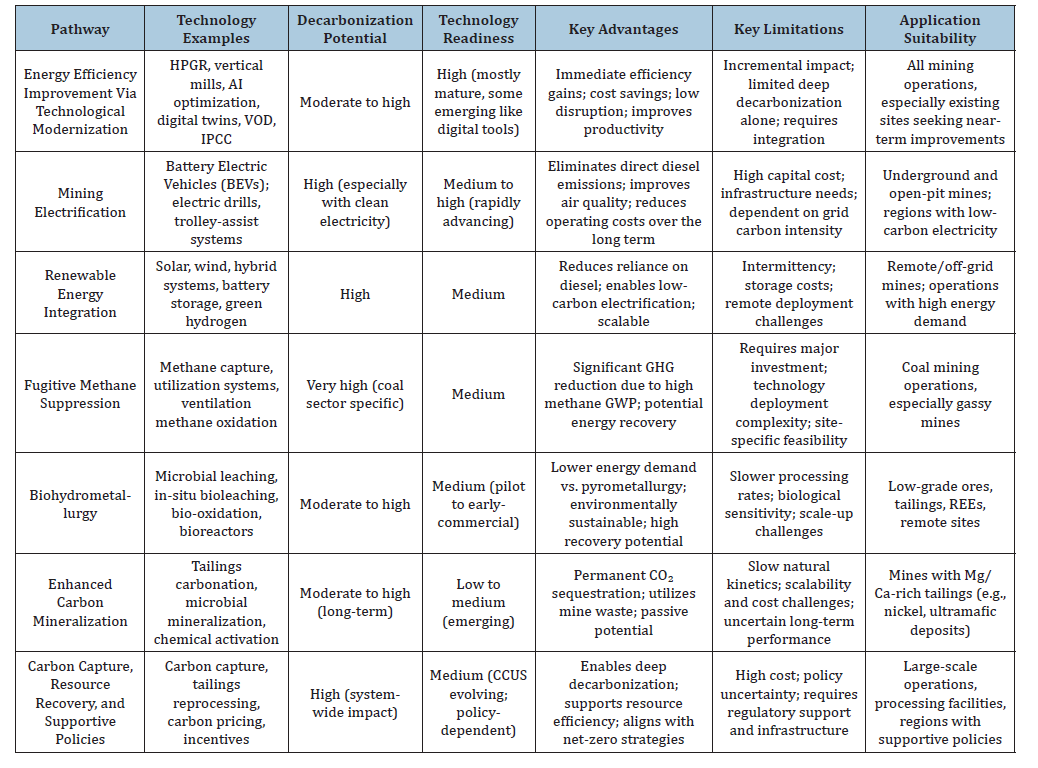
Table 1 presents a summary of the key decarbonization pathways for the mining industry, along with a comparative evaluation of their emissions reduction potential, technology readiness, advantages and limitations, and suitability for application.
Table 1:Comparative evaluation of key mining decarbonization pathways.
Current Status and Future Perspective
To date, decarbonization efforts in the mining sector have primarily concentrated on improving operational efficiency, advancing electrification, expanding the integration of renewable energy, and reducing fugitive methane emissions. While these approaches address the most significant emission sources under current technological and economic conditions, emerging research and development initiatives highlight additional innovative pathways to accelerate the mining-decarbonization progress. These include advanced biohydrometallurgical processes, CCUS technologies, circular economy strategies for resource recovery, and policy instruments designed to incentivize low-carbon investment and operations.
Despite these developments, overall progress in mining decarbonization remains limited and continues to lag behind policy targets and societal expectations. Increasing pressure from regulators, investors, and consumers is, however, driving stronger commitments to emission reduction and climate alignment. As technological capabilities evolve and supportive policy and financial frameworks mature, the sector is expected to accelerate its transition toward low-carbon operations. Achieving sustained and meaningful progress will require a holistic approach that integrates technological innovation, economic viability, regulatory support, and environmental stewardship.
Conclusion
In conclusion, decarbonizing the mining industry is both essential and challenging. While current efforts, such as technological modernization and energy efficiency improvements, electrification, renewable integration, and methane mitigation, offer meaningful reductions, deeper decarbonization will rely on emerging technologies like CCUS, biohydrometallurgy, and enhanced carbon mineralization. Achieving sustained progress will require not only technological innovation but also supportive policies, investment, and industry collaboration. A coordinated and integrated approach is therefore crucial for enabling the mining sector to meet net-zero targets while maintaining its vital role in supporting global development.
References
- Capturing the opportunity: A Carbon Management Strategy for Canada. Minister of Natural Resources, 2023 (ISSN 978-0-660-49513-2).
- Delevingne L, Glazener W, Grégoir L, Henderson K (2020) Climate risk and decarbonization: What every mining CEO needs to know. McKinsey Insights.
- Wu C, Lai J, Liao N, Sheng H, Chen Z, et al. (2025). Energy saving and grinding circuit optimization in tungsten ore processing plant through high pressure grinding rolls and one stage grinding design: An industrial case study. Minerals Engineering 227: 109276.
- Bugarski AD, Ritter DA (2025) Advanced diesel powertrains for underground mining mobile equipment. Mining, Metallurgy & Exploration 42(2): 449-464.
- Saleem HA (2025) Energy consumption reduction in underground mine ventilation system: An integrated approach using mathematical and machine learning models toward sustainable mining. Sustainability 17(3): 1038.
- Chikande T, Phillips HR, Cawood FT (2022) Ventilation optimization through digital transformation. Journal of the Southern African Institute of Mining and Metallurgy 122(12): 687-696.
- Hussain MA, Hati AS (2026) An intelligent digital twin framework for real time underground mines ventilation on demand system. IEEE Transactions on Industry Applications.
- Chinyadza CR, Risso N, Aramayo A, Momayez M (2026) Integrating artificial intelligence into ventilation on demand: Current practice and future promises. Sensors 26(3): 1042.
- Wang X, Li B, Wang F, Zhang Y, Bi L, et al. (2026) Evaluation and optimization of in-pit crushing and conveying (IPCC) systems in open-pit metal mining: A systematic literature review. Mining, Metallurgy & Exploration pp. 1-24.
- Ertugrul N, Kani AP, Davies M, Sbarbaro D, Morán L (2020) Status of mine electrification and future potentials. In 2020 International Conference on Smart Grids and Energy Systems (SGES) pp. 151-156.
- Slobodiannykova I, Pryvalov V, Usatenko V (2026) Prospects for electrification of the mining industry through the implementation of advanced battery technologies. In IOP Conference Series: Earth and Environmental Science 1630(1): 012100.
- Roemer J, Mungyeko Bisulandu BJR, Rousse DR, Pellerin M, Bozorg M, et al. (2026) Energy consumption, decarbonization pathways, and renewable energy integration in the mining industry: A system-level review. Energies 19(8): 1890.
- Figueiredo RL, da Silva JM, Ortiz CEA (2023) Green hydrogen: Decarbonization in mining-Review. Cleaner Energy Systems 5: 100075.
- Darvanjooghi MHK, Magdouli S, Brar SK, Abdollahi H, Zolfaghari M (2022) Bio-oxidation of gold from refractory sulfide ores: A journey ahead. Geomicrobiology Journal 39(3-5): 399-415.
- Ngoma E, Pakostova E, Wiesner JA, Clark T, Laamanen C, et al. (2025) Commissioning and optimization of pilot-scale stirred tank reactors in biohydrometallurgy. Journal of Sustainable Metallurgy 11: 3806-3822.
- Meng X, Zhao Y, Zou K, Zhang Y, He N, et al. (2026) Industrial scale in-situ bioleaching of ion-adsorption rare earth ores: Emphasis on ecological impact assessment. Minerals Engineering 235: 109799.
- Wang Q, Lv J, Guo L, Shen X (2025) Chemical activation of ultramafic tailings for improved large-scale CO2 sequestration in mine backfill. Construction and Building Materials 492: 143010.
- Wilcox SM, Mulligan CN, Neculita CM (2025) Mineral carbonation for carbon sequestration: A case for MCP and MICP. International Journal of Molecular Sciences 26(5): 2230.
- Jin H (2023) Analyzing factors and resource policymaking options for sustainable resource management and carbon neutrality in mining industry: Empirical study in China. Resources Policy 86: 104185.
© 2026 Frances Chikanda. This is an open access article distributed under the terms of the Creative Commons Attribution License , which permits unrestricted use, distribution, and build upon your work non-commercially.
Editor In Chief







.jpg)































Signup for Newsletter

Quick Links
 Editorial Board Registrations
 Submit your Article
 Best Paper of the Volume
 Reprints
 Refer a Friend
 Advertise With Us
Our Recent Edition

.jpg)



Top Editors




.jpg)

















.bmp)
.jpg)
.png)
.jpg)













.jpg)






.png)

.png)




.png)




Financial Support

Sponsors

Latest e-Books

Latest Video

 a Creative Commons Attribution 4.0 International License. Based on a work at www.crimsonpublishers.com.
Best viewed in
a Creative Commons Attribution 4.0 International License. Based on a work at www.crimsonpublishers.com.
Best viewed in 
 | Above IE 9.0 version