

- About Us
- Information
-

The Author ensures that the research has been conducted responsibly and ethically with adherence to all relevant regulations. read more..
- For Authors
- For Reviewer
- Manuscript Guidelines
- Membership
- Publication Ethics
-
- Journals
- Reprints
- e-Books
- Videos
- Policies
- Contact Us
 COVID-19
- Submissions



Full Text
Aspects in Mining & Mineral Science
SEM-EDS Microanalysis of Sedimentary and Felsic Volcanic Units in Uruguay: A New Analytical Approach for Pozzolanic Resource Assessment
Gonzalo Blanco1*, Paulina Abre1, Camila Zunino1 and Sebastián Mármol2
1Department of Geosciences, Regional University Center of the East, University of the Republic, Uruguay
2Faculty of Agronomy, Department of Soils and Waters, University of the Republic, Uruguay
*Corresponding author:Gonzalo Blanco, Department of Geosciences, Regional University Center of the East, University of the Republic, Route 8 km 282, Treinta y Tres, Uruguay
Submission: May 11, 2026: Published: May 22, 2026

ISSN 2578-0255Volume15 Issue 1
Abstract
The mineralogy and major element distribution of selected samples from 13 localities, comprising sedimentary and felsic volcanic rocks, are evaluated using Scanning Electron Microscopy Equipped with An Energy-Dispersive X-ray Spectrometry (SEM-EDS). This study aimed to characterize clay textures, identify mineral phases, and determine elemental composition and distribution. Precambrian pelites and tuffs show a composition dominated by illite, quartz and feldspar. Paleozoic sedimentary rocks show variations in clay composition: the Cordobés Formation is predominantly composed of kaolinite, while the Yaguarí Formation is characterized by montmorillonite. Rhyolites from the Lower Cretaceous Arequita Formation are composed of quartz, sanidine, volcanic glass and alteration product such as kaolinite and illite-smectite. The summatory of SiO2+Al2O3+Fe2O3 above 70%, combined with the fineness and mineralogy of all analyzed rocks, when compared to similar examples from the literature, suggests their potential use as natural pozzolans after thermal treatment.
Keywords:SEM-EDS; Mineralogical characterization; Natural pozzolans; Felsic volcanic rocks; Sedimentary rocks; Uruguay
Introduction
The characterization and use of natural pozzolans as aggregate in Portland cement have gained importance worldwide, not only because processing results in minimal CO2 emissions [1], but also it improves durability and long-term strength [2]. The pozzolanic activity of a natural mineral compound depends on its chemical composition, amorphous components, and fineness. Consequently, the mineralogy of pozzolanic materials of geological origin is characterized by high content of amorphous silica, which, upon contact with water, reacts with calcium in a manner similar to Portland cement, forming hydrosilicates [2]. The high concentration of silica, alumina, and iron oxide in these hydrosilicates promotes pozzolanic activity. A natural pozzolan is defined either as a raw or calcined material that has pozzolanic properties, such as volcanic ash or pumicite, opaline chert, shales, tuffs, and some diatomaceous earths. According to the ASTM C618, the natural pozzolans in the raw or calcined state are designated as Class N pozzolans and are described in the specifications as: “Raw or calcined natural pozzolans that comply with the applicable requirements for the class as given herein, such as some diatomaceous earth; opaline chert and shales; tuffs and volcanic ashes or pumicites, any of which may or may not be processed by calcination; and various materials requiring calcination to induce satisfactory properties, such as some clays and shales [2,3].
Figure 1 shows a summary of Uruguay’s geology, showing a Precambrian basement divided into four Terranes: Piedra Alta, Cuchilla Dionisio, and Nico Pérez, separated by the Sarandí del Yí, Sierra Ballena and Colonia shear zones [4]. Folded sedimentary and/or very lowgrade metasedimentary deposits associated with the Ediacaran basins are located within the Nico Pérez and Cuchilla Dionisio Terranes (Table 1). These basins correlate with sedimentary units of the Tandilia Terrane in Argentina and the Camaquã Basin in Brazil and comprising extended pelitic deposit of marine origin [5]. Paleozoic sedimentary deposits are characterized by extensive sequences of stratified clay-rich rocks, affected only by early diagenesis and without deformation. Notable examples include the Cordobés Formation (Devonian), composed of kaolinite, and the Yaguarí Formation (Permian), composed of mortmorillonite, which have been exploited for ceramics and bentonite production, respectively [6]. The Arequita Formation (Lower Cretaceous) composed of felsic lavas and pyroclastic rocks, is part of the Mesozoic magmatism widespread in the Paraná Basin and adjacent areas, encompassing southern Brazil, Argentina, Paraguay, and Uruguay [4,7]. The original mineralogical composition of these units can undergo significant modification during hydrothermal alteration, metasomatism, diagenesis and/or metamorphism; therefore, conducting detailed mineralogical analyses is essential to verify material quality. In Uruguay, pozzolans have been commercialized as additives in the cement industry solely by the company Cementos Artigas SA. Precambrian pelites from the Don Mario Formation were exploited at the Cerro Verdún open-pit and subsequently activated by calcination [8], (Table 1).
Figure 1:A. Location of Uruguay. B: Simplified Uruguayan geological map, modified from [4,5]. See Table 1 for location of the analyzed samples.
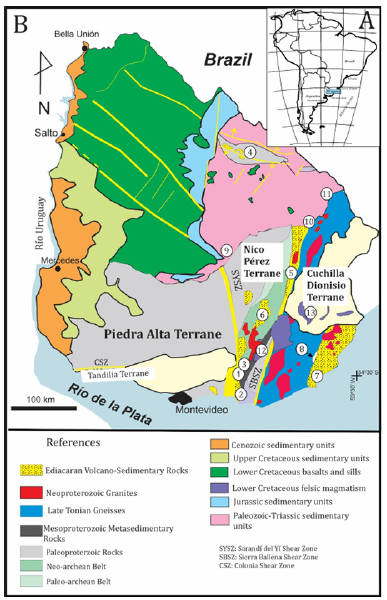
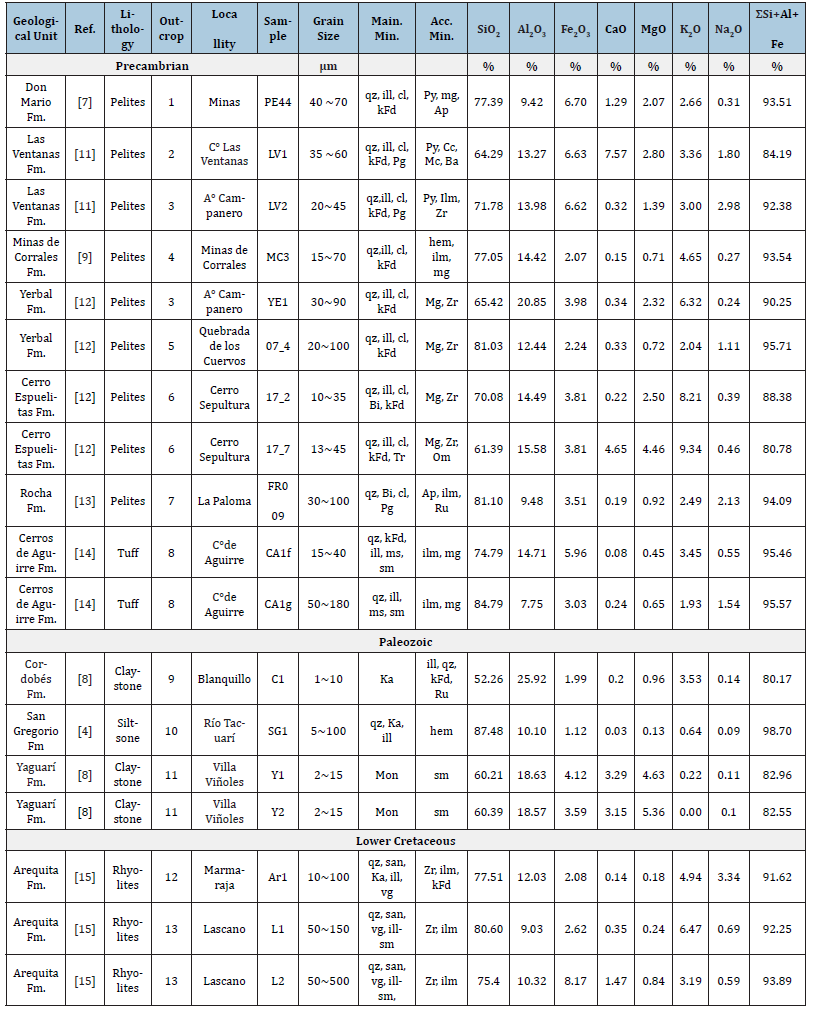
Table 1:Summary of geological units, location, grain size, mineralogical and major elements composition of the analyzed sample sin this work.
Scanning Electron Microscopy (SEM) investigations are based on the interaction of a focused electron beam under vacuum with a sample surface, leading to emission of Secondary Electrons (SE) and Back Scattered Electrons (BSE) from the surface. The Energy-Dispersive X-ray Spectrometry (EDS) attached to the SEM provides information on the topography, morphology, and chemical composition of both single grains and composite areas within the samples. In this work, representative rock samples from eleven geological units of Uruguay, encompassing Precambrian pelites and tuffs, Paleozoic claystones, and Lower Cretaceous felsic volcanic rocks, are compared using the SEM-EDS [9]. This approach enables a preliminary evaluation of the pozzolanic activity by: 1) the identification of the mineral phases and the amorphous material present, 2) the determination of grain size and its distribution, and 3) the quantification of the average major element’s composition, specifically SiO2+Al2O3+FeO.
Materials and Methods
A total of 19 rock samples from 13 localities were collected (Figure 1 & Table 1) and processed at the Laboratorio de Geología del Departamento de Geociencias del Centro Universitario Regional del Este. To perform textural observations of the clay fraction, small rock fragments were mounted and gold sputtered. For elemental analysis, 30μm thick, thin sections were prepared and polished using a diamond paste of 3μm, 1μm and 1/4μm to obtain a mirrorlike surface; subsequently, these were carbon-coated for SEM observation. Back-Scattered Electron (BSE) imaging and elemental analysis of the polished thin sections and rock fragments were done using a Jeol NeoScope JCM-6000 Plus equipped with an Energy- Dispersive X-Ray Spectrometry (EDS) consisting of a 10mm2 Silicon Drift Detector (SDD). Major element mapping and singlegrain analysis of major and minor elements analysis were achieved according to established recommendations [10]. Electrons were emitted by a traditional tungsten filament with a working distance of 19mm. The X-ray take-off angle was approximately 25°. The energy resolution of the SDD was ~133eV at the energy of Mn Kα (5894eV). The EDS analyses were conducted using a standard probe current (~30nA), a collection time of 60s, and an accelerating voltage of 15kV.
Results and Discussion
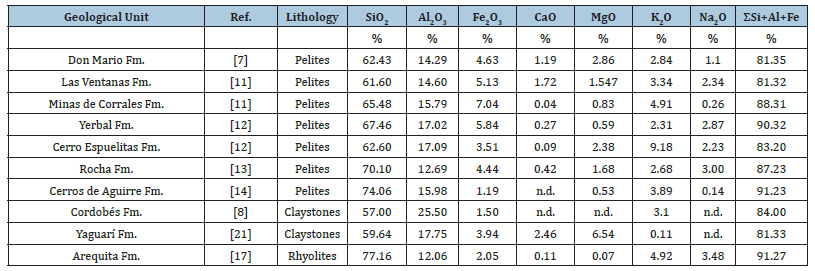
The comparative results of all samples are presented in Table 1. Precambrian pelites and tuffs, with a sum of SiO2+Al2O3+Fe2O3 exceeding 70%, exhibit favorable geochemical conditions as precursors for natural pozzolans. The mineralogical composition shows that these units are primarily composed of illite, detrital quartz and potassium feldspar (Figure 2 & 3). The Paleozoic claystones of the Cordobés Formation are primarily composed of very fine-grained kaolinite, as evidenced by high Al2O3 content of 26% accompanied by minor amounts of illite (Figure 3E & 3F).
Figure 2:Metapelites of the Las Ventanas Formation (LV2). A: Elemental map showing the distribution of major elements. B: SEM image showing thin illite layers. C: EDS analysis on a polished thin section showing qz: quartz, Zr: zircon, ilm: ilmenite, Ab: albite.
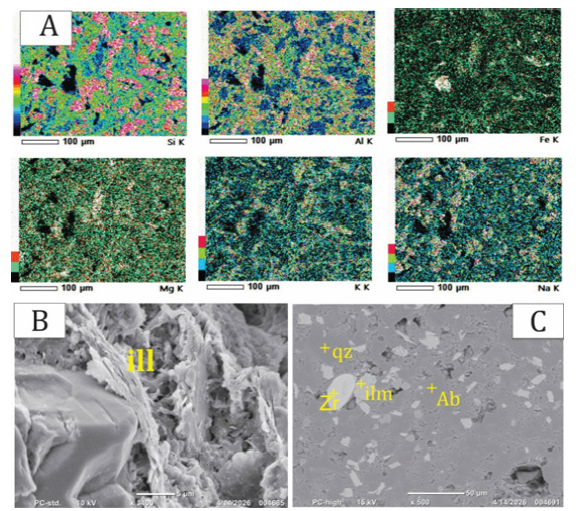
Figure 3:Clays identification using SEM images. A:and B Kaolinite (Ka), quartz (qz) and smectite (sm)of rhyolites from the Arequita Formation. C: illite (ill) and quartz from the Cerros de Aguirre Formation metatuff. D: Kaolinite of the San Gregorio Formation siltstones. E and F: Kaolinite crystal and Illite of Codobés Formation. G and H: Montorillonite and honeycomb texture of smectite of Yaguarí Formation.
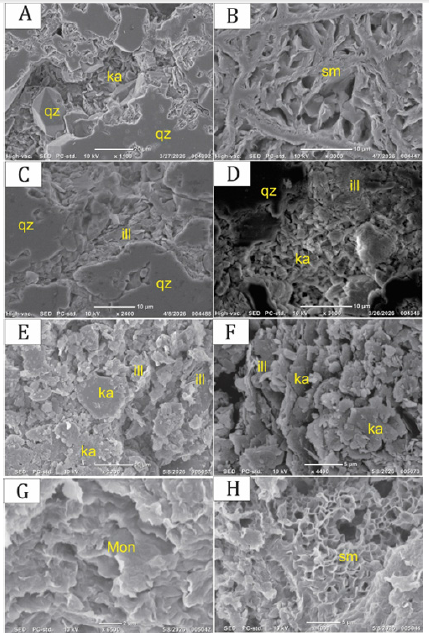
Potassium feldspar altered to illite is also present. The siltstones of the San Gregorio Formation consist of an alternation of silt and clay layers (varves) of glacial origin. Very fine-grained detrital quartz is the main component, and potassium feldspar altered to kaolinite is very common. Both units exceed a total content of 70% for SiO2+Al2O3+FeO oxides. The claystones of the Yaguarí Formation are mainly composed of montmorillonite, followed in order of abundance by smectites (Figure 3G & 3H); they are very fine-grained, yet their SiO2+Al2O3+FeO content do not exceed 70%. The rhyolites of the Arequita Formation are mainly composed of quartz and sanidine immersed in a glassy matrix; this matriz is mostly altered to kaolinite at the Marmarajá site and to smectites at the Lascano site (Figure 3A & 3B). All three samples exhibit a SiO2+Al2O3+Fe2O3 oxide content well above 70%.
Mineralogical and geochemical results for the Precambrian rocks show a consistent composition across the various units analyzed. The samples here analyzed exceed the 70% minimum requirements for the sum of SiO2, Al2O3, and Fe2O3 oxides of [3]. Furthermore, they show similar values when compared to wholerock geochemistry data from the literature (Table 2). Given their vast areal extent and distribution, this work suggests a high prospecting potential for natural pozzolanic materials within the Ediacaran metapelites of the Nico Pérez Terrane. A similar mineralogical composition, dominated by illite and fine-grained quartz and feldspar, was observed for the Minas de Corrales, Las Ventanas, Yerbal and Cerro Espuelitas Formations. It is worth noting that illite-dominated pelites (shales) can exhibit pozzolanic activity after thermal treatment at 950 °C, as seen in samples of the Cerro Largo and Cerro Negro Formations in Buenos Aires, Argentina [11]. These Ediacaran units are correlative in age with the Yerbal, Cerro Espuelitas, Las Ventanas and Minas de Corrales Formations; they were likely deposited in a similar shallow marine environment and exhibit almost identical mineralogical characteristics [5,12].
Table 2:Representative XRF analysis take from previous works.
Due to its Al2O3:2SiO2 ratio and high kaolinite content (>90%), the El Cordobés Formation claystones could be used for the manufacture of metakaolin. When heated to temperatures between 600 and 900 °C, this material can generate a highly reactive pozzolanic product [13]. The Yaguarí Formation is primarily composed of montmorillonite; however, its use as a natural pozzolan could be problematic, as untreated clays have been unsatisfactory in terms of reactivity and workability. Nevertheless, the material could be transformed through calcination, following a typical thermal transformation sequence of dehydration, dehydroxylation, amorphization, and subsequent crystallization [14].
Among the geological materials that can be used as natural pozzolans in their raw state, those of felsic volcanic origin, such as rhyolites, are particularly useful due to the high reactivity of the volcanic glass when its concentration exceeds 40% of the total weight. The most recent geological record of acidic volcanism in Uruguay occurred during the Lower Cretaceous, recorded by the Arequita Formation. This unit is mainly composed of quartz, sanidine, and altered glassy material, and underwent transformations during diagenesis or weathering. The precise identification of alteration products and volcanic glass via SEMEDS indicates a high potential for prospecting these volcanic rocks. Moreover, rhyolitic rocks with a glass content between 40 and 100 % require no calcination for pozzolanic activation [1].
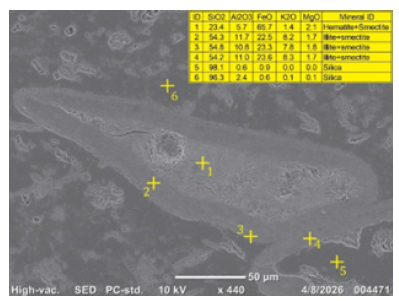
Relict glassy material was detected in this study, although mostly devitrified and transformed into clays (illite-smectite, Figure 4). Moreover, previous work on unit’s correlative to the Arequita Formation in Brazil, such as the Serra Geral Formation have shown its potential use as pozzolan after thermal treatment [15]. The quantification of volcanic glass in the Arequita Formation serves as an exploration guide for natural pozzolanic materials, as the preservation and distribution of the volcanic glass is not homogenous across the different outcrop sites.
Figure 4:SEM image and EDS analyses of the Arequita Formation rhyolites showing ignimbrite texture, evidence of devitrification (1) and illite-smectite formation (2, 3 and 4), within a matrix of poorly crystalline silica paste (5 and 6) at the Lascano locality.
Conclusion
An initial assessment of several geological materials of Uruguay using SEM-EDS provides critical information regarding: 1) the identification and composition of mineral phases, including alteration products and accessory minerals; 2) the presence of vitreous and/or amorphous material; 3) the compositional and textural characterization of clays (e.g., kaolinite, smectite, illite); 4) the estimation of the average composition and distribution of the major oxides (SiO2+Al2O3+Fe2O3) in the sample [16,17]. The methodology applied serves as a preliminary exploration guide for geological materials in an area of interest, leading to a rational use of pozzolanic index tests on selected samples (e.g. 28-day strength activity index with Portland cement [1]), which are otherwise expensive and time-consuming [18-21].
The sample set analyzed in this work identifies specific targets
for the exploration of sedimentary and volcanic rocks that could be
processed to produce natural pozzolan in Uruguay:
a. Precambrian metapelites: fine-grained and mostly
composed of illite, feldspar, and quartz; require a thermal
treatment (~950 °C) to produce pozzolanic geomaterial.
b. Claystones of the Cordobés Formation: composed of
90% kaolinite and 10% illite, emerge as an ideal candidate as
the transformation to metakaolin (a highly reactive pozzolan)
requires calcination at temperatures close to 600 °C.
c. Rhyolites of the Arequita Formation: the glass content is a
critical parameter in the exploration of this unit. Samples with
over 40% glass may require minimal or no thermal treatment
to achieve adequate pozzolanic reactivity.
Acknowledgement
The authors thank the Universidad de la República and PEDECIBA Geociencias for their support of this work. The reviewers and the Editor are deeply acknowledged.
References
- International Energy Agency (2024) Definitions for near-zero and low emissions steel and cement, and underlying emissions measurement methodologies. Summary of Emerging Understandings. IEA Paris France.
- Tikalsky PJ, Huffman MV (2012) Use of raw or processed pozzolans in concrete. Reported by ACI (American Concrete Institute) p. 23.
- ASTM (2023) ASTM C618-22, Standard specification for coal fly ash and raw or calcined natural pozzolan for use in concrete. West Conshohocken PA, USA.
- Bossi J, Ferrando L (2001) Geological Map of Uruguay, Scale 1:500,000, Digital Version 2.0 - Faculty of Agronomy, Montevideo.
- Abre P, Blanco G, Frei D (2026) Provenance of the late ediacaran minas de corrales formation, nico pérez terrane, Uruguay: Paleogeographic implications. Front Earth Sci 14: 1698347.
- Bossi J, Navarro R, (2000) Recursos Minerales del Uruguay. ISBN9974 39 281 0 Montevideo, Uruguay, p. 416.
- Blanco G, Abre P, Ferrizo H, Gaye M, Gamazo P, et al. (2021) Revealing weathering, diagenetic and provenance evolution using petrography and geochemistry: A case of study from the Cretaceous to Cenozoic sedimentary record of the SE Chaco-Paraná basin in Uruguay. JS Am Earth Sci 105: 102974.
- Blanco G, Abre P, Ferrizo H (2021) Evaluation of pelites as a pozzolanic material in the verdún mine quarry. Cementos Artigas Sa Y Centro Universitario Regional Del Este Project. Technical report p. 15.
- Flude S, Haschke M, Storey M (2017) Application of benchtop micro-XRF to geological materials. Mineralogical Magazine 81(4): 923-948.
- Chen Y, Chen Y, Liu Q, Liu Xi (2023) Quantifying common major and minor elements in minerals/rocks by economical desktop scanning electron microscopy/silicon drift detector energy-dispersive spectrometer (SEM/SDD-EDS). Solid Earth Sciences 8: 49-67.
- Lemma R, Irassar EF, Rahhal R (2015) Calcined illitic clays as portland cement replacements. In: Calcined clays for sustainable concrete, Proceedings of the 1st International Conference on Calcined Clays for Sustainable Concrete pp. 269-276.
- Blanco G, Rajesh HM, Gaucher C, Germs GJB, Chemale F (2009) Provenance of the arroyo del soldado group (Ediacaran to Cambrian, Uruguay): Implications for the paleogeographic evolution of southwestern Gondwana. Precambrian Res 171: 57-73.
- Gao Q, Zhang Z, Zhang X (1989) The relationship of structure and pozzolanic activity of kaolinite at different calcination temperatures. 2nd Beijing International Symposium on Cement and Concrete, 1 Beijing China, pp. 377-382.
- Garg N, Skibsted J (2015) Heated montmorillonite: Structure, reactivity, and dissolution. In: Calcined clays for sustainable concrete proceedings of the 1st international conference on calcined clays for sustainable concrete pp. 117-124.
- Montanheiro TJ, Yamamoto JK, Kihara Y (2004) Serra geral formation-São Paulo State, Brazil: A potential source for natural pozzolans. Materials Letters 58: 876-881.
- Blanco G, Gaucher C, Abre P (2013) Sedimentary geochemistry of the las ventanas formation: Extensional tectonics and glacial influence during the Ediacaran. VII Uruguayan Congress of Geology and I Symposium on Mining and Development of the Southern Cone - Proceedings, Montevideo. pp. 103-108.
- Abre P, Blanco G, Gaucher C, Frei D, Frei R (2020) Provenance of the late Ediacaran Rocha formation, cuchilla dionisio terrane, Uruguay: Tectonic implications on the assembly of Gondwana. Precambrian Res 342: 105704.
- Campal N, Schipilov A (2005) The Cerros De Aguirre formation: Evidence of Vendian Magmatism in Uruguay. Latin American Journal of Sedimentology and Basin Analysis 12(2): 161-174.
- Cernuschi F, Dilles JH, Kent AJR, Schroer G, Raab AK, et al. (2015) Geology, geochemistry and geochronology of the Cretaceous Lascano East intrusive complex and magmatic evolution of the Laguna Merín basin, Uruguay. Gondwana Res 28: 837-857.
- Gaye M (2016) Petrology of the volcanic rocks of Cerro Marmarajá (Arequita Formation, Lavalleja Department) - Undergraduate Thesis p. 71.
- Albarnaz LD, Dani N, Formoso LLM, Mexias AS, Lisboa AL, (2009) The bañado de medina bentonite deposit, melo, Uruguay: Geology, mineralogy, and technological utilization. Pesquisas em Geociências 36(3): 263-273.
© 2026 Gonzalo Blanco. This is an open access article distributed under the terms of the Creative Commons Attribution License , which permits unrestricted use, distribution, and build upon your work non-commercially.
Editor In Chief







.jpg)































Signup for Newsletter

Quick Links
 Editorial Board Registrations
 Submit your Article
 Best Paper of the Volume
 Reprints
 Refer a Friend
 Advertise With Us
Our Recent Edition

.jpg)



Top Editors




.jpg)

















.bmp)
.jpg)
.png)
.jpg)













.jpg)






.png)

.png)




.png)




Financial Support

Sponsors

Latest e-Books

Latest Video

 a Creative Commons Attribution 4.0 International License. Based on a work at www.crimsonpublishers.com.
Best viewed in
a Creative Commons Attribution 4.0 International License. Based on a work at www.crimsonpublishers.com.
Best viewed in 
 | Above IE 9.0 version