

- About Us
- Information
-

The Author ensures that the research has been conducted responsibly and ethically with adherence to all relevant regulations. read more..
- For Authors
- For Reviewer
- Manuscript Guidelines
- Membership
- Publication Ethics
-
- Journals
- Reprints
- e-Books
- Videos
- Policies
- Contact Us
 COVID-19
- Submissions



Full Text
Aspects in Mining & Mineral Science
From Process Parameters to Industrial Qualification: A Comprehensive Review of WAAM Technology
Casagrande HC1*, Rodrigues Neto JB2, Daleffe A3, Vieira da Silva J3, Castelan J3 and Menegaro Possamai PH4
1 PhD Student in Materials Science and Engineering, Materials Laboratory, Brazil
2 PhD in Materials Science and Engineering, Brazil
3 PhD in Mining, Metallurgical and Materials Engineering, Brazil
4 Master’s student in Metallurgical Engineering, Additive Manufacturing Laboratory, Brazil
*Corresponding author:Henrique Cechinel Casagrande, PhD Student in Materials Science and Engineering, Materials Laboratory, UFSC, Florianopolis, Brazil
Submission: March 02, 2026: Published: March 18, 2026
ISSN 2578-0255Volume14 Issue 5
Abstract
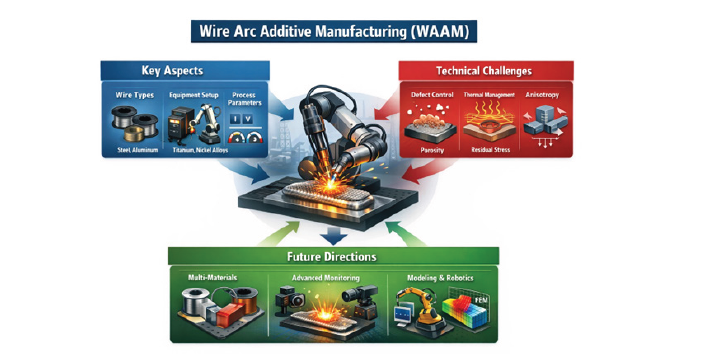
Wire Arc Additive Manufacturing (WAAM) has emerged as a promising metal additive manufacturing technology due to its high deposition rates, cost-effectiveness, and suitability for large-scale structural components. This review discusses the main research trends, process parameters, microstructural evolution, defect formation mechanisms, and mechanical performance associated with WAAM-fabricated components. Particular emphasis is placed on the influence of key processing parameters-current, voltage, travel speed, and wire feed rate-on heat input, bead geometry, melt pool stability, and resulting microstructure. The mechanics of bead formation and deposition geometry are analyzed in terms of thermal-fluid interactions and mass conservation principles, highlighting their impact on layer uniformity and structural integrity. Persistent technical challenges are examined, including porosity, lack of fusion, residual stresses, geometric distortion, and anisotropy in mechanical properties resulting from the layer-by-layer thermal cycling. The review further addresses the complexity of multi-material deposition, where thermal mismatch and intermetallic phase formation represent significant barriers to reliable structural integration. Emerging research directions are discussed, including advanced wire development, functionally graded materials, real-time process monitoring, predictive thermo-metallurgical modeling, robotic motion optimization, and process standardization. The need for harmonized qualification protocols and robust databases is emphasized as a critical step toward large-scale industrial adoption, particularly in aerospace, naval, energy, and advanced manufacturing sectors (Figure 1).
Figure 1:Graphical abstract illustrating key aspects, technical challenges, and future research directions.
Keywords:Wire arc; Material deposition; Fabrication; Superalloys; Stainless steels; Electrode; Geometry; Metallurgical simulation
Introduction
Researchers have continuously sought to improve traditional manufacturing methods in order to develop approaches that are more efficient in terms of capital investment, material utilization, and production time [1-10]. In this context, Additive Manufacturing (AM) has consolidated in recent years as a promising alternative for the production of three-dimensional components and rapid prototyping applications [11-15]. The term Additive Manufacturing was officially standardized by international standardization bodies to replace previously used designations such as rapid prototyping, rapid manufacturing, and freeform fabrication. According to ISO/ ASTM 52900 [16], additive manufacturing is defined as the process of joining materials to fabricate objects from three-dimensional model data, usually through layer-by-layer deposition, in contrast to subtractive or formative methodologies.
Thus, this technology is based on a digital data workflow that guides the successive deposition of material in layers, enabling the construction of fully dense three-dimensional geometries [17- 19]. Additive manufacturing offers significant advantages related to reduced production time and more efficient raw material usage, since material is added in a controlled and digitally driven manner [20]. This approach minimizes the need for conventional tooling, such as cutting tools, dies, fixtures, and complex machining operations. Furthermore, substantial reductions in production costs-particularly for low-volume batches-as well as shorter production cycle times have been reported [21-24]. In addition, there are publications addressing the fabrication of cutting tools for machining produced by additive manufacturing, as demonstrated by Wang, Li & Lu [25].
Another relevant aspect of AM is the possibility of functional consolidation of parts, reducing the number of individual components required in a final system. This feature contributes to the simplification of production steps and a reduction in assembly operations [26-31]. At the same time, material utilization efficiency tends to be higher than in conventional processes such as casting and forging [32]. When compared to subtractive methods, such as CNC machining, additive manufacturing presents advantages associated with improved structural integrity, enhanced mechanical performance, and the feasibility of designs with high geometric complexity. Owing to these benefits, AM is frequently associated with technological advances characteristic of the so-called Fourth Industrial Revolution [33,34] and is recognized as one of the leading emerging technologies for the production of high-performance components.
Wire Arc Additive Manufacturing (WAAM) is a metal additive manufacturing technology based on the deposition of wire feedstock melted by an electric arc, characterized by the fabrication of three-dimensional components from a digital model through the successive deposition of molten metal layers. From a technical classification perspective, WAAM belongs to the Directed Energy Deposition (DED) category, in which the energy source for melting is an electric arc and the feedstock material is a continuously supplied metallic wire [35-40]. Currently, components produced by additive manufacturing-particularly by WAAM-have been increasingly applied in demanding industrial sectors, including the automotive, aerospace, naval, oil and gas, energy, and biomedical industries. In these fields, the technology is used both for the fabrication of new structural components and for the repair and refurbishment of high-value parts [41-51].
From a materials standpoint, WAAM exhibits high versatility and is widely used for the deposition of structural and highstrength steels [52-55], stainless steels [56-59], aluminum alloys, bimetallic materials [60-63], titanium alloys, and nickel-based superalloys [64-66], among others. This material diversity enables its application in components subjected to severe mechanical loading conditions, significant thermal variations, and corrosive environments, thereby expanding the potential of the technology for the production of complex and large-scale structures.
Contextualization of additive manufacturing
The development of Additive Manufacturing (AM) dates back to the 1980s, when the first rapid prototyping technologies emerged with the objective of accelerating product development cycles. Since then, this class of processes has evolved rapidly, transitioning from prototyping tools to fully integrated industrial manufacturing solutions applicable to a wide range of materials-including polymers, metals, ceramics, and composites-and industrial sectors such as aerospace, automotive, medical, and electronics.
Among the main benefits associated with AM are [14,67-71]:
a. The ability to fabricate components with highly complex
geometries without a proportional increase in manufacturing
costs;
b. Significant reduction in raw material waste, as only the
material required for the component is deposited;
c. On-demand customization and personalization of parts,
eliminating the need for dedicated tooling for each product;
and
d. Increased flexibility in new product and prototype
development, with shorter design cycles compared to
conventional manufacturing methods.
In the current industrial landscape, AM is regarded as a key enabler of the transition toward Industry 4.0, integrating with intelligent systems, digitalization, and automation to transform production paradigms. Studies indicate that these technologies not only improve efficiency and reduce costs but also enable innovative manufacturing strategies, such as decentralized production and ondemand maintenance [72-76].
Despite significant technical advances and the growing adoption of additive manufacturing in industrial applications, several challenges still limit its large-scale implementation. Among the most frequently cited challenges in the literature are the high costs associated with equipment and feedstock materials-particularly in metal-based and large-scale processes-which can render cost comparisons unfavorable relative to traditional manufacturing methods at high production volumes. These factors contribute to the fact that, despite its considerable potential, additive manufacturing has not yet widely replaced conventional processes in industrial applications where certification, repeatability, and economies of scale are essential requirements [69,77].
Insertion of WAAM in this context
The physical principle of WAAM is closely related to conventional arc welding techniques, such as Gas Metal Arc Welding (GMAW) and Gas Tungsten Arc Welding (GTAW), which are applied in an automated and controlled manner for layer-by-layer deposition rather than simply for joining components. An electric arc established between the wire electrode and the substrate generates sufficient heat to melt the feedstock material, which subsequently solidifies upon cooling and metallurgically bonds to the previously deposited layers, thereby forming a three-dimensional structure. This approach enables high deposition rates due to the substantial mass and energy transfer associated with the electric arc [78-87].
Although its adoption has been expanding, the integration of WAAM into mature industrial production lines still faces technical and standardization-related challenges. These include the need for material qualification and process certification, as well as integration with intelligent manufacturing systems (Industry 4.0) and advanced automation strategies to ensure repeatability and consistent quality [37,88-89].
Gaps in the literature and objectives of the review
In recent years, WAAM technology has gained considerable attention in both scientific research and industrial development due to its broad range of advantages and application versatility. Several review studies emphasize that, despite its significant potential, multiple technical challenges and knowledge gaps still limit its full adoption in critical industrial applications [37,82,90,91]. A recurring theme in the literature is the recognition that process parameters, resulting microstructure, defect formation (such as porosity, distortion, and residual stresses), and mechanical properties are not yet fully understood or standardized across different materials and deposition conditions. Numerous studies highlight that the complexity of thermal and metallurgical interactions inherent to the WAAM process hinders the reliable prediction of final component characteristics without systematic approaches to modeling, monitoring, and parameter optimization [12,92-94].
Furthermore, although a substantial body of experimental research and general state-of-the-art reviews exists-including analyses of processing parameters and material performancethe literature still lacks integrated syntheses that clearly identify specific gaps related to deposition quality, integration into industrial production lines, and guidelines for the certification of metallic components manufactured by WAAM. This absence of consolidated guidance complicates the transition of the technology from academic environments to demanding industrial settings, where repeatability, reliability, and compliance with standards are essential requirements [46,90,95-97].
In light of this context, the primary objective of the present
review is to map and synthesize recent contributions from the
scientific literature on WAAM, with emphasis on:
a. The main research and development trends, focusing on
process parameters, microstructure evolution, and material
performance;
b. Persistent technical challenges, including defect
formation, thermal control, and mechanical properties;
c. Existing knowledge gaps that continue to limit the full
industrial application of the technology, particularly regarding
process standardization and component qualification
methodologies; and
d. Emerging proposals and future research directions,
including the integration of real-time monitoring techniques
and data-driven optimization strategies.
e. Therefore, this review aims not only to present the
current state of WAAM technology but also to provide a critical
perspective on the research needs that must still be addressed
to strengthen its scientific foundation and promote its broader
adoption in the metallurgical and advanced manufacturing
industries.
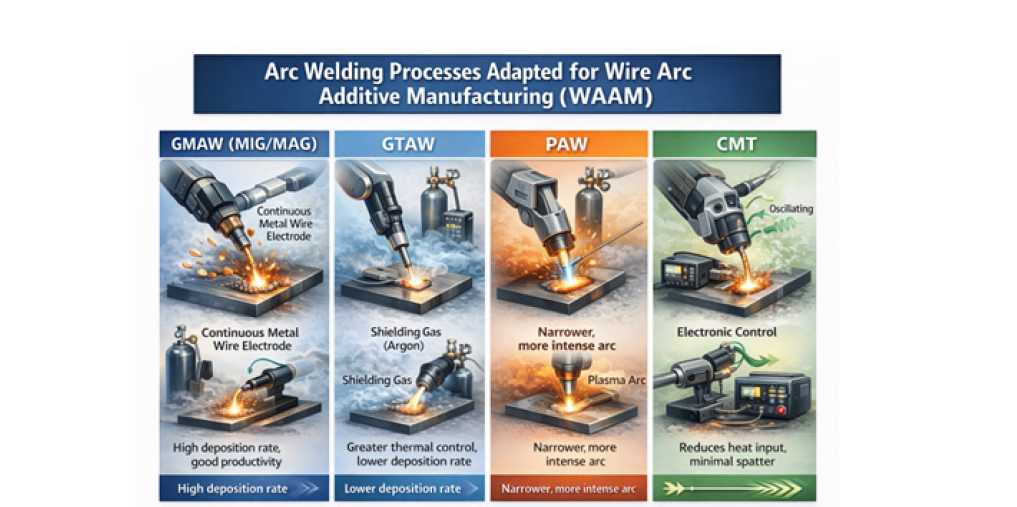
Electric arc deposition process
WAAM is based on arc welding processes adapted for additive
deposition. Among the main processes employed are:
A. GMAW (Gas Metal Arc Welding): Also known as MIG/
MAG, this process provides high deposition rates and good
productivity, making it suitable for large-scale components and
applications requiring elevated material feed rates.
B. GTAW (Gas Tungsten Arc Welding): Offers superior
thermal control and arc stability; however, it typically presents
lower deposition rates compared to GMAW-based processes. It is
often preferred when precision and microstructural control are
critical.
C. PAW (Plasma Arc Welding): Characterized by a more
constricted arc and higher energy density, resulting in deeper
penetration and improved arc stability, which can be advantageous
for specific geometries and materials.
D. CMT (Cold Metal Transfer): A modified GMAW process
featuring advanced control of metal transfer through controlled
wire retraction, leading to reduced heat input and improved control
over droplet transfer. This makes it particularly attractive for thin
walls and heat-sensitive materials. Figure 2 presents a summary of
the main characteristics of each process.
Figure 2:Main electric arc deposition processes.
These processes differ primarily in terms of arc stability, metal transfer mode (short-circuit, globular, or spray), heat input, and penetration characteristics. Recent studies indicate that low heat input processes, such as CMT, are particularly advantageous for dimensional control and distortion reduction, especially in thin-walled structures and geometrically complex components [37,98,99]. The underlying physical principle involves the formation of an electric arc between the electrode (wire) and the substrate, generating a molten pool (melt pool). The controlled solidification of this melt pool enables the incremental construction of the component through successive layer deposition.
Main research and development trends: process parameters, microstructure, and material performance:
Equipment configurations and process parameters: The optimization of process parameters in WAAM is a critical factor in achieving adequate geometric, microstructural, and mechanical quality in deposited components. Experimental studies and recent reviews demonstrate that parameters such as current, voltage, travel speed, and wire feed rate directly influence bead geometry, deposition rate, heat input, and the final properties of the component [41,100-103].
The heat input equation (Q), derived from classical arc welding theory, can be expressed as [37,104]:
where:
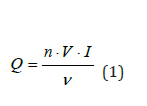
i. V = voltage
ii. I = current
iii. v = travel speed
iv. η = thermal efficiency
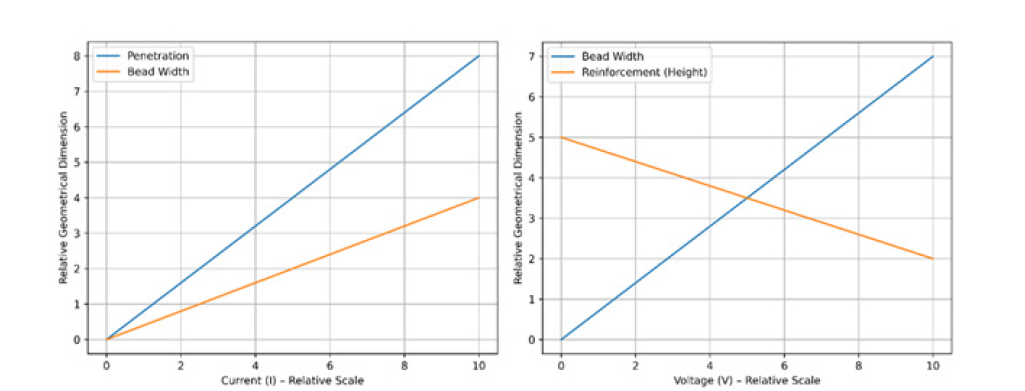
Voltage and current: The electric current (I) in arc-based processes governs the amount of energy supplied to the arc, directly affecting penetration depth, bead width, and arc stability. In combination with voltage (V), these parameters determine the overall heat input and, consequently, influence melt pool formation, cooling rate, and resulting microstructural features.
Reviews indicate that variations in current and voltage lead to significant differences in bead geometry and mechanical properties of the final component, acting as primary control variables for surface roughness and penetration characteristics of the deposited bead [12,41,100,105,106]. The effect of current (a) and voltage (b) on the geometry of the deposited material is illustrated in Figure 3.
Figure 3:Effect of current (a) and voltage (b) on bead geometry.
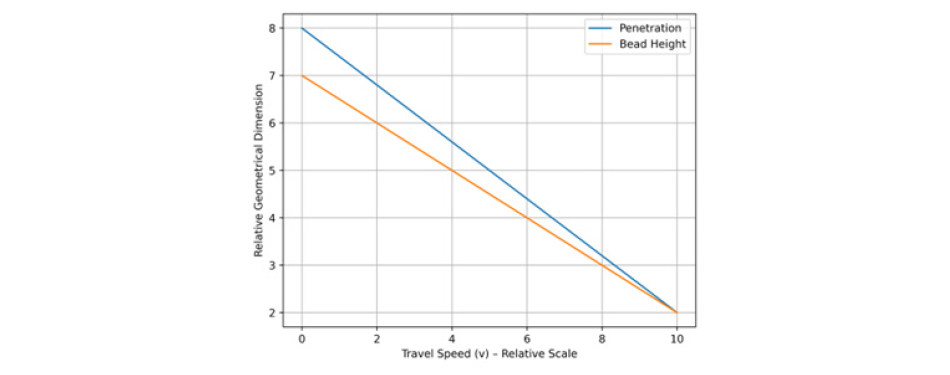
Travel speed: Travel speed, defined as the velocity at which the torch moves along the substrate, regulates the thermal interaction time per unit length. Reductions in travel speed tend to increase the heat input per layer and arc penetration, whereas higher travel speeds promote higher cooling rates, narrower bead widths, and more refined microstructures, as experimentally observed in carbon steels [107] and aluminum alloys [108].
Studies indicate that higher torch travel speeds may enhance cooling rates and promote grain refinement, while lower speeds result in larger bead volumes and steeper thermal gradients, directly affecting the microstructure and mechanical properties of the deposited material [37,41,109]. Furthermore, the interaction between travel speed and wire feed rate is crucial in determining the height and width of the deposited layer, directly influencing surface finish and the extent of required post-processing operations [12]. The effect of torch travel speed on bead geometry is illustrated in Figure 4.
Figure 4:Effect of torch travel speed on bead geometry.
Mechanics of bead formation and deposition geometry: The formation of the bead in WAAM is influenced by the interaction between the electric arc, molten material flow, melt pool dynamics, and kinematic parameters. The bead geometry is commonly characterized by width (w), height (h), and penetration (p). These parameters are directly dependent on the combination of current, voltage, travel speed, and wire feed rate, as highlighted in both experimental studies and recent reviews [12,60,108,110-112].
The literature demonstrates that:
Current and voltage modify the melt pool shape by altering surface forces and penetration into the substrate [12]. Travel speed regulates the thermal residence time and, consequently, influences the energy deposited per unit length - directly affecting bead width and height [41]. These combined parameter effects are frequently modeled using empirical correlations and mass conservation models, which relate arc characteristics and energy input to the final geometric features [41]. Inadequate control of these parameters may lead to defects such as porosity, overheating, layer height variation, and residual thermal stresses, compromising both structural integrity and geometric accuracy of the component [12,37,91].
Persistent technical challenges, defects, thermal control, and mechanical properties
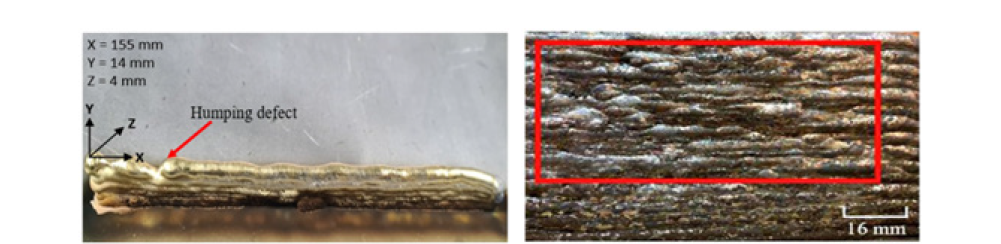
Despite its clear benefits-such as high deposition rates, low material waste, and reduced operational cost compared to other metal additive manufacturing technologies-Wire Arc Additive Manufacturing (WAAM) still faces substantial technical challenges that limit its full industrial adoption and the final quality of manufactured components [82,92]. One of the most frequently cited challenges in the literature is defect control during deposition, which directly impacts the mechanical integrity of the parts. Defects such as porosity, lack of fusion, spatter, and irregularities in the deposited bead geometry may arise due to inadequate parameterization (such as wire feed rate, travel speed, and heat input), surface contamination, or arc instabilities. These defects negatively affect density, tensile strength, and fatigue performance of fabricated components [37,41,46,52,57,91,95,97,113,114] . Figure 5 illustrates the most common irregularities observed in deposited materials.
Figure 5:Surface structure of walls produced using different interpass times [37].
Thermal management represents another central technical challenge: the layer-by-layer nature of Wire Arc Additive Manufacturing (WAAM) imposes repeated heating and cooling cycles, leading to heat accumulation, steep thermal gradients, and microstructural heterogeneity throughout the component. This behavior may result in geometric distortion, high residual stresses, and anisotropy in mechanical properties between different orientations (e.g., build direction versus deposition plane) [91,115]. Microstructural and mechanical anisotropy is particularly pronounced in WAAM-fabricated components due to preferential grain growth along the deposition direction and the specific thermal history experienced by each layer. This leads to measurable differences in strength and ductility between orientations, posing challenges for critical structural applications that require uniform mechanical behavior [12,57,115-117].
The integration of multiple materials within the same metallic component-an emerging trend in advanced research and applications-also presents substantial technical challenges. The deposition of dissimilar materials can induce thermal mismatch, formation of brittle intermetallic phases, delamination, and elevated residual stresses, requiring tailored material transition strategies and compositional gradients [92,118]. In addition, aspects related to process control and real-time monitoring are still under development. The complexity of coupled physical phenomena (thermal, metallurgical, and fluid-dynamic) makes it difficult to autonomously predict and adjust parameters, hindering full industrialization of the process with assured repeatability and compliance with robust quality standards [119].
Finally, although WAAM can produce components with satisfactory mechanical strength in many cases, post-deposition heat treatments, microstructure control strategies, and standardized certification procedures remain necessary to ensure that largescale industrial components meet regulatory requirements in sectors such as aerospace, automotive, and energy [37].
Knowledge gaps limiting full industrial application, process standardization, and component qualification methods
Proposed directions and emerging research trends for future developments: Wire Arc Additive Manufacturing (WAAM) continues to evolve rapidly, and the literature highlights several promising research directions that may help overcome current technical limitations and expand the industrial applicability of the technology. Among the main research fronts are material innovation, advanced monitoring and control strategies, predictive modeling, and process standardization.
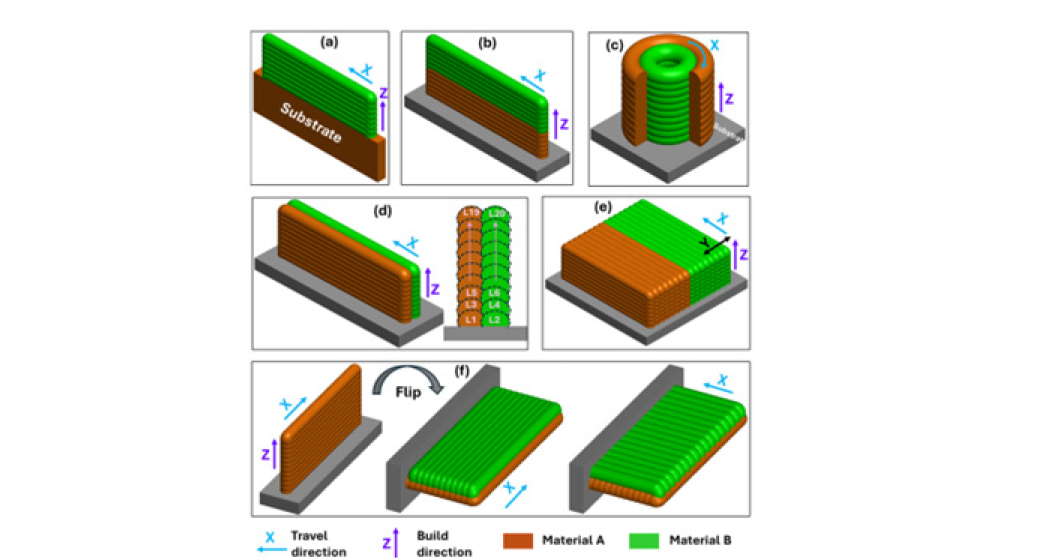
A priority research area is the development of advanced materials. The fabrication of multi-material structures by WAAM still faces significant challenges due to the formation of brittle intermetallic phases and thermal incompatibility between dissimilar alloys. Progress in the development of optimized wire compositions and functionally graded materials may mitigate detrimental segregation and enable more reliable bonding between distinct materials, particularly for applications requiring combined property performance (e.g., simultaneous wear resistance and ductility). This advancement is especially relevant for renewable energy, naval, and aerospace systems, where bimetallic or graded structures can provide unique functional advantages [92]. Figure 6 illustrates different deposition strategies employed in recent studies for the fabrication of bimetallic structures.
Figure 6:Deposition strategies for bimetallic structures. (a) Material deposited onto the substrate; (b) Material deposited over a layer of another material; (c) Radial bimetallic structure; (d) Interlaced multilayer structure along the Z direction; (e) Interlaced multilayer structure along the X and Y directions; and (f) Material deposited on the lateral surface of another material [92].
Another emerging direction is real-time process monitoring and control. Most Wire Arc Additive Manufacturing (WAAM) systems still operate in open-loop mode, limiting the ability to detect and correct defects during part fabrication. Advances in integrated sensors, computer vision, laser scanning systems, and thermal sensors can provide immediate feedback on deposited bead geometry, arc stability, and local thermal conditions. This enables dynamic parameter adjustments, improving repeatability and reducing defect formation [120-125].
Predictive modeling and simulation also stand out as essential research directions. Thermo-metallurgical simulation methodsincluding finite element modeling, computational heat flow simulations, and microstructure modeling-are important tools to anticipate thermal evolution and microstructural development during deposition. Recent literature emphasizes the need for robust models capable of capturing the complex interaction between process parameters and defect formation. Overcoming this challenge would allow faster and more targeted process optimization [126-133]. Within methodological innovation, the application of collaborative robotics and coordinated motion control for deposition on complex geometries is another promising research line. Emerging studies explore multi-robot systems and control algorithms that adjust torch orientation according to build direction, reducing adverse effects such as uncontrolled overheating and defects in overhangs or inclined surfaces-features that remain difficult to manufacture using conventional WAAM approaches [134-138].
Finally, process standardization and the development of robust databases are considered fundamental for WAAM’s industrial evolution. The lack of widely accepted technical standards hampers comparison between studies, part certification, and adoption in high-demand sectors such as aerospace and biomedical engineering. The literature recommends establishing harmonized guidelines for material qualification, monitoring procedures, parameter reporting, and defect acceptance criteria, facilitating integration of WAAM into mature production chains [92,139,140].
Acknowledgment
The authors would like to thank the Fundação de Amparo à Pesquisa e Inovação do Estado de Santa Catarina (FAPESC) for the financial support that enabled the development of this review. The authors also acknowledge the institutional support provided by Centro Universitário SATC (UNISATC) and Universidade Federal de Santa Catarina (UFSC) for the infrastructure and academic environment that significantly contributed to the completion of this work.
References
- Kokare S, Shen J, Fonseca PP, Lopes JG, Machado CM, et al. (2024) Wire arc additive manufacturing of a high-strength low-alloy steel part: environmental impacts, costs, and mechanical properties. The International Journal of Advanced Manufacturing Technology 134: 453-475.
- Uyen TMT, Minh PS, Nguyen VT, Do TT, Nguyen VT, et al. (2023) Trajectory strategy effects on the material characteristics in the WAAM technique. Micromachines 14(4): 827.
- Rasiya G, Shukla A, Saran K (2021) Additive Manufacturing -A Review. Materials Today: Proceedings 47: 6896-6901.
- Treutler K, Wesling V (2021) The current state of research of wire arc additive manufacturing (WAAM): A review. Applied Sciences 11(18): 8619.
- Casagrande HC, Daleffe A, Ferreira C, Fritzen D, March G, et al. (2023) Manufacturing process for metal parts using additive manufacturing with localized melting of low-alloy steels Open Science Research XI 11: 997-1008.
- Zhang Y (2021) A review of aluminum alloy fabricated by different processes of wire arc additive manufacturing. Materials Science 27(1).
- Gawel TG (2020) Review of additive manufacturing methods. Solid State Phenomena 308: 1-20.
- Haghdadi N, Laleh M, Moyle M, Primig S (2021) Additive manufacturing of steels: A review of achievements and challenges. Journal of Materials Science 56: 64-107.
- Khalid M, Peng Q (2021) Sustainability and environmental impact of additive manufacturing: A literature review. Computer-Aided Design & Applications 18: 1210-1232.
- Banerjee A, Souza P, Mckegney S, Pimentel M, Silva L, et al. (2026) Near-net-shape wire-arc additive manufacturing (WAAM) of bimetallic P22 steel and Inconel 625: microstructure-property correlations. Progress in Additive Manufacturing.
- Dekis M, Tawfik M, Egiza M, Dewidar M (2025) Challenges and developments in wire arc additive manufacturing of steel: A review. Results in Engineering 26: 104657.
- Gain S, Veeman D (2025) A review on advances and challenges in wire arc additive manufacturing: Process parameters, microstructural evolution and material performance across alloys. Journal of Alloys and Compounds 1029: 180735.
- Ginson, I, Rosen D, Stucker B (2015) Additive manufacturing technologies: 3D printing, rapid prototyping, and direct digital manufacturing. 2nd (edn), Springer, New York, USA.
- Ngo TD, Kashani A, Imbalzano, B, Nguyen KTQ, Hui D (2018) Additive manufacturing (3D printing): A review of materials, methods, applications and challenges. Composites Part B: Engineering 143: 172-196.
- Kharat VJ, Singh P, Raju GS, Yadav DK, Gupta MS, et al. (2023) Additive manufacturing (3D printing): A review of materials, methods, applications and challenges. Materials Today: Proceedings.
- ISO/ASTM 52900:2021. Additive manufacturing-General principles-Fundamentals and vocabulary. ISO; West Conshohocken: ASTM International, Geneva, Switzerland.
- Dagostin DK, Daleffe A, Casagrande HC, March G, Ferreira CA, et al. (2024) Development of an additive manufacturing process with localized deposition using twin-wire GMAW technology. Latin American Economy Observatory Magazine 22: 01-27.
- Ferreira CA, Casagrande HC, Daleffe A, Fritzen D, March G, et al. (2024) Manufacturing of metal parts by additive manufacturing with different surface mechanical characteristics. Journal of Management and Secretarial Studies 15(7): 1-15 .
- Schneider DM, Santos MF, Malfati CF, Casagrande HC, Daleffe A, et al. (2025) Additive manufacturing by localized melting of ER70S-6 wire. Vincci Journal-Scientific Periodical of UniSATC 10: 316-336.
- Mohammadkamal H, Ajabshir SZ, Mostafaei A (2026) Additive Manufacturing at the Crossroads: Costs, Sustainability, and Global Adoption. J Manuf Mater Process 10(1): 1-41.
- Yeshiwas TA, Tiruneh AB, Sisay A (2025) A review article on the assessment of additive manufacturing. Journal of Materials Science: Materials in Engineering 20: 85.
- Rahmani R, Bashiri B, Lopes SI, Hussain A, Maurya HS, et al. (2025) Sustainable additive manufacturing: An overview on life cycle impacts and cost efficiency of laser powder bed fusion. J Manuf Mater Process 9(1): 18.
- Kokare S, Oliveira JP, Godina R (2023) A LCA and LCC analysis of pure subtractive manufacturing, wire arc additive manufacturing, and selective laser melting approaches. J Manuf Process 101: 67-85.
- Trapani MG, Lorenzo RD, Fratini L, Ingarao G (2025) A flexible decision support tool for the green selection of additive over subtractive manufacturing approaches. Journal of Cleaner Production 519: 146024.
- Wang L, Liu H, Lu B (2025) Additive manufacturing of metal cutting tools: toward synergistic innovation in design, materials, processes, and performance. Front Mech Eng 20: 51.
- Kwon S, Oh Y, Rosen DW, Kim S (2025) Part consolidation and decomposition in redesign for additive manufacturing (RfAM): A taxonomy and review. Additive Manufacturing 114: 105044.
- Yang S, Zhao YF (2018) Additive manufacturing-enabled part count reduction: A lifecycle perspective. Mechanical Design 140(3): 1-12.
- Freitas B, Richhariya V, Silva M, Vaz A, Lopes SF, et al. (2025) A review of hybrid manufacturing: integrating subtractive and additive manufacturing. Materials 18(18): 4249.
- Ferreira C, Schaeffer L, Daleffe A, Castelan J, Casagrande H, et al. (2025) M.A. hybrid manufacturing process and hot forging: Preform manufacturing through localized melting material deposition using UTP AF DUR 600 wire. Journal of Social and Environmental Management - RGSA 19(5): e012427.
- Wilms MB, Shkodich N, Shokri H, Gökce B, Farle M, et al. (2026) High-temperature additive manufacturing of Nd-Fe-B by powder bed fusion. Progress in Additive Manufacturing.
- Zhou Q, Li W, Hong Y, Zhao L, Zhong X, et al. (2018) Microstructure improvement related coercivity enhancement for sintered NdFeB magnets after optimized additional heat treatment. J Rare Earth 36(4):379-384.
- Villafranca J, Veiga F, Martin MA, Uralde V, Villanueva P (2026) Comparing metal additive manufacturing with conventional manufacturing technologies: is metal additive manufacturing more sustainable? Sustainability 18(1): 512.
- Kim J, Cheon J, Ji C (2021) Review on the wire arc additive manufacturing process and trends in non-ferrous alloys. Journal of Welding and Joining 39(6): 603-612.
- Moreira EA, Bomfim MHS, Liberato FM (2025) The evolution of manufacturing: Comparison and synergy between additive and subtractive manufacturing. Research, Society and Development 14: 5.
- Teichmann E, Santos L, Fukushima F, Etchemendy G, Boutillier T, et al. (2024) Productivity gain in wire arc additive manufacturing brought by robot-integrated cooling system using compressed air. E-TECH Magazine: Technologies for Industrial Competitiveness 17.
- Possamai PHM, Daleffe A, Casagrande HC, Ferreira CA, Schaeffer L, et al. (2025) Study of the additive manufacturing process by localized melting for E71T-1 and ER70S-6 alloys. Journal of Social and Environmental Management - RGSA 19(7): e012784.
- Shah A, Aliyev R, Zeidler H, Krinke S (2023) A review of the recent developments and challenges in wire arc additive manufacturing (WAAM) process. Journal of Manufacturing and Materials Processing 7(3): 97.
- Costanzi CB (2023) Wire arc additive manufacturing. Springer Nature pp. 61-84.
- Srivastava M, Rathee S, Tiwari A, Dongre M (2023) Wire arc additive manufacturing of metals: A review on processes, materials and their behaviour. Materials Chemistry and Physics 294: 126988.
- Ferreira C, Daleffe A, Casagrande H, March GD, Martins H, et al. (2025) Mechanical analysis of ER70S-6 wire in pulsed additive manufacturing. Journal of Social and Environmental Management - RGSA 19(5): e012421.
- Lambiase F, Yanala PB, Paoletti A (2025) Thermal, microstructural, and mechanical characterization of early‑stage deposition in wire arc additive manufacturing. The International Journal of Advanced Manufacturing Technology 138: 953-970.
- Koul P, Siddaramu Y (2025) A review of wire arc additive manufacturing. International Journal of Scientific Research in Modern Science and Technology 4(8).
- Klein T, Schnall M, Gomes B, Warczok P, Fleischhacker D, et al. (2021) Wire-arc additive manufacturing of a novel high-performance Al-Zn-Mg-Cu alloy: Processing, characterization and feasibility demonstration. Additive Manufacturing 37: 101663.
- Ding D, Pan Z, Cuiuri D, Li H (2015) Wire-feed additive manufacturing of metal components: technologies, developments and. future interests. Int J Adv Manuf Technol 81: 465-481.
- Herzog D, Seyda V, Wycisk E, Emmelmann C (2016) Additive manufacturing of metals. Acta Materialia 117: 371-392.
- Wu B, Pan Z, Ding D, Cuiuri D, Li H, et al. (2018) A review of the wire arc additive manufacturing of metals: properties, defects and quality improvement. Journal of Manufacturing Processes 35: 127-139.
- Sarikaya M, Onler DB, Dagli S, Hartomacioglu S, Gunay M, et al. (2024) A review on aluminum alloys produced by wire arc additive manufacturing (WAAM): Applications, benefits, challenges and future trends. Journal of Materials Research and Technology 33: 5643-5670.
- O´Neill F, Mehmanparast A (2024) A review of additive manufacturing capabilities for potential application in offshore renewable energy structures. Forces in Mechanics 14: 100255.
- Shunmugesh K, Mathew S, Raphel A, Kumar R, Ramachandran T, et al (2025) Investigation of wire arc additive manufacturing of cylindrical components by using cold metal transfer arc welding process. Nature: Scientific Reports 15: 21599.
- Gao Y, Jiang W, Zeng D, Liang X, Ma C, et al. (2025) Additive manufacturing of titanium alloys for biomedical applications: A systematic review. Review of Materials Research 1(1): 100011.
- Bandekian S, Baghbaderani Z, Drelich JW, Sharif S, Ismail AF, et al. (2025) Additive manufacturing of zinc-based biomaterials: Fabrication, performance and property evaluation. Journal of Materials Research and Technology 36: 5484-5508.
- Sohaib H, Schaefer HM, Lentz J, Weber S, Röttger A (2026) Microstructure evolution and hard phase formation in boron-containing tool steels for additive manufacturing. Materials & Design 264: 115647.
- Ferreira CA, Schaeffer L, Daleffe A, Casagrande HC, de March G, et al. (2026) Hot forging of DIN 8555 E6-UM-60 alloy produced by directed energy deposition: understanding the metallurgical effects. Materials 19(2): 373.
- Ferreira CA, Casagrande HC, Daleffe A, Fritzen D, March G de, et al. (2024) Manufacturing of metal parts by additive manufacturing with different surface mechanical characteristics. Journal of Management and Secretarial Studies 15(7): e3850.
- Casagrande HC, Daleffe A, Martins H, March G, Milanez A, et al. (2024) Microstructural and microhardness characterization for UTP AF Ledurit 60 tubular wire printed using electric arc additive manufacturing. Vincci Magazine - Scientific Journal of UniSATC 9(2): 622-638.
- Hwang YH, Lee CM, Kim DH (2023) The effects of the variable-pressure rolling of a wire arc additively manufactured Inconel625-SS308L bimetallic structure. Appl Sci 13(18): 10187.
- Cipriano A, Malfatti CDF, Casagrande HC, Daleffe A, Castelan J, et al. (2025) Analysis of the microstructure and mechanical properties of austenitic stainless steel 310 manufactured via WAAM. Materials 18(16): 3855.
- Niu F, Bi W, Zhang K, Sun X, Ma G, et al. (2023) Additive manufacturing of 304 stainless steel integrated components by hybrid WAAM and LDED. Materialstoday communications 35: 106227.
- March Gde, Daleffe A, Casagrande H, Ferreira C, Schaeffer L, et al. (2025) Additive manufacturing by arc deposition: Study of mechanical and chemical properties with stainless electrode ER 310. Journal of Social and Environmental Management - RGSA 19(5): e012423.
- Ahsan MRU, Tanvir ANM, Seo GJ, Bates B, Hawkins W, et al. (2020) Heat-treatment effects on a bimetallic additively manufactured structure (BAMS) of the low-carbon steel and austenitic-stainless steel. Addit Manuf 32: 101036.
- Ahsan MRU, Fan X, Seo GJ, Ji C, Noakes M, et al. (2021) Microstructures and mechanical behavior of the bimetallic additively-manufactured structure (BAMS) of austenitic stainless steel and Inconel 625. J Mater Sci Technol 74: 176-188.
- Silva JV, Schaeffer L, Daleffe A, Milanez A, Casagrande HC, et al. (2025) Analysis of the bimetallic joint of a hot-forged crosshead composed of ASTM B221 6060 aluminum and AWS A5.36 E110C-G M low alloy steel obtained by localized fusion additive manufacturing. Materials Research 28: e20250347.
- Silva JV da, Daleffe A, Schaeffer L, Castelan J, Casagrande HC, et al. (2025) Study of the mechanical joint of a bimetallic cross obtained by localized additive manufacturing of fusion applied to automotive transmissions. Journal of Social and Environmental Management - RGSA 19(5): e012404.
- Artaza T, Suárez A, Veiga F, Braceras I, Tabernero I, et al. (2020) Wire arc additive manufacturing Ti6Al4V aeronautical parts using plasma arc welding: Analysis of heat-treatment processes in different atmospheres. Journal of Materials Research and Technology 9(6): 15454-15466.
- James WS, Ganguly S, Pardal G (2023) High temperature performance of wire‑arc additive manufactured Inconel 718. Nature: Scientific reports 13: 4541.
- Kim YS, Yun D, Han JH, Ahsan MRU, Huang EW, et al. (2022) Bimetallic additively manufactured structure (BAMS) of Inconel 625 and austenitic stainless steel: Effect of heat-treatment on microstructure and mechanical properties. Int J Adv Manuf Technol 121(11) :7539-7549.
- Zhou L, Miller J, Vezza J, Mayster M, Raffay M, et al. (2024) Additive manufacturing: A comprehensive review. Sensors 24(9): 2668.
- Cipriano A, Casagrande HC, Castelan J, Daleffe A, Malfatti C de F, et al. (2025). Investigation of the additive manufacturing process with melting of low-alloy steel through the Tandem Process. Caribbean Magazine 14(9): e4801.
- Yeshiwas T, Tiruneh AB, Sisay MA (2025) A review article on the assessment of additive manufacturing. J Mater Sci: Mater Eng 20: 85.
- Casagrande HC, Daleffe A, Ferreira CA, Milanez A, March Gde, et al. (2025) Additive manufacturing in the forging process: Preform manufacturing through localized melting material deposition using low carbon wire. Journal of Social and Environmental Management - RGSA 19(5): e012422.
- Klenam DEP, McBagonluri F, Asumadu TK, Osafo SA, Bodunrin MO, et al. (2025) Additive manufacturing: Shaping the future of the manufacturing industry - overview of trends, challenges and opportunities. Applications in Engineering Science 22: 100224.
- Inácio D, Drozda FO, de Assis Silva W, Mendes Marques MA, Seleme R (2020) The importance of additive manufacturing as a digital technology for Industry 4.0: A systematic review. Competitiveness and Sustainability Magazine -ComSus 7(3):
- Tartici I, Kilic ZM, Bartolo P (2023) A systematic literature review: Industry 4.0 based monitoring and control systems in additive manufacturing. Machines 11(7): 712.
- Sahoo S, Lo CY (2022) Smart manufacturing powered by recent technological advancements: A review. Journal of Manufacturing Systems 64: 236-250.
- Santos R, Rocha C, Dias R, Quintas J (2023) Enhancing smart manufacturing systems: A digital twin approach employing simulation, flexible robots and additive manufacturing technologies. Simulation for a Sustainable Future pp. 277-291.
- Banadaki Y (2019) On the use of machine learning for additive manufacturing technology in industry 4.0. Journal of Computer Science and Information Technology 7(2): 2334-2374.
- Kumar R, Mehdi H, Bhati SS, Arunkumar M, Mishra S, et al. (2025) A comprehensive review of advancements in additive manufacturing for 3D printed medical components using diverse materials. Discover Materials 5: 152.
- Rodrigues TA, Duarte V, Miranda RM, Santos TG, Oliveira JP (2019) Current status and perspectives on wire and arc additive manufacturing (WAAM). Materials 12(7): 1121.
- Schneider DM, Santos MF, Malfati CF, Casagrande HC, Daleffe A, et al. (2025) Localized melt additive manufacturing (LMFA) of ER70-6 wire: a comparative study of hardness and microstructure between different layers. Vincci Magazine 10(1): 316-336.
- Srivastava M, Rathee S, Tiwari A, Dongre M (2023) Wire arc additive manufacturing of metals: A review on processes, materials and their behaviour. Materials Chemistry and Physics 294: 126988.
- Pan Z, Ding D, Wu B, Cuiuri D, Li H, et al. (2018) Arc welding processes for additive manufacturing: A review. Springer Nature, Singapore, pp. 3-24.
- Chaturvedi M, Scutelnicu E, Rusu CC, Mistodie LR, Mihailescu D, et al. (2021) Wire arc additive manufacturing: Review on recent findings and challenges in industrial applications and materials characterization. Metals 11(6): 939.
- Pattanayak S, Sahoo SK (2021) Gas metal arc welding based additive manufacturing-A review. CIRP Journal of Manufacturing Science and Technology 33: 398-442.
- Rodríguez-González P, Ruiz-Navas EM, Gordo E (2023) Wire arc additive manufacturing (WAAM) for aluminum-lithium alloys: A review. Materials 16(4): 1375.
- Carvalho GHSFL, Campatelli G, Cota BS, Campanella D, Di Lorenzo R (2025) Development of a NC-controlled GTAW-based wire arc additive manufacturing system for using friction stir extrusion recycled wires. Machines 13(1): 10.
- Tabernero I, Paskual A, Álvarez P, Suárez A, Ivántabernero (2018) Study on arc welding processes for high deposition rate additive manufacturing. Procedia CIRP 68: 358-362.
- Kopf T, Gluck T, Gruber D, Staderini V, Eugui P, et al. (2024) Process modeling and control for additive manufacturing of Ti-6Al-4V using plasma arc welding - methodology and experimental validation. Journal of Manufacturing Processes 126: 12-23.
- Dewangan K (2026) Machine learning applications in wire arc additive manufacturing: A short review. J Inst Eng India Ser C.
- Pai KR, Vijayan V, Prabhu KN (2024) Recent challenges and advances in metal additive manufacturing: A review. Materials Today: Proceedings.
- Kumar JP, Prakash RA, Raman RJ (2023) Wire ARC additive manufacturing of functional metals - A review. International Journal of Research and Review 10(6): 572-589.
- Jafari D, Vaneker THJ, Gibson I (2021) Wire and arc additive manufacturing: Opportunities and challenges to control the quality and accuracy of manufactured parts. Materials and Design 202: 109471.
- Jadhav S, Kusekar S, Belure A, Digole S, Mali A, et al. (2025) Recent advances and scientific challenges in wire arc additive manufacturing of multi-material metal structures. Journal of Manufacturing and Materials Processing 9(8): 284.
- Mattera G, Nele L, Paolella D (2024) Monitoring and control the wire arc additive manufacturing process using artificial intelligence techniques: A review. Journal of Intelligent Manufacturing 35: 467-497.
- Alkunte S, Gupta M, Rajeshirke M, More N, Cheepu M, et al. (2024) Functionally graded metamaterials: fabrication techniques, modeling, and applications-A review. Processes 12(10): 2252.
- Tomar B, Shiva S, Nath T (2022) A review on wire arc additive manufacturing: processing parameters, defects, quality improvement and recent advances. Materials: Communications 31: 103739.
- Kawalkar R, Dubey HK, Lokhande SP (2022) Wire arc additive manufacturing: a brief review on advancements in addressing industrial challenges incurred with processing metallic alloys. Materials Today: Proceedings 50: 1971-1978.
- Nguyen VT, Minh PS, Uyen TMT (2023) WAAM technique: process parameters affecting the mechanical properties and microstructures of low-carbon steel. Metals 13(5): 873.
- Herzog D, Seyda V, Wycisk E, Emmelmann C (2016) Additive manufacturing of metals. Acta Materialia 117: 371-392.
- Lee SH (2020) Optimization of cold metal transfer-based wire arc additive manufacturing processes using gaussian process regression. Metals 10(4): 461.
- Qin H, Zhu W, Zhang H (2026) Effect of process parameters on bead geometry and microstructure of the stainless steel fabricated by wire arc additive manufacturing. Journal of Alloys and Metallurgical Systems 13: 100231.
- Irfan M, Fu YF, Singh S, Butt SU, Arif AF, et al. (2025) Data-driven parameter optimization for bead geometry in wire arc additive manufacturing of 17-4 PH stainless steel. Journal of Advanced Joining Processes 12: 100319.
- Dinovitzer M, Chen X, Laliberte J, Huang X, Frei H (2019) Effect of wire and arc additive manufacturing (WAAM) process parameters on bead geometry and microstructure. Additive Manufacturing 26: 138-146.
- Manokruang S, Vignat F, Museau M, Limousin M (2021) Advances on mechanics, design engineering and manufacturing III. Lecture Notes in Mechanical Engineering. Proceedings of the International Joint Conference on Mechanics, Design Engineering & Advanced Manufacturing.
- Kou S (2003) Welding metallurgy. New Jersey, USA 431(446): 223-225.
- Aliyu A, Bishop DP, Nasiri A (2024) Effect of heat input on bead geometry and mechanical properties in wire arc additive manufacturing of a nickel aluminum bronze alloy. Journal of Materials Research and Technology 30: 8043-8053.
- Kumar MDB, Arivazhagan N, Tofil S, Andersson J, Kozak J, et al. (2024) Influence of pulsed current GTAW-WAAM process parameters on the single layer bead geometry and multi bead multi-layer deposition of a nickel-based superalloy. Materialstoday: Communications 39: 108824.
- Klimova M, Nasonovskiy K, Astakhov I, Fedoseeva A, Korsmik R, et al. (2025) Microstructure and mechanical properties of low-carbon steel produced by WAAM with high deposition rate. Materials Science and Engineering: A 947: 149182.
- Zhou Y, Lin X, Kang N, Huang W, Wang J, et al. (2020) Influence of travel speed on microstructure and mechanical properties of wire + arc additively manufactured 2219 aluminum alloy. J Mater Sci Technol 37: 143-153.
- Vieweger D, Vinicic J, Rotzsche S, Tong Y, Mayr P (2025) The influence of welding speed on geometry, porosity, and microstructure of AlSi10Mg multilayer structures manufactured with arc and powder‑based DED. The International Journal of Advanced Manufacturing Technology 141: 2257-2275.
- Šket K, Brezočnik M, Karner T, Belšak R, Ficko M, et al. (2025) Predictive modelling of weld bead geometry in wire arc additive manufacturing. Journal of Manufacturing and Materials Processing 9(2): 67.
- Gurmesa FD, Lemu HG, Adugna YW, Harsibo MD (2024) Residual stresses in wire arc additive manufacturing products and their measurement techniques: A systematic review. Applied Mechanics 5(3): 420-449.
- Bachus NA, Strantza M, Clausen B, D’Elia CR, Hill MR, et al. (2024) Novel bulk triaxial residual stress mapping in an additive manufactured bridge sample by coupling energy dispersive X-ray diffraction and contour method measurements. Addit Manuf 83: 104070.
- Zahidin MR, Yusof F, Rashid SHA, Mansor S, Raja S, et al. (2023) Research challenges, quality control and monitoring strategy for Wire Arc Additive Manufacturing. Journal of Materials Research and Technology 24: 2769-2794.
- Zhao YT, Li WG, Liu A (2020) Optimization of geometry quality model for wire and arc additive manufacture based on adaptive multi-objective grey wolf algorithm. Soft Comput 24: 17401-17416.
- Li R, Xiong J, Lei YY (2019) Investigation on thermal stress evolution induced by wire and arc additive manufacturing for circular thin-walled parts. Journal of Manufacturing Processes 40: 59-67.
- Zarei MA, Shabestari MG, Shabestari SG, Abedi H (2025) Microstructural heterogeneity and anisotropic mechanical propertiers of titanium alloys manufactured by wire arc additive manufacturing: A review. Journal of Materials Research and Technology 36: 8381-8409.
- Zhang X, Liang Y, Yi F, Liu H, Zhou Q, et al. (2023) Anisotropy in microstructure and mechanical properties of additively manufactured Ni-based GH4099 alloy. Journal of Materials Research and Technology 26: 6552-6564.
- Yang F, Wu C, Li R, Fang F, Dong L, et al. (2025) Wire arc additive manufacturing of dissimilar alloys: Processing strategies and interfacial phenomena. Journal of Manufacturing Processes 156: 463-496.
- Franke J, Heinrich F, Reisch RT (2025) Vision based process monitoring in wire arc additive manufacturing (WAAM). Journal of Intelligent Manufacturing 36(3): 1711-1721.
- Klobcar D, Reza Ghavi M, Povh J, Bračun D, Trdan U, et al. (2025) A review of recent advances and future trends in wire arc additive manufacturing. Advances in Science and Technology 163: 21-37.
- Arjomandi M, Motley J, Ngo Q, Anees Y, Afzal MA, et al. (2025) A review on in-situ monitoring in wire arc additive manufacturing: technologies, applications, challenges, and needs. Machines 14(1): 19.
- Mattera G, Yap EW, Polden J, Brown E, Nele L, et al.(2024) Utilising unsupervised machine learning and IoT for cost-effective anomaly detection in multi-layer wire arc additive manufacturing. Int J Adv Manuf Technol 135: 2957-2974.
- Guo Y, Zhang Y, Pan Z, Zhou W (2024) Recent progress of sensing and machine learning technologies for process monitoring and defects detection in wire arc additive manufacturing. Journal of Manufacturing Processes 125: 489-511.
- Kishor G, Mugada KK, Mahto RP (2025) Sensor-integrated data acquisition and machine learning implementation for process control and defect detection in wire arc-based metal additive manufacturing. Precision Engineering 95: 163-187.
- Xia C, Pan Z, Polden J, Li H, Xu Y, et al. (2020) A review on wire arc additive manufacturing: monitoring, control and a framework of automated system. Journal of Manufacturing Systems 57: 31-45.
- Chen Z, Yuan L, Pan Z, Zhu H, Ma N, et al. (2025) A comprehensive review and future perspectives of simulation approaches in wire arc additive manufacturing (WAAM). International Journal of Extreme Manufacturing 7(2): 022016.
- Sampaio RFV, Pragana JPM, Bragança IMF, Silva CMA, Nielsen CV, et al. (2023) Modelling of wire-arc additive manufacturing -A review. Advances in Industrial and Manufacturing Engineering 6: 100121.
- Gurmesa FD, Lemu HG (2023) Literature review on thermomechanical modelling and analysis of residual stress effects in wire arc additive manufacturing. Metals 13(3): 526.
- Abbaszadeh M, Carvalho GHSFL, Campatelli G, Grossi N (2025) Thermal modeling and experimental validation of dot‑by‑dot wire arc additive manufacturing. Progress in Additive Manufacturing 10: 11683-11695.
- Pilli SSK (2025) Transient thermal finite element simulation for process modeling in wire arc additive manufacturing. Michigan Technological University.
- Pragana JPM, Sampaio RFV, Bragança IMF, Silva CMA, Nielsen CV, et al. (2025). Macro-scale finite element simulation of wire-arc additive manufacturing. Proceedings of the Institution of Mechanical Engineers, Part L: Journal of Materials: Design and Applications 239(5): 1013-1022.
- Béraud N, Ledoux Y, Mechekour ELH, Vignat F, Pourroy F (2024) Fast thermal simulation of WAAM processing: toward manufacturing strategy evaluation. CIRP Journal of Manufacturing Science and Technology 55: 234-246.
- Zhang L, Zhou H, Chen J, Wang H, Liu W, et al. (2024). Numerical simulation for microstructure control in wire arc additive manufacturing of thin-walled structures. Thin-Walled Structures 205: 112581.
- Coutinho F, Lizarralde N, Lizarralde F (2025) Coordinated motion control of a wire arc additive manufacturing robotic system for multi-directional building parts. arXiv preprint arXiv:2505.14858.
- He H, Lu CL, Dhar J, Saunders G, Wason J, et al. (2025) Open-source software architecture for multi-robot wire arc additive manufacturing (WAAM). Applications in Engineering Science 22: 100204.
- Li Y, Fu W, Meng L, Wang X, Liu X, et al. (2025) Calibration of multi-robot coordinates for collaborative wire arc additive manufacturing using cross-source 3D point cloud models. Measurement 242: 116294.
- Chen-Lung L, Honglu H, Ren J, Dhar J, Saunders G, et al. (2025) Multi-robot scan-n-print for wire arc additive manufacturing. ASME Letters in Translational Robotics 1(1): 011003.
- Zimermann R, Mohseni E, Vasilev M, Loukas C, Vithanage RKW, et al. (2022) Collaborative robotic wire + arc additive manufacture and sensor-enabled in-process ultrasonic non-destructive evaluation. Sensors (Basel) 22(11): 4203.
- Chen Z, Han C, Gao M, Kandukuric SY, Zhou K (2022) A review on qualification and certification for metal additive manufacturing. Virtual and Physical Prototyping 17(2): 382-405.
- Kawalkar R, Dubey HK, Lokhande SP (2022) A review for advancements in standardization for additive manufacturing. Materials Today: Proceedings 50: 1983-1990.
© 2026 Casagrande HC. This is an open access article distributed under the terms of the Creative Commons Attribution License , which permits unrestricted use, distribution, and build upon your work non-commercially.
Editor In Chief







.jpg)






























Signup for Newsletter

Quick Links
 Editorial Board Registrations
 Submit your Article
 Best Paper of the Volume
 Reprints
 Refer a Friend
 Advertise With Us
Our Recent Edition

.jpg)



Top Editors




.jpg)

















.bmp)
.jpg)
.png)
.jpg)













.jpg)






.png)

.png)




.png)




Financial Support

Sponsors

Latest e-Books

Latest Video

 a Creative Commons Attribution 4.0 International License. Based on a work at www.crimsonpublishers.com.
Best viewed in
a Creative Commons Attribution 4.0 International License. Based on a work at www.crimsonpublishers.com.
Best viewed in 
 | Above IE 9.0 version