

- About Us
- Information
-

The Author ensures that the research has been conducted responsibly and ethically with adherence to all relevant regulations. read more..
- For Authors
- For Reviewer
- Manuscript Guidelines
- Membership
- Publication Ethics
-
- Journals
- Reprints
- e-Books
- Videos
- Policies
- Contact Us
 COVID-19
- Submissions



Full Text
Aspects in Mining & Mineral Science
Mineralogical and Geochemical Characteristics of the Gerdeh-Bardan Titanium-Rich Bauxite Deposit, Irano–Himalayan Karst Bauxite Belt, NW Iran
Ali Abedini*
Faculty of Sciences, Department of Geology, Urmia University, Iran
*Corresponding author:Ali Abedini, Faculty of Sciences, Department of Geology, Urmia University, 57153165, Urmia, Iran
Submission: January 09, 2026: Published: January 30, 2026

ISSN 2578-0255Volume14 Issue 5
Opinion
The Irano-Himalayan karst bauxite belt in northwestern Iran hosts numerous karst bauxite deposits, including the Hossein-Abad, Ailibaltalu, Kanirash, Shahindezh, and Aghadjari deposits [1-5]. These deposits are predominantly of Permian to Triassic age. The Gerdeh-Bardan bauxite deposit is another representative karst bauxite deposit of Permian-Triassic age in northwestern Iran. This deposit is readily distinguishable from other known Permian-Triassic bauxite deposits in the region, and even worldwide, due to its high TiO₂ content (4.66-8.44wt%). The Gerdeh-Bardan bauxite deposit occurs as stratiform layers and lenses developed at the boundary between the limestones of the Rute Formation (Permian) and the dolomites of the Elika Formation (Triassic). The ores are composed mainly of diaspore, hematite, pyrophyllite, and chlorite, with minor amounts of boehmite, rutile, anatase, goethite, ilmenite, amesite, and illite. The ores are green and red in color and exhibit typical textures of authigenic bauxites [6], including pisoidic, ooidic, macropisoidic, pseudo-breccia, pseudo-porphyry, colloform, and nodular textures.
Studies have shown that in most karst bauxite deposits worldwide, there is a strong positive correlation between Al₂O₃ and TiO₂ concentrations, reflecting the similar geochemical behavior of these two elements during the bauxitization process [7,8]. However, this well-established geochemical relationship is not observed in the ores of the Gerdeh-Bardan bauxite deposit, which distinguishes it from other karst bauxite deposits globally. The decoupling of the distribution and concentration of Al₂O₃ and TiO₂ in the Gerdeh-Bardan ores indicates the influence of post-formation diagenetic and/or metasomatic processes on the deposit [9]. Deferruginization and the destruction of kaolinite are identified as two major factors controlling the development of bauxite ores. In this deposit, illite minerals, through adsorption processes, and hematite and goethite minerals, through scavenging mechanisms, have played key controlling roles in the distribution and concentration of most trace elements, especially the lanthanides [10-12].
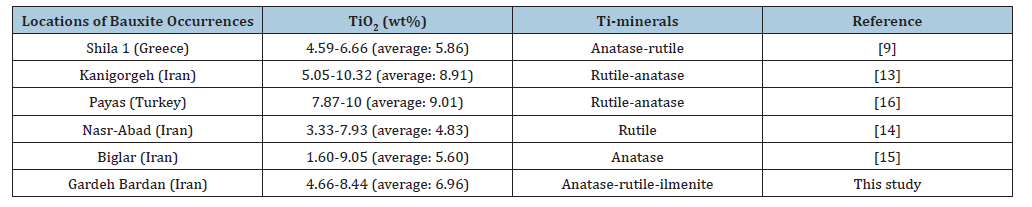
To date, only a limited number of titanium-rich bauxite deposits have been reported worldwide. These include the Shilla-1 karst bauxite deposit in Greece [9]; the Kanigorgeh [13], Nasr-Abad [14], and Biglar [15] deposits in Iran; and the Payas deposit in Turkey [16]. Table 1 compares the titanium mineralogical characteristics and TiO₂ concentrations of these deposits with those of the Gerdeh-Bardan bauxite deposit. The TiO₂ concentration in the Gerdeh-Bardan bauxite deposit (average 6.96 wt%) is higher than that of the Shilla-1 (average 5.86 wt%), Nasr-Abad (average 4.83 wt%), and Biglar (average 5.60 wt%) karst bauxite deposits, but lower than that of the Kanigorgeh (average 8.91 wt%) and Payas (average 9.01 wt%) deposits. In terms of titanium mineralogy, the Gerdeh-Bardan bauxite deposit, characterized by an anatase-rutile-ilmenite assemblage, differs from all previously reported deposits. The Shilla-1, Kanigorgeh, and Payas bauxite deposits are dominated by anatase-rutile mineralogy, whereas the Nasr-Abad and Biglar deposits are characterized predominantly by rutile and anatase, respectively.
Table 1:Comparison of the Gerdeh Bardan karst bauxite deposit with other known titanium-rich karst bauxite deposits worldwide in terms of titanium mineralogy and TiO2 concentration.
References
- Abedini A, Khosravi M, Mongelli G (2022) The middle permian pyrophyllite-rich ferruginous bauxite, northwestern Iran, Irano-Himalayan karst belt: Constraints on elemental fractionation and provenance. Journal of Geochemical Eploration 233: 106905.
- Abedini A, Calagari AA, Mikaeii K (2014) Geochemical characteristics of laterites: The Ailibaltalu deposit, Iran. Bulletin of the Mineral Research and Exploration 148(148): 69-84.
- Abedini A, Habibi Mehr M, Khosravi M, Calagari AA (2019) Geochemical characteristics of the karst-type bauxites: An example from the Kanirash deposit, NW Iran. Arabian Journal of Geoscience 12: 1-16.
- Abedini A, Calagari AA (2013) Geochemical characteristics of bauxites: The Permian Shahindezh horizon, NW Iran. New Yearbook for Geology and Paleontology 270: 301-324.
- Abedini A, Calagari AA, Hadjalilu B (2008) Geological-mineralogical characteristics and trace-elements geochemistry in Aghadjari bauxite deposit, South of Shahindezh, NW of Iran. Iranian Journal of Crystallography and Mineralogy 16(2): 346-356.
- Bardossy G (1982) Karst Bauxites. Elsevier Scientific, Amsterdam, p. 441.
- MacLean WH, Bonavia FF, Sanna G (1997) Argillite debris converted to bauxite during karst weathering: Evidence from immobile element geochemistry at the Olmedo Deposit, Sardinia. Mineralium Deposita 32: 607-616.
- Norton SA (1973) Laterite and bauxite formation. Economic Geology 68(3): 353-361.
- Mondillo N, Di Nuzzo M, Kalaitzidis S, Boni M, Santoro L, et al. (2022) Petrographic and geochemical features of the B3 bauxite horizon (Cenomanian-Turonian) in the Parnassos-Ghiona area: A contribution towards the genesis of the Greek karst bauxites. Ore Geology Reviews 143: 104759.
- Abedini A, Calagari AA (2016) Geochemical characteristics of the Arabshah kaolin deposit, Takab geothermal field, NW Iran. Arabian Journal of Geosciences 9: 548.
- Abedini A, Calagari AA (2015) Geochemical characteristics of the Abgharm kaolin deposit, NW Iran. New Yearbook for Mineralogy, Treatises 278 (3): 125-139.
- Abedini A, Rezaei Azizi M, Calagari AA, Cheshmehsari M (2017) Rare earth element geochemistry and tetrad effects of the Dalir phosphatic shales, Northern Iran. New Yearbook for Geology and Paleontology, Treatises 286: 169-188.
- Abedini A, Calagari AA (2014) REE geochemical characteristics of titanium-rich bauxites: The Permian Kanigorgeh horizon, NW Iran. Turkish Journal of Earth Sciences 23(5): 513-532.
- Abedini A, Khosravi M, Mongelli G (2024) Critical metals distribution in the late Triassic-early Jurassic Nasr-Abad bauxite deposit, Irano-Himalayan karst bauxite belt, NW Iran. Geochemistry 84(2): 107030.
- Calagari AA, Kangarani F, Abedini A (2010) Geochemistry of major, trace, and rare earth elements in Biglar Permo-Triassic bauxite deposit, northwest of Abgarm, Ghazvin province. Iranian Journal of Science, Islamic Republic Iran 21(3): 225-236.
- Öztürk H, Hanilçi N, Cansu Z, Kasapçi C (2021) Formation of Ti-rich bauxite from alkali basalt in continental margin carbonates, Payas region, SE Turkey: Implications for sea level change in the Upper cretaceous. Turkish Journal of Earth Sciences 30: 116-141.
© 2025 Ali Abedini. This is an open access article distributed under the terms of the Creative Commons Attribution License , which permits unrestricted use, distribution, and build upon your work non-commercially.
Editor In Chief







.jpg)































Signup for Newsletter

Quick Links
 Editorial Board Registrations
 Submit your Article
 Best Paper of the Volume
 Reprints
 Refer a Friend
 Advertise With Us
Our Recent Edition

.jpg)



Top Editors




.jpg)

















.bmp)
.jpg)
.png)
.jpg)













.jpg)






.png)

.png)




.png)




Financial Support

Sponsors

Latest e-Books

Latest Video

 a Creative Commons Attribution 4.0 International License. Based on a work at www.crimsonpublishers.com.
Best viewed in
a Creative Commons Attribution 4.0 International License. Based on a work at www.crimsonpublishers.com.
Best viewed in 
 | Above IE 9.0 version