

- About Us
- Information
-

The Author ensures that the research has been conducted responsibly and ethically with adherence to all relevant regulations. read more..
- For Authors
- For Reviewer
- Manuscript Guidelines
- Membership
- Publication Ethics
-
- Journals
- Reprints
- e-Books
- Videos
- Policies
- Contact Us
 COVID-19
- Submissions



Full Text
Aspects in Mining & Mineral Science
Role of Nanotechnology in Enhancing Mineral Exploration and Processing: A Mini Review
Himanshu Prasad Mamgain1*, Shivani2 and Reema Rawat3
1Department of Physics, Applied Science, School of Advanced Engineering, India
2Himalayan Institute for Learning and Leadership (HILL), India
3Health Technology Cluster, School of Health Sciences and Technology, India
*Corresponding author:Himanshu Prasad Mamgain, Department of Physics, Applied Science, School of Advanced Engineering, UPES, Dehradun-248007, Uttarakhand, India
Submission: November 18, 2025: Published: December 12, 2025

ISSN 2578-0255Volume14 Issue 4
Abstract
Nanotechnology has emerged as a game-changing tool in the mining and mineral processing industries, providing new solutions for effective exploration, enhanced recovery, and sustainable operations. Nanomaterials’ distinct features, such as high surface area, customizable chemistry, and extraordinary reactivity, allow for improved sensing, selective separation, and efficient treatment of mining waste. Nano sensors and nano-enabled geophysical devices improve mineral signature detection sensitivity, and nanoparticle tracers improve subsurface mapping. Nanotechnology in mineral processing improves flotation efficiency, facilitates selective adsorption, and speeds up catalytic processes for ore beneficiation. This brief study covers current advances and future potential for nanotechnology in mineral discovery and processing.
Keywords:Nanotechnology; Mineral processing; Mining; Rare earth elements; Surface engineering
Introduction
Demand to increase resource efficiency, lessen environmental effect, and find new deposits in deeper and more complicated geological conditions is mounting on the mining and mineral processing industries. Sensitivity, selectivity, and sustainability are frequently lacking in conventional exploration and beneficiation techniques. With its capacity to work with materials at the molecular and atomic levels, nanotechnology offers a way around these restrictions [1]. Nanomaterials, nano sensors, and nano-enabled chemical additives are increasingly being investigated to improve detection accuracy, enhance mineral recovery, and reduce waste during processing [2].
Nanotechnology in Mineral Exploration
Nano-enhanced geophysical techniques
There is growing demand in the mining and mineral processing sectors to find new deposits in deeper and more complicated geological settings, decrease their environmental effect, and increase resource efficiency. The sensitivity, selectivity, and sustainability of traditional exploration and beneficiation techniques are frequently lacking. Because nanotechnology can change materials at the molecular and atomic dimensions, it offers a way around these restrictions.
Nano sensors for trace mineral detection
Ultra-low concentrations of mineral indicators including gold, copper, rare earth elements, and sulfide can be detected via nano sensors based on Carbon Nanotubes (CNTs), graphene, and metallic nanoparticles. More precise detection of concealed deposits is made possible by their strong conductivity and chemical reactivity.
Nano-assisted remote sensing
Nanocoating’s on satellites and drones improve imaging resolution by enhancing optical sensitivity and reducing noise. This leads to more reliable identification of alteration zones and mineralized structures from aerial and space-based platforms [3,4].
Nanotechnology in Mineral Processing
Nano-flotation agents
Flotation efficiency can be significantly improved using nanoparticle-based collectors and frothers. Gold nanoparticles, silica nanoparticles, and alumina nanoparticles enhance bubbleparticle interactions and increase surface hydrophobicity, leading to better recovery rates and improved selectivity.
Nano-adsorbents for selective separation
Nanomaterials such as nano-Fe₃O₄, TiO₂ nanoparticles, and graphene oxide exhibit exceptional adsorption capabilities. These materials selectively bind valuable metals (e.g., gold, copper, cobalt) or remove unwanted gangue minerals, enabling improved beneficiation [5].
Nano catalysts in ore beneficiation
Nano catalysts accelerate leaching and mineral dissolution processes by increasing reaction rates. For example, silver or gold nanoparticles enhance cyanidation efficiency, while TiO₂- and ZnObased nano catalysts improve photocatalytic leaching under UV or visible light.
Nanostructured protective coating
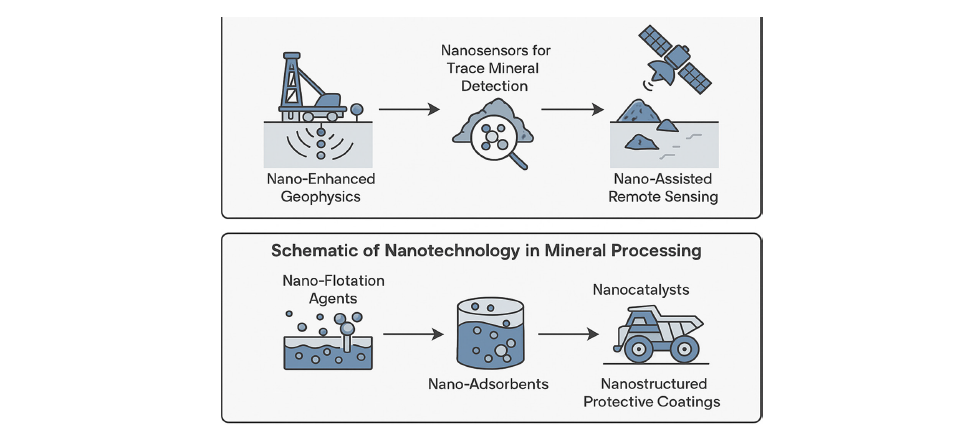
An important use of nanotechnology in mining is the development of nanostructured protective coatings, which provide improved defence against chemical, abrasive, and corrosion damage. Superior hardness, decreased wear, and longer service life are offered by nano-ceramic and nano-composite coatings for mineral-processing equipment, pipelines, conveyor parts, drilling tools, and crushers. Furthermore, Figure 1 illustrates how nanoengineered hydrophobic and anti-fouling coatings reduce surface contamination, slurry adhesion, and scaling, enhancing equipment dependability, energy efficiency, and overall operating performance.
Figure 1:Key applications of nanotechnology in mineral exploration, processing, and environmental management.
Nano-flocculants for solid-liquid separation
Polymer-based nano flocculants enhance sedimentation and clarification processes. Their high reactivity and large surface area result in faster settling, improved dewatering, and cleaner process water.
Environmental Applications in Mining
Heavy-metal removal with nanomaterials
a. A range of nano-based adsorbents-such as ironoxide
nanoparticles, CNTs, and chitosan-derived
nanomaterials-are used to capture toxic metals including
arsenic, lead, cadmium, and mercury.
b. These nanomaterials provide a larger active surface
and stronger binding ability than many conventional
adsorbents, making them highly effective for treating
mine wastewater.
Nanofiltration and advanced membrane systems
a. Nanometre-scale membranes allow selective separation of
dissolved ions and impurities.
b. Such filtration systems enhance water recycling in mining
operations and help reduce the dependence on freshwater
sources, while also lowering pollutant discharge.
Nano-enhanced phytoremediation
a. Certain metallic nanoparticles can boost the uptake of
contaminants by plants grown on polluted mine sites.
b. This approach helps accelerate soil rehabilitation and supports
faster ecological restoration.
Challenges and Future Prospects
Key issues that currently limit the wider use of nanotechnology
in mining include:
a. Insufficient knowledge about long-term environmental and
health impacts of nanomaterials.
b. High costs involved in producing and applying nanoparticles
on an industrial scale.
c. Difficulty in developing large-scale manufacturing processes
that meet mining industry requirements.
d. Lack of clear regulations or guidelines regarding the safe use of
nanoparticles in open and sensitive environments.
Conclusion
a. Nanotechnology is steadily reshaping mineral exploration and
processing by improving detection methods, enhancing ore
recovery, and supporting cleaner operational practices.
b. The use of nanostructured protective coatings adds further
value by increasing the durability of machinery and lowering
maintenance demands in harsh mining conditions.
c. Although several challenges remain particularly regarding
cost, scalability, and safety the continuous progress in
nanomaterials and surface engineering indicates strong
potential for broader adoption across the mining sector.
References
- Morrison SJ, Tripathi A (2011) Nanotechnology in the mining industry: Applications and implications. Minerals Engineering 24(6): 506-513.
- Hosseini MR, Ahmadi A, Ghasemi E (2018) Nanotechnology in mineral processing: Fundamentals and applications. International Journal of Mineral Processing 170: 1-12.
- Wang L, Li X, Chen J (2017) Nanosensors for geological and mineral exploration. Sensors and actuators B: Chemical 243: 673-684.
- Peng Y, Grano S (2010) Use of nanoparticles in flotation systems. Minerals Engineering 23(11-13): 917-926.
- Zhou Z, Meng X (2015) Magnetic nano-adsorbents for selective removal of heavy metals from mining wastewater. Journal of Hazardous Materials 300: 358-365.
© 2025 Himanshu Prasad Mamgain. This is an open access article distributed under the terms of the Creative Commons Attribution License , which permits unrestricted use, distribution, and build upon your work non-commercially.
Editor In Chief







.jpg)































Signup for Newsletter

Quick Links
 Editorial Board Registrations
 Submit your Article
 Best Paper of the Volume
 Reprints
 Refer a Friend
 Advertise With Us
Our Recent Edition

.jpg)



Top Editors




.jpg)

















.bmp)
.jpg)
.png)
.jpg)













.jpg)






.png)

.png)




.png)




Financial Support

Sponsors

Latest e-Books

Latest Video

 a Creative Commons Attribution 4.0 International License. Based on a work at www.crimsonpublishers.com.
Best viewed in
a Creative Commons Attribution 4.0 International License. Based on a work at www.crimsonpublishers.com.
Best viewed in 
 | Above IE 9.0 version