

- About Us
- Information
-

The Author ensures that the research has been conducted responsibly and ethically with adherence to all relevant regulations. read more..
- For Authors
- For Reviewer
- Manuscript Guidelines
- Membership
- Publication Ethics
-
- Journals
- Reprints
- e-Books
- Videos
- Policies
- Contact Us
 COVID-19
- Submissions



Full Text
Aspects in Mining & Mineral Science
Time-Resolved Scanning Electron Microscopy, Time-Resolved 2D FFT Analysis and High-Speed Line Scanning Oscilloscopic Measurements in Electrostatic Sand Saltation Registration
Gradov OV*, Maklakova IA and Sergeev AI
NN Semenov Federal Research Center for Chemical Physics of the Russian Academy of Sciences (FRC CP RAS), Russia
*Corresponding author:Gradov OV, NN Semenov Federal Research Center for Chemical Physics of the Russian Academy of Sciences (FRC CP RAS), Moscow, Kosygin Str. 4, Russia
Submission: October 31, 2025: Published: November 18, 2025

ISSN 2578-0255Volume14 Issue 3
Abstract
The role of electrostatics in sand saltation is well known (including the formation of dunes, as well as variations of sand flows in dust storms and sand clouds in aeolology). Various electrostatic phenomena can be reproduced on the sand grains in laboratory conditions using elementary experimental setups based on two electrodes and a high-speed camera. This method does not allow to influence a single sand grain electrically and to observe all the dynamic phenomena accompanying saltation in which it participates (electrostatic multistability, reversible aggregation, rotation of sand (micro)particles, etc.). We propose to use time-resolved scanning electron microscopy for this purpose, since in the column of a scanning electron microscope it is possible to program/control the potential difference/field strength by varying the accelerating voltage on the cathode. This paper contains time-resolved microimages of the dynamics of calibrated “sand models” (with measured surface charge, porosity and morphometric distributions) are shown in the series of SEM images with 2D FFT spectra and oscillograms of the model sand particle dynamics.
Keywords:Sand saltation; Sand rotation; Sand clouds; Bagnold dunes; Electrostatic multistability; Time-resolved SEM; 2D Fourier spectra; High-speed memory oscilloscopic measurements
Introduction
The role of electrostatics in sand “saltation” is well known, including the dune formation (according to the modified Bagnold mechanism), as well as in the variations of the sand flows in dust storms and sand clouds in aeolology [1-4]. Despite the recent revision of some saltation mechanisms, in particular, the recently discovered non-monotonic dependence of the fluidity threshold on the particle diameter, electric field applied and the surface charge density (leading to the separation of conductive particles from dielectric ones in the flows due to a decrease in the fluidity threshold up to 31% for conductive particles and an increase in the fluidity threshold up to 76% for negatively charged dielectric particles due to electrostatics) [5], in general, various electrostatic phenomena are readily reproduced on the sand grains under laboratory conditions in elementary setups such as that described in [6]. Two parallel electrode plates are used to generate a uniform electric field simulating an atmospheric or aeolian electric field. Under the influence of the electric field, sand particles acquire an inductive charge and rise into the air. Their trajectories are recorded with a high-speed camera, which is used to calculate the total charges of individual sand particles and their charge per a mass unit. The threshold electric field strength required to cause the sand particles to rise is also measured (it is known to increase with the grain diameter). This method does not allow to influence a single sand grain and to observe the dynamic phenomena accompanying saltation in which it participates (electrostatic multistability and reversible aggregation, particle rotation in vortex fields, etc.).
We propose to use time-resolved (including stroboscopic) scanning electron microscopy for this purpose, as the potential difference/field strength in the scanning electron microscope column can easily be programmed by varying the accelerating voltage on the cathode. Sand grains placed on a specialized platform with confining walls or in a “subchamber” (in the case of ASEMatmospheric scanning electron microscopy) exhibit dynamics strictly within the regions exposed to the electron beam. This allows monitoring their dynamics under the electron beam with a time resolution corresponding to the technical parameters of the detectors and a scanning system.
Materials and Methods
A time-resolved study of the dynamics of sand grains with different charges (including chemically modified ones) and sizes/ morphometric characteristics was performed for the first time using a custom-modified JEOL JSM T330-A scanning electron microscope in a TV mode with an ADC and video digitization module connected to a BNC connector output to a monitor (usually when using a TV mode). When recording video signals of the saltation dynamics of the sand particles with the recording parameters displayed in the address-time code/time code, a resolution from tens of milliseconds to milliseconds was achieved. The cathode voltage was varied from several kilovolts to 25 kilovolts.
Result
Sand particle rotation
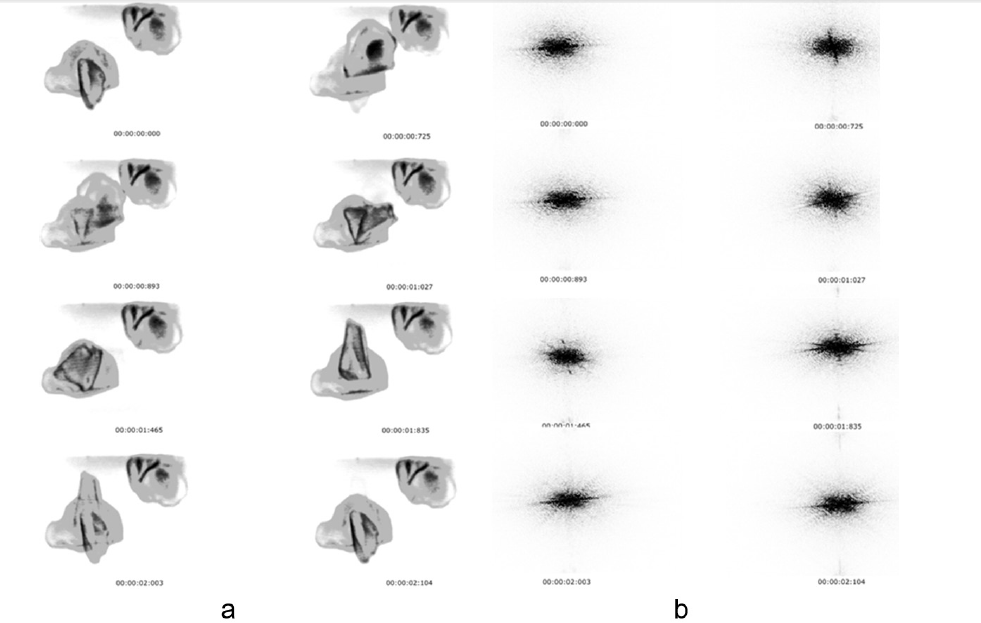
Examples of the time-resolved images of the dynamics of calibrated sand grain models with the known charge, porosity, and morphometric characteristics (SILASORB) are shown in Figure (1a). One can see the rotation of one particle on the surface of another, which is governed by electrostatic forces. Rotation can be confirmed using a real-time 2D Fourier transform (we performed this using QAVIS software developed by the Pacific Oceanological Institute, Far Eastern Branch of the Russian Academy of Sciences): dynamics of 2D FFT changes in this series of rapid micrographs can be seen in Figure (1b). In some cases, particle precession can also be observed, as well as the phenomena similar to gyroscopic motion of a sand grain confined on the surface. After detachment from the surface, the particles are carried outward, sometimes beyond the scanning zone.
Figure 1:Rotation of a model sand grain: a-a series of micrographs; b-two-dimensional fourier spectra (2D FFT) obtained by QAVIS software.
Sand particle bistability
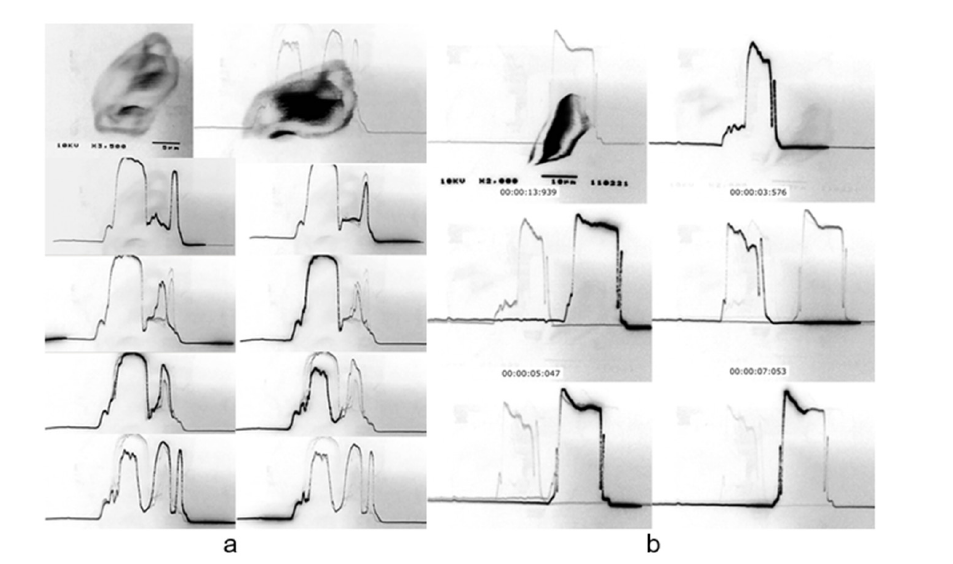
Another extraordinary phenomenon observed under the electron beam is discrete dynamics of the particle rotation switching (when the sand particles “stop” at specific angular positions), as well as discrete transitions in the sand grain orientation between two (“bistability”) or more (“multistability”) states. Long-range particle displacements are also observed, presumably correlated with the grain size and its surface charge. They are detected using oscillographic techniques on the specific scanning lines. Examples of the above effects are shown in Figure 2a & 2b. The results of model experiments have been published earlier [7]. Such experiments can be reproduced on any sand, provided the electrophysical experimental conditions are met, and can also form the basis for classifying sands based on their dynamics.
Figure 2:Time-resolved oscilloscopic 1D scans of the model sand grain dynamics: a-rotation with intermediate phases; b-abrupt movement of a single particle.
Discussion
The approach developed may be used in geology, particularly to study the mechanisms of extraction of individual minerals from sands (a classic example, known from the works of R. Collings in the 1960s-the extraction of pyrite from Potsdam sands and the works of A. Oberrauner and H. Flachberger in the 2000-2010s on electrostatic separation of complex quartz-feldspar sands) using electrostatic methods. In the areas of geobiology and geomicrobiology, the above method can be used for the analysis and modeling of electrostatic effects of sand/dust storms affecting plant vegetation and physiological processes, as well as the soil microbiota during weathering [8]. It can also be useful for the study of adhesion and recombination of viral particles on sands with different charges, which has both geomicrobiological and geoepidemiological significance [9]. In terms of astromineralogy and geochemistry of exoplanets, the phenomena of electrostatic aggregation of sand granules on Mars (including in the Bagnold Dunes on Mars) are of great interest. These phenomena were first described in 1980 in the Reports of Planetary Geology Program by Marshall et al. and then in NASA report CP-10074 (Ames Research Center, Moffett Field, CA) in 1991 (in particular by D. Sentman and R. Leach). Essentially, it becomes possible to model the behavior of the sand particles or regolith under the influence of an induced electrostatic field (charging under an electron microscope beam) in a wide range of conditions-from the deep vacuum of space or cryovacuum (high-vacuum electron microscopy/cryomicroscopy- HVEM/CryoHVEM) to the conditions similar to those on Earth or other exoplanetary surfaces (atmospheric and environmental scanning electron microscopy-ASEM/ESEM). Colocalization with WDXRS data allows one to correlate the dynamics or electrostatic charging with the particle composition, “bridging geophysics and geochemistry” in the studies of rapid sand/regolith dynamics.
References
- Schmidt DS, Schmidt RA, Dent JD (1998) Electrostatic force on saltating sand. Journal of Geophysical Research: Atmospheres 103(D8): 8997-9001.
- Yue GW, Huang N, Zheng XJ (2003) Effect of irregular sand grains and electrostatic force on threshold wind speed. Journal of Desert Research 23(6): 621-627.
- Yue GW, Zheng XJ (2007) Effect of thermal diffusion and electrostatic force on evolution of wind-blown sand flow. Applied Mathematics and Mechanics 28(2): 183-192.
- Zheng XJ, Huang N, Zhou Y (2006) The effect of electrostatic force on the evolution of sand saltation cloud. The European Physical Journal E 19(2): 129-138.
- Zhang H (2024) Revisiting the effects of electrostatic forces on the lifting of sand particles in dust storms. Journal of Electrostatics 127: 103880.
- Xie L, Liu Y, Zhou C, Wang M, Lacks DJ, et al. (2021) A laboratory study of the electrostatic charge of individual sand particles lofted in an electric field. Aeolian Research 50: 100675.
- Elfimov A, Gradov OV, Gradova MA, Maklakova IA, Sergeev AI (2025) Field-driven and electron beam-driven discrete multi-stable microrotators based on modified HPLC sorbents. Advanced Structured Materials 221: 157-189.
- Li XC, Zhao N (2012) A theoretical analysis of the effect of wind-blown sand electrostatic field on vegetation physiological processes. Journal of Desert Research 33(6): 1731-1734.
- Redman JA, Grant SB, Olson TM, Hardy ME, Estes MK (1997) Filtration of recombinant Norwalk virus particles and bacteriophage MS2 in quartz sand: Importance of electrostatic interactions. Environmental Science & Technology 31(12): 3378-3383.
© 2025 Parga Torres JR. This is an open access article distributed under the terms of the Creative Commons Attribution License , which permits unrestricted use, distribution, and build upon your work non-commercially.
Editor In Chief







.jpg)































Signup for Newsletter

Quick Links
 Editorial Board Registrations
 Submit your Article
 Best Paper of the Volume
 Reprints
 Refer a Friend
 Advertise With Us
Our Recent Edition

.jpg)



Top Editors




.jpg)

















.bmp)
.jpg)
.png)
.jpg)













.jpg)






.png)

.png)




.png)




Financial Support

Sponsors

Latest e-Books

Latest Video

 a Creative Commons Attribution 4.0 International License. Based on a work at www.crimsonpublishers.com.
Best viewed in
a Creative Commons Attribution 4.0 International License. Based on a work at www.crimsonpublishers.com.
Best viewed in 
 | Above IE 9.0 version