

- About Us
- Information
-

The Author ensures that the research has been conducted responsibly and ethically with adherence to all relevant regulations. read more..
- For Authors
- For Reviewer
- Manuscript Guidelines
- Membership
- Publication Ethics
-
- Journals
- Reprints
- e-Books
- Videos
- Policies
- Contact Us
 COVID-19
- Submissions



Full Text
Associative Journal of Health Sciences
Phase 3 Cardiac Rehabilitation and Fall Recovery are Under-Utilized Opportunities to Improve Clinical and Functional Outcomes in Transcatheter Aortic Valve Replacement Patients
Brandon Ichino1* and James Craner2
1 University of Nevada Reno, Reno, Nevada USA
2 Assistant Clinical Professor (Adjunct), University of California, San Francisco School of Medicine, Department of Medicine, Division of Occupational, Environmental and Climate Medicine, San Francisco, California USA
*Corresponding author:Brandon Ichino, University of Nevada Reno, Reno, Nevada USA
Submission: June 23, 2026;Published: July 06, 2026

ISSN:2690-9707 Volume4 Issue4
Abstract
Transcatheter aortic value replacement (TAVR) patients tend to be older, frail, and have one or more comorbidities. Cardiac rehabilitation is essential to returning these patients to their pre-intervention level of activity and functioning. However, once outpatient (Phase 2) rehabilitation has been completed, most remain patients at elevated risk for serious adverse events, notably falling, that impact their prognosis for meaningful recovery and resumption of an active lifestyle. Home-based cardiac rehabilitation (Phase 3) is elective and often is either not prescribed or haphazardly programmed, and consequently it has received relatively little research and formal practice attention or utilization. This manuscript examines how and why the incorporation of a structured, Phase 3 program for training patients to independently recover from an accidental fall into standard cardiac rehabilitation practice would enhance cardiologists’ ability to improve their post-TAVR patients’ long-term clinical and functional outcomes as well as quality of life. A model is proposed for a physician-prescribed and -supervised Phase 3 fall recovery program that maximizes patient access and participation while ensuring quality and consistency. This functional fall recovery model program comprises three components: (1) prognostic screening and assessment tools; (2) a specific fall recovery maneuver and supporting exercises; and (3) performance and outcome metrics, not only for clinical application but also to comparatively utilize in research studies of fall recovery methods. Each of these components can be delivered either in person, virtually/remotely or a hybrid by cardiac rehabilitation nurses or other qualified staff.
Introduction
Transcatheter aortic valve replacement (TAVR) has revolutionized the treatment of valvular heart disease, allowing individuals who otherwise are not candidates for surgical aortic valve replacement (SAVR) to increase their survival and extend their quality of life (QoL) [1-3]. The TAVR procedure is currently performed to treat severe aortic valve stenosis in patients over age 65, and is an American College of Cardiology/American Heart Association class 1A management guideline recommendation for heart failure patients [4]. Candidates for TAVR over SAVR include those patients with previous cardiac surgery, advanced age, multiple co-morbidities, and frailty [5,6]. In association with being older and having co-morbidities, TAVR patients tend to have advanced physical deconditioning at the time of the procedure resulting from sedentary lifestyle, reduced exercise capacity, decreased physical and cognitive function, depression, and sarcopenia [2,7-10].
Cardiac rehabilitation (CR) is a standard practice after TAVR and SAVR. CR is also strongly recommended after other common cardiac procedures such as any open-heart surgery (e.g., coronary artery bypass graft (CABG) for coronary artery disease (CAD) or valvular repair/replacements, and for coronary stent placement post-acute coronary syndrome [10]. Survival and QoL after any cardiac intervention procedure are highly correlated with completion of a CR program [11].
Phase 3 Cardiac Rehabilitation and Fall Recovery: Overlapping Risk Pathways and Opportunity for Integration
Three phases of cardiac rehabilitation
CR has three sequential phases: inpatient during post-operative recovery (Phase 1); a highly structured (“intensive”) outpatient program (Phase 2); and optionally, an ongoing, self-guided set of supervised, home-based exercises and practices (Phase 3) [7]. Phase 2 CR is a well-established, insurance-reimbursed process for all heart interventions (including TAVR) that commonly comprises up to a 12-week program of exercise, diet, lifestyle, and mind-body connection, with instruction and practice mostly focused on tertiary prevention of CAD [12]. Exercises prescribed post-operatively are intended to help patients to return to their pre-intervention level of activity and thereafter stay active and mobile for the remainder of their lives [9]. Whereas the technical TAVR procedure itself has continuously improved over time [1,12,13], only a relatively small proportion of patients actually get referred to CR, and most such candidates either choose not to attend or otherwise do not complete a CR program [5-7,14].
Beyond prescribing the Phase 2 CR program, the cardiologist who performs the TAVR procedure has little control over patients’ long-term clinical outcomes and improving their QoL past basic activities of daily living (ADL). Graduation from a Phase 2 CR program typically entails completing a 6 minute walk test and basic strengthening and flexibility exercises [15]. Home exercises for patients are available online (e.g., American Heart Association Strength and Balance Exercises [16]) or patients may be provided with a list of recommended exercises. Performing independent home exercises consistently and correctly in this population requires substantial motivation, instruction and support to demonstrate objective success [7,17].
In contrast to Phase 2 CR, Phase 3 CR provides uncertain value and accessibility for physicians and patients in terms of long-term functional gain [7,12]. Particularly for post-TAVR patients, Phase 3 CR is elective and commonly it is not prescribed or is not formally structured in its approach or insurance payment requirements. Phase 3 CR offers valuable opportunities to address functional resilience, gait recovery, and fall vulnerability outside the scope of traditional Phase 2 CR. Thus, Phase 3 CR has many opportunities for innovation, improvement and optimization both in its content as well as its methods of delivery to increase the likelihood of its utilization and positive outcomes-not only for post-TAVR patients but also for other post- cardiac intervention patients [1,7,14,18].
Fall recovery
One such target opportunity for Phase 3 CR is reducing the sequalae of accidental falling at ground level. Falling (and prevention thereof) is a key indicator of QoL for elderly and physically impaired patients [8,11]. Risks for and prevention of falling have been well studied in geriatric patients [19] and cardiorespiratory fitness objectives for CR have been well characterized in cardiac patients [7,9]. A retrospective cohort study examining cardiorespiratory fitness and musculoskeletal fitness positively associated older adults’ inability to rise from the floor with increased all-cause mortality [20]. Even though most falls do not cause serious injuries, deconditioned people who fall may nonetheless struggle or fail to stand up independently [10]. Multiple functional limitations and factors can contribute to falling risk including impaired balance or coordination, loss of flexibility and mobility, medication side effects, visual and proprioceptive function deficits, strength diminution and sarcopenia, joint disorders, obesity, and generalized physical deconditioning affecting cardiopulmonary and strength endurance [8,9,12]. ‘Frailty’ is a term that encompasses many of these functional limitations [21].
The role of and need for tertiary preventive rehabilitation for accidental falling after post-cardiac procedures remains largely anecdotal, particularly post-TAVR and post-completion of a Phase 2 CR program [8,11,12,22]. Extensive patient and clinical educational information are available from governmental and non-governmental agency sources on falling risk factors, prevention, safeguards to soften the landing, and complications and consequences resulting from falls. However, a dearth of formal research or consensus exists on how patients can efficiently and independently stand up from a fall without the assistance of a chair or other object, i.e., ‘fall recovery’ [23]. Furthermore, some generic falling-related exercises may not be applicable or may be too difficult for patients with limited mobility, flexibility, or strength, thereby rendering the exercises either ineffective or avoided altogether. Figure 1 summarizes the post-cardiac intervention, rehabilitation and fall recovery continuum.
Figure 1:Post-cardiac intervention, rehabilitation and fall recovery continuum.

A structured model for fall recovery and clinical implications
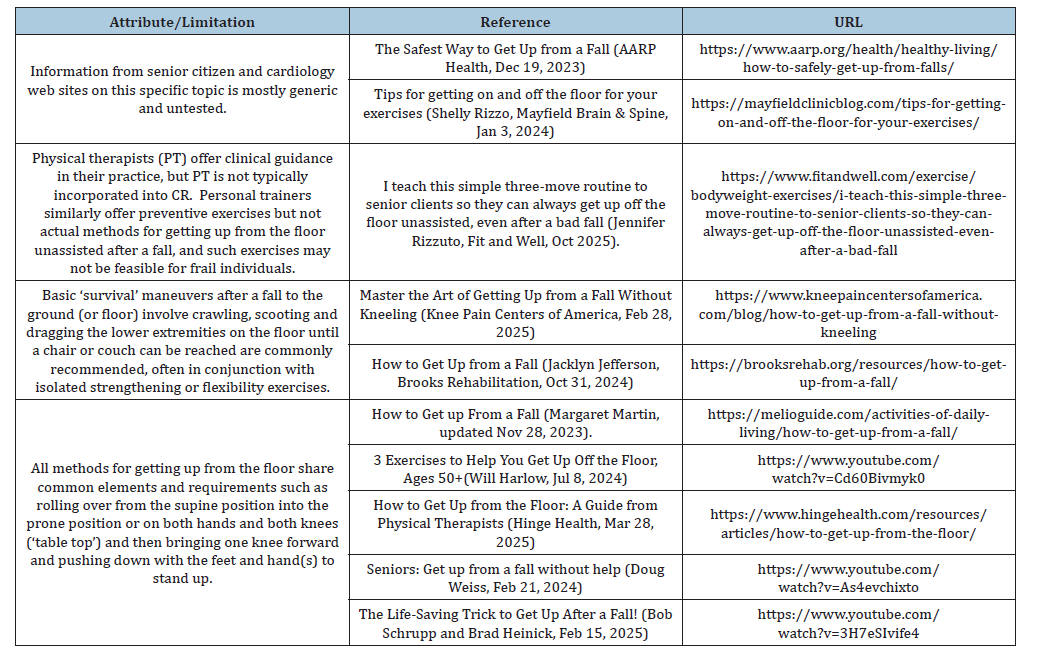
No single standard method for fall recovery is universally accepted or prescribed to patients either in the continuum of the CR framework or for other conditions treated with physical therapy (PT). Table 1 summarizes fall recovery methods’ attributes and limitations, with example references.
Table 1:Fall recovery attributes and limitations.
A model physician-administered and supervised program for fall recovery would have three (3) main components:
Prognostic Tool (Screening and Assessment): The clinical recognition and measurement of fall risk (‘risk assessment’) entails several physical, mental and psychological factors that can be effectively evaluated through clinical questions or questionnaires (‘subjective’), and/or physical examination and observation of functional behavior (‘objective’) [24]. Risk assessment metrics may be applied a priori as selection criteria and a posteriori to measure clinical prognosis. An in-person assessment is preferable to ensure accurate patient selection, allocation of resources, risk stratification, and (if applicable) customization [18]. Prognostic tools that help clinicians qualify patients for cardiac interventions and assess pre- versus post-CR health status include questionnaires such as the Kansas City Cardiomyopathy Questionnaire (KCCQ-12) [6,25]. A relative dearth of research has been conducted to determine to what extent these questions and scoring algorithms predict the likelihood of CR participation or long-term post-intervention outcomes [26].
Technique (Maneuver and Exercises): Prescribed, selfadministered strengthening exercises have been demonstrated to be effective even in frail individuals [27]. However, post-CR exercises that can be both demonstrated and objectively observed by a health professional are rarely practiced outside of standard PT. Didactic patient education of exercises, such as a presenting a brief lecture topic during CR, also has significant limitations. To increase patient compliance and efficacy, the maneuver and exercisescollectively, the ‘technique’-should be fun and stimulating to learn and practice, and it should contribute to the prevention, slowing or reversal of sarcopenia [7]. An engaging approach to hands-on learning appeals to patients with low motivation as well as to those with the aforementioned functional limitations [11,17,28].
Performance and outcome metrics: Scoring methods and prognostic interpretation guidelines can be incorporated to objectively measure the feasibility and execution of prescribed exercises and maneuvers [9,19]. Comparative (pre- vs. post-) subjective metrics such can be administered either as stand-alone responses to formal questions or incorporated into a standardized questionnaire such as the KCCQ-12 [6,25]. Objective metrics of performance akin to the Timed Up and Go (TUG) test [29] can be administered and reported using registries for standardized outcome tracking and reporting [18,22].
The recent focus on the need for increasing CR accessibility and scope [18] presents a timely opportunity to incorporate fall recovery training as an adjunctive area of clinical practice. All three components can be readily designed to be physician-prescribed and -supervised. They can be delivered either in person, remotely, or a hybrid combination at home by CR-trained nurses or other health care team staff to maximize quality, accessibility, participation, efficiency, cost-effectiveness, and compliance with governmental payor requirements [7,14,18]. From a practical perspective, the exercises and maneuvers can be taught or assessed by a nurse or medical assistant, or taught using a readily accessible, easy-tofollow video as an extension of an existing CR program [13,30].
Conclusion
Phase 3 CR is an under-utilized clinical tool to address important long-term patient outcome risks, notably accidental falling, in the post-TAVR patient population. Fall recovery-the ability to independently stand up from a ground level fall-can and should become a standard part of a structured, physician-prescribed and supervised, home-based Phase 3 CR program. By integrating innovative, evidenced-based approaches and alternative models of delivery for fall recovery into CR practice, cardiologists could substantively improve their elderly and frail patients’ clinical outcomes and functional resilience after TAVR and other cardiac and non-cardiac procedures.
Acknowledgment
The authors acknowledge Stephanie Carlson, DNP for reviewing and suggesting edits to the manuscript, and Abhilash Akinapelli, MD for guidance and mentorship of the primary author.
References
- Tona F (2025) When cardiology forgets to ask why. Open Heart 12(2): e003874.
- Al Balool J, Rajan R, Al Jarallah M, Raja D, Al Mulla K, et al. (2012) Aortic stenosis: From diagnosis to treatment: A review (2021 update). Ann Clin Cardiol 3(2): 54-62.
- Dibben G, Faulkner J, Oldridge N, Rees K, Thompson DR, et al. (2012) Exercise-based cardiac rehabilitation for coronary heart disease. Cochrane Database of Syst Rev 11(11): CD001800.
- Heidenreich PA, Bozkurt B, Aguilar D, Allen LA, Byun JJ, et al. (2022) 2022 AHA/ACC/HFSA guideline for the management of heart failure: A report of the American College of Cardiology/American Heart Association Joint Committee on clinical practice guidelines. J Amer Coll Cardiol 145(18): e263-e421.
- Sukul D, Albright J, Thompson MP, Villablanca P, Keteyian SJ, et al. (2023) Predictors and variation in cardiac rehabilitation participation after transcatheter aortic valve replacement. JACC Adv 2(8): 100581.
- Mesnier J, Panagides V, Nuche J, Rodés-Cabau J (2022) Evolving indications of transcatheter aortic valve replacement-where are we now, and where are we going. J Clin Med 11(11): 3090.
- Damluji AA, Tomczak CR, Hiser S, O’Neill DE, Goyal P, et al. (2025) Benefits of cardiac rehabilitation: Mechanisms to restore function and clinical impact. Circ Res 137(2): 255-272.
- Hashimoto K, Hirashiki A, Ozaki K, Kawamura K, Sugioka J, et al. (2022) Benefits of a balance exercise assist robot in the cardiac rehabilitation of older adults with cardiovascular disease: A preliminary study. J Cardiovasc Dev Dis 9(6): 191.
- Laukkanen JA (2020) Cardiac rehabilitation in the modern interventional cardiology era. Eur J Prev Cardiol 27(16): 1713-1715.
- Al Quait A, Doherty P (2016) Does cardiac rehabilitation favour the young over the old? Open Heart 3(2): e000450.
- Liu L, Chen J, Zhao N, Zhang M, Zhou L, et al. (2022) Early exercise-based rehabilitation for patients with acute decompensated heart failure: A systemic review and meta-analysis. Rev Cardiovasc Med 23(11): 356.
- Pollmann AGE, Frederiksen M, Prescott E (2017) Cardiac rehabilitation after heart valve surgery: Improvement in exercise capacity and morbidity. J Cardiopulm Rehabil Prev 37(3): 191-198.
- Vitez L, Bunc M, Jug B (2023) The effects of exercise training on exercise capacity and vascular function after transcatheter aortic valve implantation-A pilot study. J Cardiovasc Dev Dis 10(8): 343.
- Thomas RJ, Beatty AL, Beckie TM, Brewer LC, Brown TM, et al. (2019) Home-based cardiac rehabilitation: A scientific statement from the American Association of Cardiovascular and Pulmonary Rehabilitation, the American Heart Association, and the American College of Cardiology. J Amer Coll Cardiol 74(1): 133-153.
- Cleveland Clinic (2023) Cardiac Rehab https://my.clevelandclinic.org/health/treatments/22069-cardiac-rehab
- American Heart Association (2024) Cardiac Rehab series: Strength and Balance Exercises https://www.heart.org/en/health-topics/cardiac-rehab/getting-physically-active/strength-and-balance-exercises
- Mikkelsen N, Dall C, Holdgaard A, Frederiksen M, Rasmusen H, et al. (2019) Motivation for physical activity predicts effect of cardiac rehabilitation in an elderly cardiac population. Eur Heart J 40: 244.
- Hughes JW, Berry R, Brown TM, Carlin B, Drwal K, et al. (2025) Consensus statement on the virtual and remote delivery of cardiac and pulmonary rehabilitation and their components. J Cardiopulm Rehabil Prev 45(6): 387-396.
- Goldstein DW, Forman DE (2018) Cardiac rehabilitation in older persons with cardiovascular disease. Curr Cardiovasc Risk Rep 12: 5.
- Brito LB, Ricardo DR, Araujo DS, Ramos PS, Myers J, et al. (2014) Ability to sit and rise from the floor as a predictor of all-cause mortality. Eur J Prev Cardiol 21(7): 892-898.
- Vigorito C, Abreu A, Ambrosetti M, Belardinelli R, Corra U, et al. (2017) Frailty and cardiac rehabilitation: A call to action from the EAPC Cardiac Rehabilitation Section. Eur J Prev Cardiol 24(6): 577-590.
- Scherrenberg M, Marinus N, Giallauria F, Falter M, Kemps H, et al. (2023) The need for long-term personalized management of frail CVD patients by rehabilitation and telemonitoring: a framework. Trends Cardiovasc Med 33(5): 283-297.
- Arena SK, Wilson CM, Boright L, Cassidy B, Fedorow S, et al. (2024) Safe fall recovery education for older adults. Home Healthc Now 42(3): 130-139.
- Damluji AA, Alfaraidhy M, AlHajri N, Rohant NN, Kumar M, et al. (2023) Sarcopenia and cardiovascular diseases. Circulation 147(20): 1534-1553.
- Spertus JA, Jones PG, Sandhu AT, Arnold SV (2020) Interpreting the Kansas City Cardiomyopathy Questionnaire in clinical trials and clinical care: JACC state-of-the-art review. J Amer Coll Cardiol 76(20): 2379-2390.
- Abdel Jawad M, Jones PG, Arnold SV, Cohen DJ, Sherrod CF, et al. (2025) Interpreting population mean treatment effects in the Kansas City Cardiomyopathy Questionnaire: A patient-level meta-analysis. JAMA Cardiol 10(1): 32-40.
- Prasciene E, Icking N, Kisieliute E, Raimondas K, Birna BW, et al. (2019) Feasibility and short-term effectiveness of an additional resistance and balance training in cardiac rehabilitation for older patients after valve surgery: Results of a pilot study. Eur J Prev Cardiol 26: S39.
- Garcia A, Oliveira C, Martins A, Abrantes A, Alves Da Silva P, et al. (2024) The impact of cardiac rehabilitation on muscle strength: A crucial element of functional capacity. Eur J Prev Cardiol 31(1): I587.
- Hanson ED, Alzer M, Carver J, Stopforth CK, Lucas AR, et al. (2023) Feasibility of home-based exercise training in men with metastatic castration-resistant prostate cancer. Prostate Cancer Prostatic Dis 26(2): 302-308.
- Peng X, Su Y, Hu Z, Sun X, Li X, et al. (2018) Home-based telehealth exercise training program in Chinese patients with heart failure: a randomized controlled trial. Medicine (United States) 97(35): e12069.
© 2026 Brandon Ichino. This is an open access article distributed under the terms of the Creative Commons Attribution License , which permits unrestricted use, distribution, and build upon your work non-commercially.
Editor In Chief







.jpg)































Signup for Newsletter

Quick Links
 Editorial Board Registrations
 Submit your Article
 Best Paper of the Volume
 Reprints
 Refer a Friend
 Advertise With Us
Our Recent Edition

.jpg)



Top Editors




.jpg)

















.bmp)
.jpg)
.png)
.jpg)













.jpg)






.png)

.png)




.png)




Financial Support

Sponsors

Latest e-Books

Latest Video

 a Creative Commons Attribution 4.0 International License. Based on a work at www.crimsonpublishers.com.
Best viewed in
a Creative Commons Attribution 4.0 International License. Based on a work at www.crimsonpublishers.com.
Best viewed in 
 | Above IE 9.0 version