

- About Us
- Information
-

The Author ensures that the research has been conducted responsibly and ethically with adherence to all relevant regulations. read more..
- For Authors
- For Reviewer
- Manuscript Guidelines
- Membership
- Publication Ethics
-
- Journals
- Reprints
- e-Books
- Videos
- Policies
- Contact Us
 COVID-19
- Submissions



Full Text
Associative Journal of Health Sciences
From Hysteria to a Story to Tell: Strategies for Personal Improvement, Leadership Development, and Conflict Resolution
Daniel Rodríguez-Howell*
Associate Professor, University of Puerto Rico at Humacao, Nursing Department, José E. Aguiar Aramburu Ave., 908 Road, Km. 1.2, Humacao, P.R, 00792, USA
*Corresponding author:Daniel Rodríguez-Howell, Ph.D., M.S.N., Associate Professor, University of Puerto Rico at Humacao, Nursing Department, José E. Aguiar Aramburu Ave., 908 Road, Km. 1.2, Humacao, P.R, 00792, USA
Submission: March 13, 2026;Published: March 30, 2026

ISSN:2690-9707 Volume4 Issue4
Abstract
Introduction: Transforming hysteria into a positive story to tell depends on ourselves. This
transformation helps us improve as individuals and professionals, develop our leadership skills, solve
problems effectively and efficiently, and serve as positive role models to others.
Objective: This article focuses on presenting strategies that help transforming hysteria (e.g. chaos,
stressors, difficult moments, problems, conflicts) into a positive (e.g. favorable, beautiful, motivational)
story to tell that, also helps to think before acting, solve problems/conflicts appropriately, seek for
professional care and support from both experts and trusted people, to keep in mind that there is always
room for improvement, and serve as a positive example/model to others.
Methodology: A literature review and analysis of peer-reviewed articles was conducted to identify
validated problem-solving strategies. To facilitate understanding and application of those strategies,
examples are presented in such a way that can be used in both personal and professional settings. Also,
artificial intelligence (AI) was used to assist in the development of some of those examples and show how
AI facilitates our job.
Results: The article evidences that adversity can lead to negative emotions and actions. It also
demonstrates that most of the problems in working groups are based on process failures, not personal
conflicts. However, we have the capacity to bring about positive and favorable change and results in any
endeavour we choose. To achieve it, among others, we need commitment, discipline, leadership, and
evidence-based strategic processes. We need to look for the positive side of adversity without letting
hysteria to limit us, dominate our actions, or disturb our emotions and peace of mind. Let’s take advantage
of the story created by hysteria to live life to the fullest.
Keywords: Hysteria; Leadership; Strategies; Process-based and relationship-based conflicts
Introduction
Hysteria! Yes…we all go through moments of hysteria. Human behaviour and mental health experts define hysteria as a reaction to emotional [1] and physical [2] stressors. However, due to our differences, Dean et al. [3] denoted that hysteria is expressed in distinct ways. They added that some people self-provoke mental images projecting decompensation before others and do not feel good with themselves. Moreover, there are people who experience depression and anxiety images linked to traumatic memories or challenging situations that affect their mental health [2,3]. Like a domino effect, it is very difficult to these individuals to find an exit to their problems; therefore, they create negative mental images that could lead them to experience hysteria attacks and even more, to act wrongly [2]. Other people, like me, look for the positive side of issues that helps us to move forward favourably and take advantage of all lessons learned from each lived experience.
Interestingly, some colleagues, friends, and relatives have told me how impressed they were by the way I dealt with certain adversities. In fact, they have made comments such as: “I don’t know how you do it, I would be devasted!” or, “I really admire your optimism!”. Others, asked me: “How can you stay so calmed and normal?” That’s when I ask myself: “What is really normal?”.
I am another human. So, I also suffer and, in occasions, I feel weak, fragile, and sometimes I have felt like the world has fallen over me. However, I seek for ways to compose myself and say out loud: “nothing stops me!”. Many people know me after that saying. In fact, during difficult meetings, sometimes someone has said: “let’s calm down…let’s move forward…nothing can stop us”, causing immediate smiles in all of us. That phrase or saying has become a common proverb. I invite you to try it and, if you really believe it, you will feel better. Come on…say it… “nothing stops me!”.
Following the idea of proverbs, have you ever realized how many proverbs exist with a negative connotation? Some of them, despite intending to have a positive message, people start with negativity; in other words, they place a “no” first. One thing that has worked to maintain a positive mindset, in both myself and others, it’s giving a positive tone to those proverbs. If the proverb intends to be positive, but it starts with a “no”, I change it to a positive statement. In other words, I take away the “no”, or simply move it to the end of the statement. Undoubtedly, this brings the attention to any person near me because she or he is not used to hearing the proverb that way. Therefore, at first, it’s annoying to the ear, but then, the person gets used to it and eventually, collaborates with changing the negativity to a positive mindset with a simple proverb transformation. For better understanding, I am going to share some examples of typical proverbs I’ve heard often with negative connotation and how I change them to positive proverbs. If you know more proverbs (phrases, saying), try to change them and think about how you felt after doing it (Table 1).
Table 1:Proverbs.
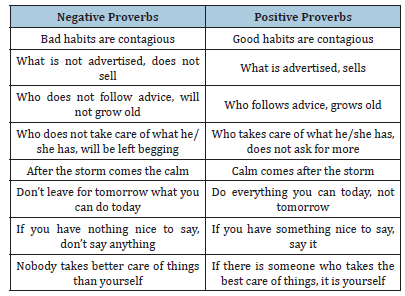
Note: Source: Author’s creation.
Although it may sound funny to some readers, I want to add that another thing that helps me organize my ideas, rethink positively, and refocus my actions is driving my 1973 Volkswagen Beetle freely. This action seems contradictory since I don’t like driving much. In fact, I wish I could pay someone to drive me around everyday. Well, let’s paraphrase that, to drive my other car, not my Beetle!
Curiously, my desire to drive is not related to the adrenaline created by speed, anger, or disappointment. Instead, I do it to enjoy the panoramic view while driving safely and following the law. In short, it makes me feel free, self-confident, and secure. That’s when my mind works better and start talking to myself. Years ago, seeing someone talking to himself or herself in a car was probably considered as “craziness”. Today, with so much technology behind the wheel, it is perfectly normal. Probably, anyone who sees me might think that I am talking on the phone. So, I encourage you to make a list of the things that make you feel good, especially when you are going through difficult times. Once you are done, try them out one by one, and if you can combine them, even better.
If I say that I don’t suffer and that painful situations don’t affect me, I would be lying. I don’t know about you, but in my case, when I go to bed, my head starts racing. Sometimes, no matter how I manage to fall asleep quickly, I end up staying up late. I have trouble falling asleep by trying to analyze the situation and searching for the why and how it happened. I also analyze whether what happened was caused by a person, for example, by personal situations, or if it occurred due to a failure in a process. In fact, establishing and understanding the difference between dilemmas or conflicts caused by people or by failures in processes is part of what inspired me to write this manuscript.
Many conflicts between people arise from poorly designed or contradictory processes, ineffective leadership styles, and communication problems [4,5], unclear or poorly defined roles [6,7], and limited resources [8]. Benitez et al. [6] explain that conflicts are divided into tasks (processes) or relationships (personal). Process-based conflicts arise during disagreements about jobs, goals, procedures, and a lack of alignment in objectives. On the contrary, differences and incompatibility between people or negative emotions lead to relationship-based conflicts. The authors add that process-related conflicts are more common and can have positive effects when managed properly. Certainly, conflicts related to relationships are more destructive. However, if we are confident that another path can be taken to continue improving, do the things we enjoy, help others, and serve as a good example to others, we must search for it and claim the value that we deserve [9]. There are multiple routs to do things, including the wrong ones. It is our job to determine which route we want to choose. I admit that when I act the right way and do things right, I sleep peacefully, I feel proud of myself, my conscience stays clear, and I walk with my head up at all times.
Because of above reasons, I have come up with the idea of transforming hysteria into a beautiful story to tell, a story to overcome adversity and help us to think before acting. Moreover, a story that leads to solve problems appropriately, to seek professional mental health care and support from trusted people, to keep in mind that there’s always room for improvement, and to serve as an example to others. Yes, we can. Yes, there are other ways. Motivate yourself to seek for them and you will find them. Just make sure that there are no conflicts of interest, ethical or legal. Given that, always maintain your professionalism, leadership, and integrity.
Some battles are impossible to win. Therefore, we must learn how to choose them. Keeping that in mind, if we decide to face the battle, there is no reason for backing down. Once we choose our battle, we must fight to the end, no matter how difficult it may be. However, when we choose to fight, it is because we are prepared to face the counterattack, including evidence, arguments, justifications, witnesses, and support, as appropriate. This is important because we need to be ready for what the other person will present against us or his or her defense strategy. If we are certain of our position and how to face the battle, there is nothing to fear. This is a great example of what a true leader should do.
We all have stories to tell, some of them are very pleasant and others, not so pleasant. Under such circumstances, there are still stories to tell. Let me ask you this, what story do you want to tell about yourself? How do you want to be remembered? Please, don’t misinterpret me. I am not saying that we have to live thinking about what others say about us. Even so, it feels good when others talk well about us. Nevertheless, we are not a hundred-dollar bill to please everyone. So, there might be someone who doesn’t like you, but I assure you that they are not the majority. Therefore, keep going.
One important thing to remember is that excesses are harmful. Long time ago, I had a coworker who loved telling jokes. Eventually, he took another job. As an interesting note, those who knew him from other offices used to stop by asking for him. When they realized that he didn’t work there anymore, they said: “no way, he used to make me laugh a lot…he was a true clown”. Others, said: “too bad, he was so funny”. Some people only came to listen to his jokes. Something that brought my attention was that none of them ever came to him looking for a job-related matter. Even less, they mentioned anything related to his performance or qualities. So, I asked myself: “that’s how you want to be remembered, like the funny guy, the joker, the clown? Although I like to incorporate humour into my lectures and training sessions, I do so with great respect and, of course, moderation. I share the opinion of Cao et al. [10] that humour contributes to the development of positive emotions and happiness. My goal is for the audience to acquire knowledge or refresh concepts while relaxing and releasing stress. In other words, they have a good time as humour is necessary to help people maintain happiness during negative and challenging situations [10]. This is done while maintaining professionalism, leadership, commitment, and without falling into recklessness or vulgarity.
Sometimes, we feel frustrated, sad, and even disappointed because certain processes seem to be unfair. Well, of course they are unfair! But they should not become a reason to give up. On the contrary, they are a reason to rethink things, motivate ourselves, and keep moving forward. If we let ourselves be consumed by all the injustice situations that occur, we wouldn’t even leave our homes.
Next, I offer additional recommendations that could help transform hysteria into a story of overcoming adversity. The best part is that they can be applied in any situation, both personally and professionally. They also work well individually and in groups.
First of all, I recommend to receive leadership training, especially in topics that provide the opportunity to internalize the leadership style that predominates in you. Have you ever asked yourself, “Who am I when I get angry?” or, “How do I react when I get upset?”. I encourage you to ask yourself those questions and be very honest in your answer. It also helps to ask people who know you well, especially those who wouldn’t lie to you. To do this practice, it is crucial that you are prepared to hear things that you may not expect to hear. Therefore, you must be receptive to endure whatever comes. However, effective leadership goes beyond learning about our own leadership style. It’s also about how to work and interact with other people who, in turn, have leadership styles different from our own. It’s not easy, but it can be done. It takes time and practice, so I encourage you to begin. Remember my positive proverb from above, “Do anything you can today, no tomorrow”.
Many cases of hysteria arise from communication barriers. It is evident that to achieve effective communication, we must learn to listen. The same hysteria has the person who speaks and does not listen than the person who listens and does not speak, whether because he or she does not dare to speak or does not want to speak or, simply, because he or she is not allowed to speak. It’s incredible how with so much literature on this subject and everything that is said about it, it’s still one of the main causes of conflict between people. That’s why the importance of practicing and promoting effective communication, even in times of difficult, uncomfortable, controversial, or sensitive topics. In their book, Patterson et al. [11] refers to that time as having crucial conversations. If you believe to have problems with effective communication or establishing crucial conversations, it wouldn’t hurt to seek professional help. Analyze whether you listen, speak and let others speak, whether you speak and don’t listen, or if you listen and don’t speak.
Guess what, silence also speaks. Therefore, it is important to promote effective communication, even if others don’t promote it with you. Set an example, and if you understand that effective communication is not possible at that moment, it’s best to resume it later, if necessary. In times of adversity and change, people follow visionary and inspiring leaders, as well as those who provide transparent information and opportunity for their voices to be heard [12,13]. Yet, we interact with people who, sadly, are impossible to have an effective communication, even less in controversial or sensitive topics. Taking myself as an example, once I encounter someone like that, I rather choose the topics to be discussed with him or her. So, one less hysterical episode for me. However, we should not run away from problems either. There are times when we have to take risks and try to communicate the best we can, even if it doesn’t turn out as expected. At least we try.
As stated at the beginning, all human beings are different. While diversity is undoubtedly one of the beauties that distinguishes us, interacting with one another can be challenging and sometimes complicated. If that were easy, there would be no war. The reason is because we are difficult to please and satisfy. We tend to find faults on everything, in other words, we always have a “but”. For example, we visit a restaurant and even though the food was good, we complain because the parking was far away, the service was slow, or the portion was too small. Perhaps we complain because the restaurant was too cold or too hot. Maybe the music was too loud or, conversely, too quiet. These differences and incompatibilities sometimes lead to negative emotions. Rely on ourselves how we choose to manage these emotions and transform them into positive ones. However, to achieve this effectively, we should seek help from a healthcare professional, preferably a mental health specialist. Those of us who believe in God could seek strategies that strengthen our spiritual well-being through theological literature and religious leaders as preferred.
Through this article, I have conveyed the message of the harm than can occur, both professionally and personally, when conflicts arise in processes or between people. In other words, they can cause chaos or, to stay on topic, hysteria. To manage conflicts effectively, I recommend seeking strategies that help design efficient processes and avoid falling into the habit of “blaming others”. Blaming others, especially in front of other people, is a form of moral self-defence, as are resentment, contempt, and other negative attitudes [13]. I keep repeating that we have the power to transform negative attitudes into positive ones. I also keep saying that, if we set our minds to it, we can achieve it. However, we must know when we need help and when to look for appropriate strategies in order to manage our emotions and actions.
Leaders take action because they expect a positive outcome, whether for themselves or significant others, the organization they work for or belong to, a process or procedure, or working teams. But everything requires order, discipline, strategic processes, commitment to those processes, and leadership. So, it is not about acting for the sake of acting. There must be a purpose for what we want to achieve and a method for doing it. Part of a strategy is aligning the objectives and goals with the purpose, as well as outlining the appropriate procedures for each task or activity we want to carry out. When working as a team, it’s imperative that consensus is reached among the members, both for aligning objectives and goals and for outlining the procedures to follow for each task.
No matter how small, large, simple, or complex is the task, it should have objectives, goals, and procedures to follow. This will help clarify processes and prevent misunderstandings or duplication of effort. Something that have always worked for me is staying organized from beginning to end. In other words, organization is automatically part of my working plan. As a result, the required effort decreases as the task progresses.
For me, this is simply working smarter, not harder [9]. A while ago, I learned to develop organizational objectives using the SMART [14] framework. The S stands for Specific, M for Measurable, A for Achievable, R for Relevant, and T for Time-bound. If you try it, it will help you align objectives with goals. This is important because it keeps us focused on what we want to do and achieve. Another advantage is that it helps us prioritize goals and, of course, organize the steps for each task according to its complexity, even if we have to restructure those steps later. However, prioritizing goals involves making realistic time projections. Since we are not perfect, we should include adequate and precise room for error, as well as room for improvement. So, another way to transform hysteria into a story of overcoming challenges is through an efficient process design.
When designing processes, we must define our role and the tasks or activities to be performed, meaning our functions/ responsibilities. Roles and responsibilities are not the same thing. Generally, each role has multiple responsibilities. For example, if you were a professor, think about all you have to do in order to achieve that students learn while you comply with the objectives of each class topic. On the other hand, if you were a student, think about your responsibilities in order to learn and ultimately graduate with honours.
Now, what if you were both a professor and a student? Your role as a professor is definitely not the same as your role as a student. Consequently, neither are your responsibilities. One thing is to stand in front of students to teach them, and quite another to sit with other students and learn from another professor. The roles as parents, grandparents, uncle/aunt, son/daughter, or siblings are not the same either. Therefore, it is extremely important to define and clarify our roles. The same principle applies in working groups. Regardless of the number of members, it’s crucial that each member has a clearly defined role. Similarly, it is important to clarify each other’s perceptions of their responsibilities, which will lead to better performance and minimize conflicts in processes [5]. Otherwise, role conflicts will arise and, eventually unnecessary hysteria.
Another aspect to consider is seeking the right information, as well as the appropriate talents (human resources) and physical resources. We need to know where to look for information, which I insist that it should be from evidence-based and reliable sources [13]. We cannot believe everything we read. Nor can we ask just anyone, even less people who don’t even know what they’re talking about.
It is important to be familiar with the events happening in our country and worldwide, as they could have a positive or negative, direct or indirect effect on us or those close to us. It is wise to verify the information, regardless of its source. Once you have reliable information, I encourage you to share everything you have learned. In other words, let’s share our knowledge and encourage others to share theirs with us. It’s like creating a network, but of knowledge. Advantageously, by acquiring knowledge we can apply it to any personal or professional scenario, project, or activity.
Previously, I explained the difference between processbased (task-based) conflicts or problems versus relationshipbased (people-based) conflicts or problems. There is substantial evidence showing how process-based conflicts often transform into relationship-based conflicts when not managed correctly [5]. In other words, problems related to how work is performed often become problems between people. This is where art and creativity take place in order to reduce errors and uncertain situations, which in turn reduce interpersonal friction [5].
Numerous expert-validated strategies and tools exist for defining, measuring, and controlling problems related to processes. Each expert presents their own analytical method for reducing errors and friction among team members. In fact, many theories and conceptual models exist for problem-solving and decisionmaking.
For the purposes of this manuscript, I will present some basic problem-solving strategies, whether for processes or relationships. These strategies have been adapted from various models, such as Root Cause Analysis [15,16], Define-Measure-Analyze- Improve-Control (DMAIC) [17,18], and Lean Six Sigma, which is a methodology for optimizing processes, improving quality and reducing costs while eliminating activities that do not add value for the costumer and reducing variability and defects [17,19].
Of course, I encourage you to familiarize with other models, as some conflicts are more complex and require more time and effort. I want to emphasize that not all problems can be solved using the same strategy or tool. However, it is helpful to have a basic strategy to get us started, based on the understanding that more information and further research will likely be needed.
Here is a process-based conflict resolution strategy:
1. Ensure the problem is process-oriented, not personal
a. Primary objective: Resolve an undesirable outcome (e.g.
delays, duplication of work, inconsistent decisions…).
b. Separate the person’s behaviour from the operational
problem. Focus on documenting facts and data and avoid
blaming others. Likewise, remain impartial at all times;
otherwise, you will end up manipulating the process and the
result will be biased.
2. Gather evidence and define the problem
a. Collect specific data (e.g. frequency of the incident, times,
products affected, participants, customers…).
b. An effective tool for gathering evidence is the Suppliers,
Inputs, Process, Outputs, Costumers (SIPOC) Model [20,21]
from Lean Six Sigma. I recommend searching for it in your
preferred internet browser. You will find several examples of
how to use it. I will also provide examples of the model below.
Feel free to create a simple process diagram with 6 to 10 steps.
c. Write the expected result in a short, precise, and concise
manner (e.g. 30% of orders arrive with errors of…, resulting in
3 hours of extra work per week).
3. Create a process map showing where the conflict occurs
a. Create a table with the tasks to be performed and identify
the areas or points in time where decisions are made.
b. This exercise helps visualize where the error lies, for
example, whether it is due to the information provided
(acquired), the responsibility of the person performing the
task, or the sequence of events.
4. Analyze the root cause
a. Involve people who perform different tasks.
b. Do not draw conclusions without confirming the causes.
c. Try to prioritize the root causes (if more than one).
5. Co-design solutions based on the shared interest of people
in improving processes
a. Separate people from the problem, explore interests
and options, and seek consensus-based solutions to avoid
the perception that the solution was imposed and; therefore,
reduce resentment.
b. This can involve redesigning steps, clarifying roles, creating
checklists, reaching internal agreements, communicating
norms/regulations, among other things.
6. Standardize processes to establish controls
a. Implement a pilot project for a short period of time (2 to 4
weeks) in a specific area. It is important to measure before and
after implementation.
b. If improvements are observed, standardize them (e.g.
procedures, documentation) and establish controls (e.g.
checklists, performance indicators based on objectives and
goals [remember SMART], audits).
7. Monitoring and Metrics
a. Some performance indicators are: incident rate, cycle
time, and short team satisfaction surveys.
b. Monthly or quarterly review.
8. Learning and Culture Development
a. Document lessons learned and reinforce teaching and
learning among members to prevent processes from being
forgotten or neglected.
b. Provide training on conflict resolution, tailored to
individual interests and communication skills, to develop
leaders. This will help prevent blame-shifting. I recommend
using the A3 Problem-Solving Model, which is also part of Lean
Six Sigma. It helps to think about and communicate processes in
a structured way [22]. In other words, it promotes continuous
improvement, collaboration, and in-depth problem analysis
[22], including root cause analysis [23].
To facilitate understanding, I am sharing blank tables to develop a SIPOC (Table 2), a Process Map (Table 3), and an A3 Problem- Solving Model (Table 4).
Table 2:SIPOC (Suppliers, Inputs, Process, Outputs, Customers).
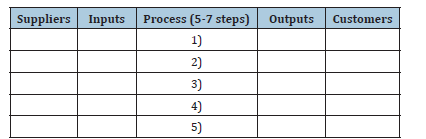
Note: Source: Adapted from Sharma S [21]. SIPOC in Six Sigma: Diagram, tools, templates. upGrad Knowledge Hut. https://www.knowledgehut.com/blog/quality/what-issipoc
Table 3:Process map.

Note: Source: Author’s creation with AI assistance. The rows represent roles or areas (e.g. Person A, System). The columns represent the main stages of the process.
Table 4:A3 problem-solving model.
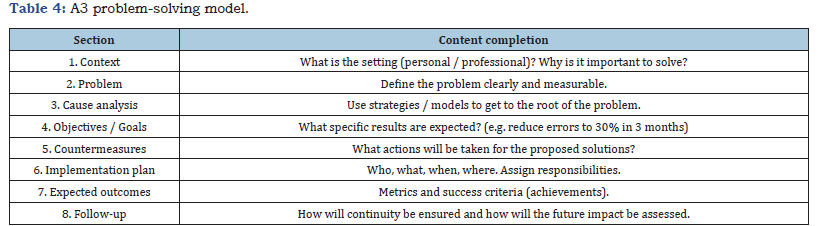
Note: Source: Author’s creation with AI assistance.
If you have never used this type of strategy, you might encounter some doubts at first. Of course, it takes practice. The more you practice with different scenarios, the better you will become. In fact, you will eventually feel comfortable training others. A great advantage we have today is that, with technological advancements, we can request assistance through Artificial Intelligence (AI). To demonstrate this, I will show an example of AI assistance applied to a process-based conflict, specifically related to communication delays within a team. When using AI, it is important to present the situation as detailed and specific as possible. Let’s see it (Tables 5-7).
Table 5:SIPOC (Filled Example - Process-based Conflict).
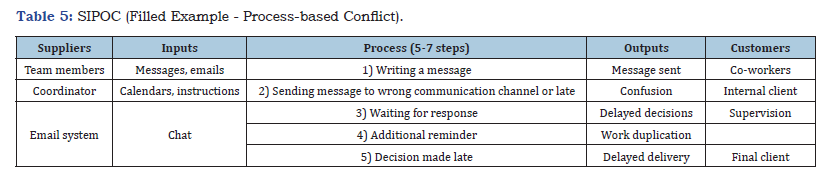
Note: Source: Author’s creation with AI assistance.
Table 6:Process map (Filled Example - Process-based Conflict).

Note: Source: Author’s creation with AI assistance.
Table 7:A3 problem-solving model (Filled Example - Process-based Conflict).
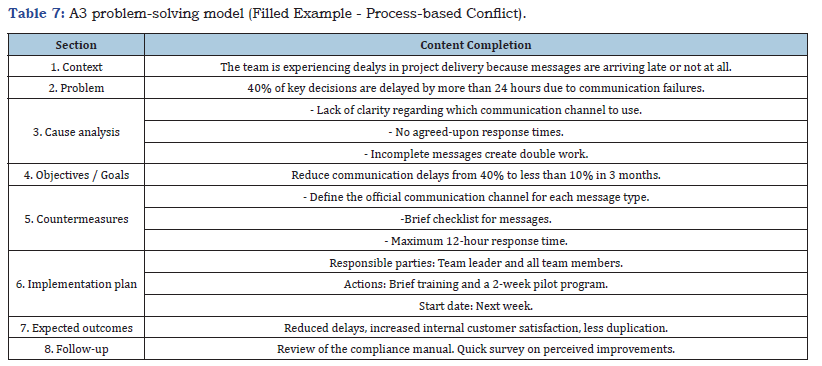
Note: Source: Author’s creation with AI assistance.
Finally, also with AI assistance, I present an example applied to a relationship-based conflict, this time, about home conflicts over domestic tasks not completed on time. Sound familiar? (Tables 8-10).
Table 8:SIPOC (Filled Example - Relationship-based Conflict).
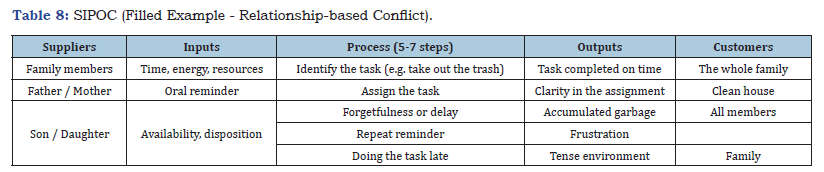
Note: Source: Author’s creation with AI assistance.
Table 9:A3 problem-solving model (Filled Example - Process-based Conflict).

Note: Source: Author’s creation with AI assistance.
Table 10:A3 problem-solving model (Filled Example - Process-based Conflict).
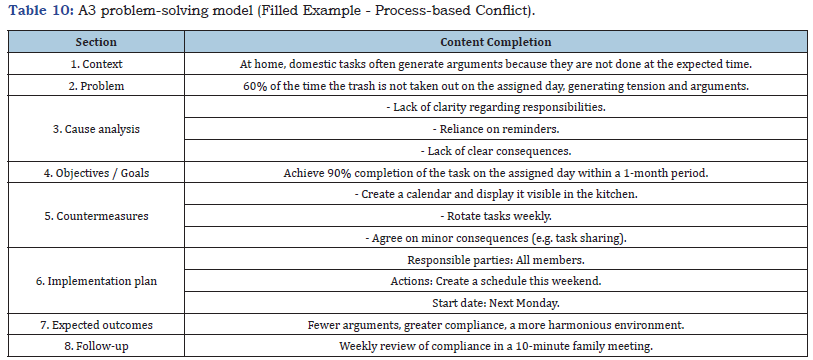
Note: Source: Author’s creation with AI assistance.
I hope the examples and recommendations provided will be of great help in transforming hysteria into a beautiful story to tell, a story of overcoming adversity. Don’t let hysteria limit you, control your actions, or disturb your peace of mind. On the contrary, learn from the experience of hysteria to live life to the fullest.
References
- Alexander E (2025) Hysteria: A historical mirror in the misogyny of medicine? The British Psychological Society.
- Fried A (2024) “The horror of it made me mad”: Hysterical narration in Richard Marsch’s The Beetle (1897). Humanities 13(4): 92.
- Dean RL, Orchard F, Pile V, Lester KJ (2025) “When I picture myself, I just see black and white and dull”: A photo-elicitation study exploring mental images of the self in young people with depression. BMC Psychiatry 25(642): 1-13.
- Colombo D (2020) How to manage organizational conflict in your company. Writings on Psychology.
- Guenter H, Emmerik HV, Schrers B, Kuypers T, Iterson AV, et al. (2016) When task conflict becomes personal. Small Group Research 47(5): 569-604.
- Benítez M, Medina FJ, Munduate L (2011) The study of conflict in work teams: An overview of scientific contributions made in Spain. Psychologist's Papers 32(1): 69-81.
- El Conflicto en las Organizaciones: Un Vistazo Detallado (2025) El Conflicto Organizacional: Características, Causas, Consecuencias y Fases Clave.
- Redacción APD (2021) Las 8 causas más frecuentes de los conflictos laborales.
- Rodriguez-Howell D (2020) Commitment: The true step towards leadership. Spanish Academic Publishing House.
- Cao Y, Liu Y, Hou Y, Ji L (2024) Essentializing humor and implications for pursuing happiness. Journal of Happiness Studies 25(11): 1-16.
- Patterson K, Grenny J, Switzler A (2012) Crucial conversations: Tools for talking when stakes are high. McGraw-Hill, USA.
- Gigliotti RA, Alvarez-Robinson S (2025) The role of leadership communication in building crisis readiness and resilient leadership in times of disruption: An exploratory study. Behavioral Sciences 15(9): 1260.
- Rodriguez Howell D (2023) Leadership, vision and commitment in organizational diversity - healthcare settings. Impulse 4: 12-18.
- Ayoub R (2017) SMART objectives: A strategic approach to achieving business success. Zenodo.
- Martin-Delgado J, Martínez-García A, Aranaz JM, Valencia-Martín J, Mira JJ (2020) How much of root cause analysis translates into improved patient safety: A systematic review. Medical Principles and Practice 29(6):524-531.
- Willis R, Jones T, Hoiles J, Hibbert PD, Schultz TJ (2023) What are the experiences of team members involved in root cause analysis? A qualitative study. BMC Health Services Research 23(1): 1152.
- Hernández J (2025) Qué es Lean Six Sigma? AGILE EXPERIENCE.
- Monday LM (2022) Define, measure, analyze, improve, control (DMAIC) methodology as a roadmap in quality improvement. Global Journal on Quality and Safety in Healthcare 5(2): 44-46.
- Laoyan S (2025) Six Sigma: Everything you need to know about this process improvement methodology. Asana.
- Sanz Forriol Á (2025) Diagram SIPOC: How to map processes clearly and strategically. OBS Business School.
- Sharma S (2025) SIPOC in Six Sigma: Diagram, tools, templates. upGrad KnowledgeHut.
- ADMIN (2025) Método A3: Guía Completa para Resolver Problemas con Eficacia. LEAN COMPONENTES.
- Lim JE (2025) Public shaming as moral self-defense. Social Theory and Practice 51(3): 437-460.
© 2026 Daniel Rodríguez-Howell. This is an open access article distributed under the terms of the Creative Commons Attribution License , which permits unrestricted use, distribution, and build upon your work non-commercially.
Editor In Chief







.jpg)































Signup for Newsletter

Quick Links
 Editorial Board Registrations
 Submit your Article
 Best Paper of the Volume
 Reprints
 Refer a Friend
 Advertise With Us
Our Recent Edition

.jpg)



Top Editors




.jpg)

















.bmp)
.jpg)
.png)
.jpg)













.jpg)






.png)

.png)




.png)




Financial Support

Sponsors

Latest e-Books

Latest Video

 a Creative Commons Attribution 4.0 International License. Based on a work at www.crimsonpublishers.com.
Best viewed in
a Creative Commons Attribution 4.0 International License. Based on a work at www.crimsonpublishers.com.
Best viewed in 
 | Above IE 9.0 version