

- About Us
- Information
-

The Author ensures that the research has been conducted responsibly and ethically with adherence to all relevant regulations. read more..
- For Authors
- For Reviewer
- Manuscript Guidelines
- Membership
- Publication Ethics
-
- Journals
- Reprints
- e-Books
- Videos
- Policies
- Contact Us
 COVID-19
- Submissions



Full Text
Annals of Chemical Science Research
Correlation Between the Electrolytic and Biological Properties of Hydroxamic Acids and their Iron(II/ III), Nickel(II), Copper(II) and Zinc(II) Complexesy
Ibrahima Sory Sow1,2 and Dong Yang3,4*
1 Department of Fundamental Sciences, Institut Supérieur des Sciences de l’Education de Guinée (ISSEG), Guinea
2 Microbiology, Bioorganic and Macromolecular Chemistry Unit, Faculty of Pharmacy, Université libre de Bruxelles (ULB), Belgium
3 Clinical Laboratory, Shanxi Provincial People’s Hospital Affiliated of Shanxi Medical University, China
4 The Fifth Clinical Medical College of Shanxi Medical University, China
*Corresponding author:Dong Yang, Clinical Laboratory, Shanxi Provincial People’s Hospital Affiliated of Shanxi Medical University, Taiyuan 030012, China and The Fifth Clinical Medical College of Shanxi Medical University, Taiyuan 030012, China
Submission: September 18, 2026;Published: October 13, 2026
Volume5 Issue4October 13, 2026
Abstract
Hydroxamic acid (HA) and their iron(II/III) (HAFeII, HAFeIIICl and HAFeIII), nickel(II) (HANiII), copper(II) (HACuII) and zinc(II) (HAZnII) complexes were synthesized and characterized by a set of physicochemical techniques: infrared (IR), ultraviolet-visible (UV-Vis), 1 H nuclear magnetic resonance (NMR) spectroscopy, mass spectrometry, single-crystal X-ray diffraction, cyclic voltammetry, magnetic susceptibility measurements, elemental analysis and molar conductivity (ΛM). In this work, we explored potential correlation between electrolytic behaviour and antimicrobial properties of parent HA and their corresponding metal complexes. ΛM data indicate HA2, HA6, HA8 and HA12 behave as non-electrolytes under the tested conditions. The antifungal activity of HA12 cannot explained by its non-electrolytic character in either methanol or aqueous media. C12 -chain metal complexes HA12NiII, HA12CuII and HA12ZnII exert inhibitory activity against Candida albicans and exhibit high ΛM consistent with ionic behavior in aqueous media, where these same complexes show no measurable activity against Mycobacterium smegmatis despite their high ΛM. For the parent HA, a moderate coefficient of determination was obtained for the raw ΛM-versus-MIC regression. This value must be interpreted cautiously because several MIC values were recorded as > 500 mM rather than exact numerical values. For the metal complexes, a strong correlation between electrolytic properties and biological activity was observed. Our observations suggest that ionic species in solution may contribute to the biological performance of HA-metal complexes, although this cannot be established as a definitive causal relationship from the present dataset alone.
Keywords:Hydroxamic acid; Metal complexes; Electrical and molar conductivities; Antifungal and antimycobacterial activities
Introduction
Hydroxamic acid (HA), with the general formula: RCONHOH, are a particularly interesting class of bidentate organic O,O-donor ligands and have many different applications, mainly in drug design and analytical chemistry [1]. HA are electronically flexible compounds for organic and inorganic analyses, due to the more delicate structures compared to carboxylic acid. These acids are easy to deprotonate to produce hydroxamate ions [2]. The derivatives of HA, especially the metal complexes, exhibit a wide variety of roles in biology and medicine. Due to the antimicrobial properties, the chemistry and biochemistry characteristics of HA and their derivatives comprise considerable attention.
The syntheses, physicochemical characterization of benzohydroxamic acid (BHA) and methyl-benzo hydroxamic acid (CH3-BHA) and their metal complexes VO(IV), Cr(III) and Ni(II) have been reported [2]. The molar conductivity (ΛM) values of the complexes are in the range of 0 - 6.82 Ω-1 cm2 mol-1, suggesting the non-electrolytic nature of the complexes in solutions [2]. It indicates that the non-existence of free ions acts as electrolytes in the solution [3]. All complexes were non-electrolyte. In concordance with the basic of chelation theory, metal complexes display higher toxicity on human colorectal cancer (HCT116) than their parent ligands, BHA and CH3-BHA, where the [Ni(CH3-BHA)2] shows the highest cytotoxicity with a IC50 of 40 μM [2].
The chemical and biological properties investigation of oxidovanadium(IV) complexes of acetylsalicyl-hydroxamic acid (N-acetyloxy-2-hydroxybenzamide) were considered to be the potential antimicrobials. They are determined by the Fourier-transform infrared spectroscopy (IR), ultraviolet–visible spectroscopy (UV-Vis), electron spin resonance (ESR) and mass spectrometry along with elemental analyses, ΛM and magnetic moment measurements. The in vitro antimicrobial assays for pathogenic Gram-positive bacteria, Gram-negative bacteria and fungi showed that the appreciable antimicrobial properties, compared with the standard drugs tetracycline and fluconazole [4].
It is known that the Co(II), Ni(II), Cu(II), Zn(II) acetate salts reacted with ortho-amino benzo HA (o-NH2 -BHA) in ethanol to generate the binary metal complex: tetra coordinate complexes. Their chemical characterizations are further evaluated by IR, UVVIS, ESR, microanalysis, ɅM, magnetic susceptibility, mass spectra and thermogravimetric analysis. The in vitro experiment was further performed to evaluate the potential activity of these tetra coordinate complexes on cancer cell lines: A549 (lung cancer), SKNSH (Human neuroblastoma cancer) and HeLa (cervical cancer) using MTT assay. These compounds showed activity on cancer cell lines at micromolar concentration. It was reported that the ligand ortho-amino benzo HA and their metal complexes also display the antimicrobial activity and anticancer activity [5], where the ɅM of the binary metal complexes in DMSO falls in the range 0.0-4.0 Ω-1 cm2 mol-1, indicating that these complexes have non-electrolytic nature [5].
Other aliphatic HA with carbon chains (C2 to C17) and their metal complexes with iron(II/III), nickel(II), copper(II) and zinc(II), as well as their antibacterial, antimycobacterial and antifungal properties were also described [6]. It was showed that they are both electrolytic and non-electrolytic complexes. In the work of Hassan et al. [2], Priya et al. [4] and Anitha [4], the correlating electrolytic and biological properties of VO(IV)-BHA, Cr(III)-BHA, Ni(II)-BHA, VO(IV)-CH3-BHA, Cr(III)-CH3-BHA and Ni(II)- CH3-BHA [2] and VO(IV) complexes of N-acetyloxy-2-hydroxybenzamide [4]; Co(II), Ni(II), Cu(II), Zn(II) complexed with o-NH2-BHA [5], were not carried out, probably due to the fact that only the non-electrolytic behaviour was observed in their studies.
In view of the contrasting results in previous studies, we also study the electrolytic studies of HA and its complexes. It was demonstrated that the HA12 and the complexes HA12NiII, HA12CuII and HA12ZnII against Candida albicans, the complexes HA12FeII and HA12FeIII against Mycobacterium smegmatis displayed the selective biological properties [6]. Furthermore, these compounds also showed the electrolytic or non-electrolytic activity.
In the present study, we performed the ɅM and minimum inhibitory concentrations (MIC) determinations to verify the correlation between electrolytic and biological properties of HA and their complexes.
Materials and Methods
The synthetic method of HA and their iron(II/III), nickel(II), copper(II) and zinc(II) complexes and the physicochemical characterization were described in previous work [6]. The electrolytic properties of HA and its complexes were determined on a conductivity meter TetraCon® 345 (WTW, Germany). The solvents utilized are methanol (Sigma Aldrich, USA), MilliQ water. The aqueous potassium chloride solution was 0.01 M as a standard electrolyte.
Firstly, the stock solutions were prepared in MeOH with different concentrations (C0). After taking 1mL of each initial solution, a 20-fold dilution was carried out using the same solvent to obtain a final volume of 20 mL (solutions at concentrations C1). The electrical conductivity of the compounds at concentration C1 was measured (ΛE 1) on the conductivity meter. The ΛM of the compounds in methanol solution (ΛM1) was calculated using the Equation 1. We then took 1mL of solution (C1) and diluted it with MilliQ H2 O to obtain 20 mL of solution at the final concentration (C2) containing 5% (v/v) MeOH. After measuring the electrical conductivity of the compounds in aqueous solution containing 5% (v/v) MeOH (ΛE2), we further determined the ΛM of the compounds (ΛM2) under these conditions (Equation 2). A KCl solution (0.01 M) was used as a reference.

C1: final concentration in methanol solution (solution C0 diluted
20-fold),
C2: final concentration in aqueous solution containing 5% (v/v)
MeOH (solution C1 diluted 20-fold),
ΛE 1 et ΛE 2: electrical conductivities measured at 22 °C of the compounds in methanolic solution and aqueous solution containing 5% (v/v) MeOH respectively (Ω-1 cm-1),
ΛM 1 and ΛM 2: molar conductivities of the compounds in methanol solution and aqueous solution containing 5 percent MeOH, respectively (Ω-1cm2mol-1). The values for concentrations Co-C2 are recorded in the results section.
The biological properties of HA and complexes was investigated from the previous study [6], including determining the MIC against bacterial, mycobacterial and fungal strains.
Results
Electrolytic properties of HA and their complexes
Firstly, the ΛM of HA, their complexes and metal chlorides were measured to confirm the electrolytic nature. Initially, we investigated the electrolytic properties of these compounds in MeOH solution. The ΛM 1 values of HA and the complexes HAFeII/HAFeIII were 0.63- 5.63 Ω-1cm2mol-1, lower than the values of FeCl2 and FeCl3 (approximately 90 Ω-1 cm2 mol-1). The ΛM 1 values of the complexes HANiII (28.17-37.11 Ω-1cm2mol-1), HACuII (21.79-24.32 Ω-1cm2mol-1) and HAZnII (43.93-48.38 Ω-1cm2mol-1) are relatively higher than the values for HAFeII/HAFeIII complexes. In addition, HA display the lower ΛM 1 than their corresponding metal chlorides (NiCl2, CuCl2 or ZnCl2), which have values of 82.42 and 52 Ω-1cm2mol-1, respectively (Table 1).
Table 1:The electrical (Ω⁻¹cm⁻¹) and molar (Ω⁻¹cm²mol⁻¹) conductivities of HA, complexes HAFeII, HAFeIII, HANiII, HACuII and HAZnII, and the metal chlorides.
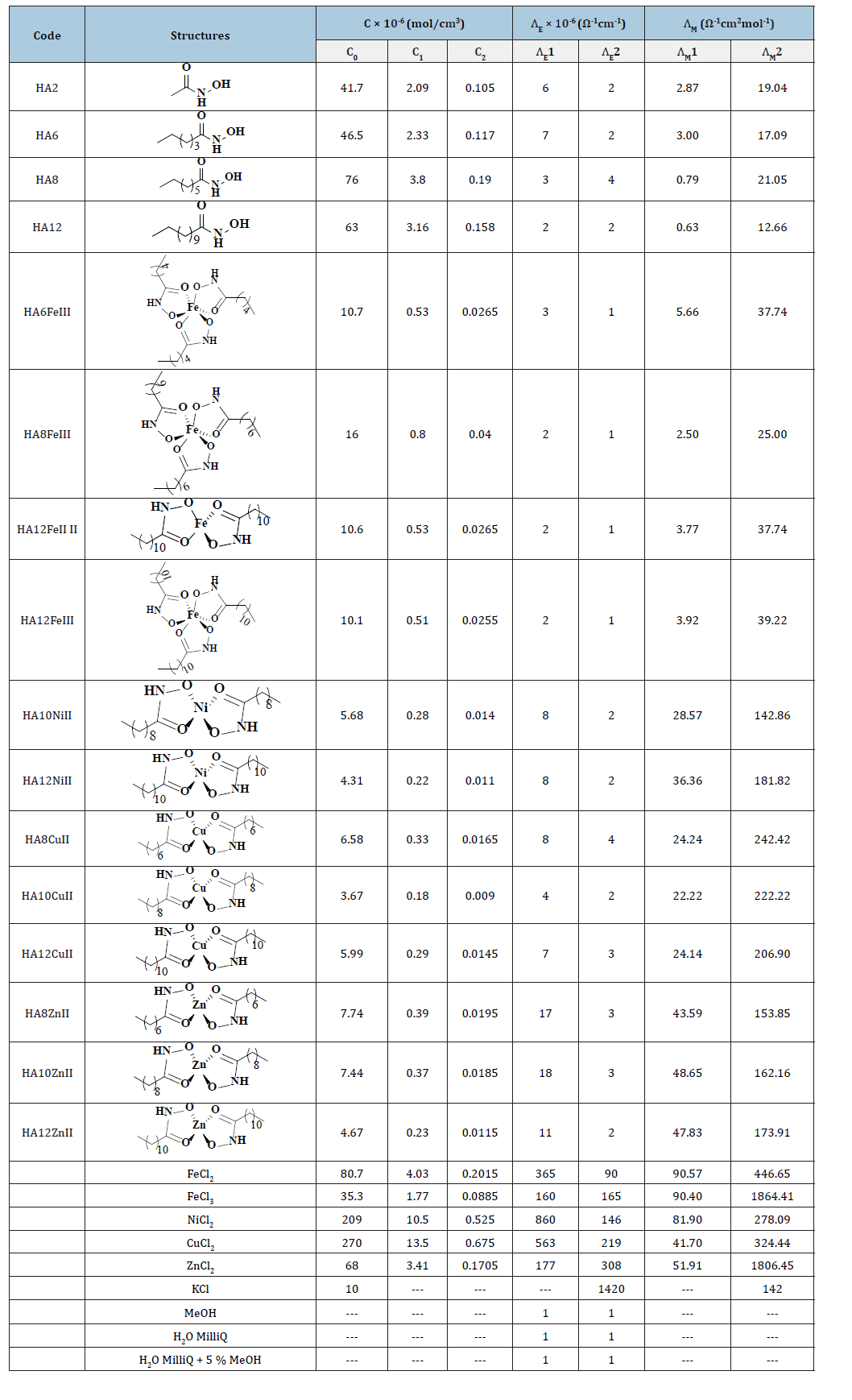
C0: concentration of the stock solutions in MeOH;
C1: C0 diluted 20-fold with MeOH;
C2: C1 diluted 20-fold with MilliQ water containing 5% MeOH;
ΛE 1 and ΛE2: measured electrical conductivities of the compounds in solution in MeOH and in MilliQ water containing
5% MeOH, respectively;
ΛM 1 and ΛM2: calculated molar conductivities of the compounds in solution in MeOH and in MilliQ H₂O containing 5%
MeOH, respectively (Equations 1 and 2).
Aqueous KCl (control);
blank: MeOH, MilliQ H₂O and 95% MilliQ H₂O + 5% MeOH (ΛE = 1 × 10⁻⁶Ω⁻¹cm⁻¹);
In the literature, ΛE for MeOH = 0.15 × 10⁻⁶Ω⁻¹cm⁻¹ [7];
---: not determined.
Secondly, the electrolytic properties were investigated in an aqueous solution containing 5% (v/v) MeOH. The ΛM values of HA and the complexes are higher than those in MeOH solution. Based on the ΛM 2 values, the HA and complexes HAFeII/HAFeIII could be in molecular form in aqueous solution, where the ΛM 2 values are more than 100 Ω⁻¹cm²mol⁻¹ for the complexes HANiII, HACuII and HAZnII. These complexes in aqueous solution could be the ionic forms with higher ΛM2 values compared with the metal chlorides (KCl solution at 10-5 mol/cm3) (Table 1).
Biological versus electrolytic properties of HA and their complexes
The antimicrobial effects of HA and their complexes against bacteria (methicillin-susceptible Staphylococcus aureus, methicillinresistant Staphylococcus aureus, Bacillus subtilis, Corynebacterium glutamicum, Escherichia coli, Klebsiella pneumoniae, Pseudomonas aeruginosa); mycobacteria (Mycobacterium bovis BCG, Mycobacterium marinum, Mycobacterium smegmatis, Mycobacterium tuberculosis) and fungi (Candida albicans) were determined in our previous publications [6]. Here, we just present the results where the HA and their complexes displayed the activities against C. albicans and M. smegmatis.
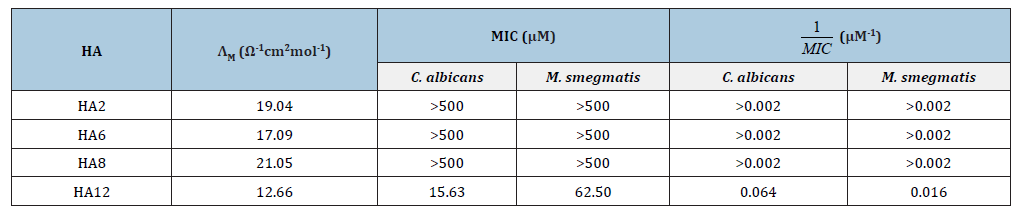
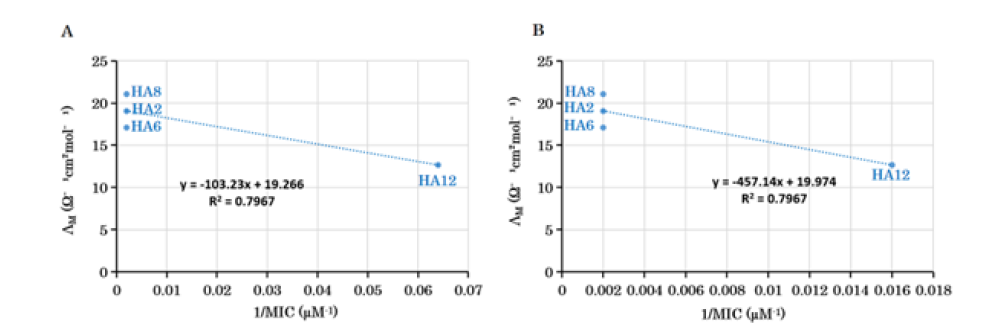
The HA with carbon chains from C2 to C8 (HA2, HA6 and HA8) do not display the significant inhibitory effects against C. albicans and M. smegmatis. But the C12 homologue (HA12) exhibited significant antifungal and antimycobacterial activity (MIC = 15.63 μM and 62.5 μM, respectively). The low ΛM of four HA indicate the nonelectrolytic nature in the present conditions (Table 2), suggesting that the biological activity is not related to the electrolytic property (non-ionic form in MeOH or aqueous solution).
Table 2:Minimal inhibitory concentrations (MIC) versus ΛM of HA.
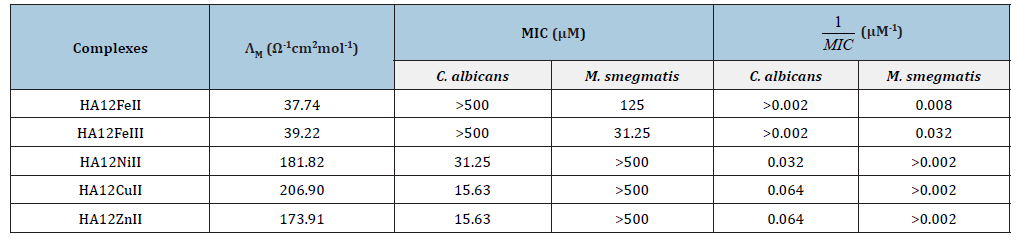
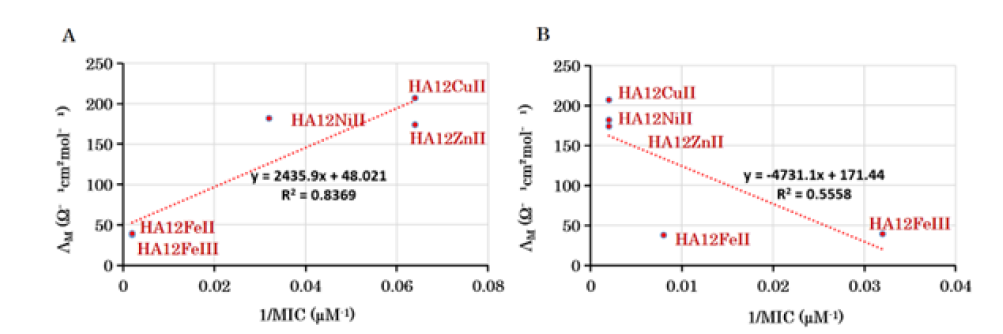
The iron complexes (HA12FeII and HA12FeIII) with an average ΛM of 38.48 Ω⁻¹cm²mol⁻¹ display the antimycobacterial activity (MIC = 125 and 31.25 μM, respectively) (Table 3). The significant inhibitory effect of the nickel(II), copper(II) and zinc(II) complexes with a C12 carbon chain (HA12NiII, HA12CuII and HA12ZnII) against C. albicans may be linked to the presence of metal ions in solution. However, no antimycobacterial effect of these complexes was observed against M. smegmatis, although the high ΛM values indicate the electrolytic nature under the experimental conditions (Table 3).
Table 3:MIC versus ΛM of iron(II/III), nickel(II), copper(II) and zinc(II) complexes.
Discussion
With regard to the electrolytic nature, it is reported from the literature that the ΛM values for chemical compounds ranging from 11 to 19 Ω⁻¹cm²mol⁻¹ indicate the non-ionic form in solution. By contrast, the chromium(II) complex with a triazole ligand display the ΛM value with 98 Ω⁻¹cm²mol⁻¹, indicating the electrolytic character with ionic form in solution [8]. Compared with ΛM values of FeCl2, FeCl3, NiCl2 and CuCl2, the complexes HAFeII/HAFeIII, HANiII and HACuII are non-ionic nature in MeOH solution. Under the same conditions, the ΛM value of HAZnII complex is close to that of ZnCl2, suggesting an electrolytic nature (Table 1).
The relatively low values of ΛM of iron complexes (Table 1) can be attributed to the formation of another new complex (metallic ion + solvent). It is well-known that certain metallic ions (Fe2+, Ag+, Cu2+, Ni2+) tend to form new complexes with special solvents [9]. Metallic ions tend to form complexes with water, resulting the stable crystalline hydrates [9]. For the HA, the intermolecular hydrogen bonds generated with the solvent (H2O, MeOH), may prevent the formation of ionic species.
The ΛM values of the complexes HANiII, HACuII and HAZnII are more than 100 Ω⁻¹cm²mol⁻¹, probably due to the ionic forms in aqueous solution under the experimental condition. The Ni(II), Cu(II) and Zn(II) complexes with Schiff bases (sulfanilamides) exhibited the ΛM values in dimethylformamide (DMF) ranging from 135 to 142 Ω⁻¹cm²mol⁻¹, confirming the ionic forms in aqueous solution [10]. Our results show that the electrolytic behaviours of HA and their complexes were associated with the electrolytic state in the solvent. Due to the hydrolysis or solubility (with the exception of metal chlorides, which are inorganic compounds), using water as a solvent for conductivity measurements is often limited. Therefore, the organic solvents are increasingly used to analysis the conductivity on organic molecules. However, with the wide range of solvents available, it is difficult to judge the substance to be electrolytic or non-electrolytic forms [7].
Notably, the regression analysis between ΛM and raw MIC values for parent HA yielded R2 = 0.7967 for both antifungal and antimycobacterial datasets (Figure 1A,B). Caution must be exercised in interpreting this R2 value, because multiple MIC observations were recorded as >500 mM (upper-limit censored data) and were assigned the value of 500 mM for plotting and regression fitting; this artificial assignment may distort the regression outcome. An R2 of 0.7967 indicates a moderate statistical association in this fitted model, rather than a complete absence of correlation. To better evaluate the relationship between electrolytic property and antimicrobial potency, potency can alternatively be represented as reciprocal MIC (1/MIC), which weights low MIC (high-activity) points more heavily. Re-analysis using 1/MIC is recommended to further verify this trend. For the parent HA investigated here, ΛM remains low (13-19 Ω⁻¹cm²mol⁻¹), consistent with predominantly non-ionic character in solution.
Figure 1:Correlation between ΛM values and the antifungal effects against C. albicans (A) and the antimycobacterial effects against M. smegmatis (B) of HA. Note: MIC values reported as >500 mM were assigned a numerical value of 500 mM for plotting and regression; this censored data treatment may bias the fitted R2.
With regard to the active complexes, HA12NiII, HA12CuII and HA12ZnII against C. albicans display high ΛM values ranging from 174 to 206 Ω⁻¹cm²mol⁻¹, indicating the ionic form in the reactions. A correlation between the electrolytic and biological properties of complexes HA12NiII, HA12CuII and HA12ZnII is existed (R2=0.8369). These results demonstrated that the ionic forms in solution are useful for the biological activity of HA complexes (Figure 2A). However, the MIC of the complexes HA12FeII and HA- 12FeIII measured against M. smegmatis indicate that non-electrolytic complexes exhibit significant activity, whereas their electrolytic counterparts are not active (Figure 2B). Whilst a correlation is observed between the electrolytic and biological properties of the complexes (R2=0.5558), the microbial strains exhibit specific characteristics that must be taken into account when studying the parameters responsible for biological activity.
Figure 2:Correlation between ΛM values and the antifungal effects against C. albicans (A) and the antimycobacterial effects against M. smegmatis (B) of iron(II/III), nickel(II), copper(II) and zinc(II) complexes.
Conclusion
The electrolytic behaviours of the complexes HA12NiII, HA12CuII and HA12ZnII, which exhibit antifungal activity, is a factor that could explain their enhanced activity. The partial dissociation of these complexes would account for the redox role of the metal ions against microorganisms, for example in the production of ROS. It should be noted that for parent HA tested against C. albicans and M. smegmatis, the regression using raw MIC data yields a moderate R2=0.7967 (Figure 1). However, several MIC measurements are only known to be above 500 mM (censored upper-limit data). Therefore, we cannot reliably conclude a true biological correlation between ΛM and HA activity from this fit alone. In contrast to HA, a correlation exists between the electrolytic and biological properties of their complexes (Figure 2). This result may explain the biological activity of HA complexes, which is partly due to the ions present in solution. As for the compound HA12, given its nonelectrolytic nature observed in aqueous and methanolic solutions, its significant antimicrobial effect cannot logically be attributed to ions. The intermolecular H-bonds between the HA groups and polar solvents (H2 O, MeOH) could be the reason for the absence of ionic forms in solution.
References
- Muri E, Nieto M, Williamson J (2002) Hydroxamic acids as pharmacological agents. Curr Med Chem 9(17): 1631-1653.
- Hassan LR, Ramasamy K, Tajuddin AM (2019) Synthesis and characterization of benzohydroxamic acid and methyl-benzo-hydroxamic acid metal complexes and their cytotoxicty study. Malaysian J Anal Sci 23(2): 263-273.
- Temel H (2004) Synthesis and spectroscopic studies of new Cu(II), Ni(II), VO(IV) and Zn(II) complexes with N,N′-bis(2-hydroxynaphthalin-1-carbaldehydene)-1,2-bis-(o-aminophenoxy)ethane. J Coord Chem 57(9): 723-729.
- Priya B, Kumar A, Sharma N (2020) Synthesis, characterization, and biological properties of oxidovanadium (IV) complexes of acetylsalicylhydroxamic acid (N-acetyloxy-2-hydroxybenzamide) as potential antimicrobials. J Chem Res 44(7-8): 460-470.
- Sree DAR (2025) Biological evaluation and anticancer activity of novel binary transition metal complexes derived from ortho amino benzo hydroxamic acid. J Pharm Pharmacol Res 9(3): 114–121.
- Sow IS, Gelbcke M, Meyer F, Vandeput M, Marloye M, et al. (2023) Synthesis and biological activity of iron(II), iron(III), nickel(II), copper(II) and zinc(II) complexes of aliphatic hydroxamic acids. J Coord Chem 76(1): 76-105.
- Geary WJ (1971) The use of conductivity measurements in organic solvents for the characterisation of coordination compounds. Coord Chem Rev 7(1): 81-122.
- Sumrra SH, Zafar W, Javed H, Zafar M, Hussain MZ, et al. (2021) Facile synthesis, spectroscopic evaluation and antimicrobial screening of metal endowed triazole compounds, BioMetals 34(6): 1329-1351.
- Kraus CA (1922) The properties of electrically conducting systems, including electrolytes and metals. Chem Cat Comp, New York, USA.
- Rani S, Sumrra SH, Chohan ZH (2017) Metal based sulfanilamides: A note on their synthesis, spectral characterization, and antimicrobial activity. Russ J Gen Chem 87: 1834-1842.
© 2026 Dong Yang. This is an open access article distributed under the terms of the Creative Commons Attribution License , which permits unrestricted use, distribution, and build upon your work non-commercially.
Editor In Chief







.jpg)





























Signup for Newsletter

Quick Links
 Editorial Board Registrations
 Submit your Article
 Best Paper of the Volume
 Reprints
 Refer a Friend
 Advertise With Us
Our Recent Edition


Top Editors




.jpg)

















.bmp)
.jpg)
.png)
.jpg)













.jpg)






.png)

.png)




.png)




Financial Support

Sponsors

Latest e-Books

Latest Video

 a Creative Commons Attribution 4.0 International License. Based on a work at www.crimsonpublishers.com.
Best viewed in

 | Above IE 9.0 version