

- About Us
- Information
-

The Author ensures that the research has been conducted responsibly and ethically with adherence to all relevant regulations. read more..
- For Authors
- For Reviewer
- Manuscript Guidelines
- Membership
- Publication Ethics
-
- Journals
- Reprints
- e-Books
- Videos
- Policies
- Contact Us
 COVID-19
- Submissions



Full Text
Annals of Chemical Science Research
Clinical Characteristics and Inflammatory Biomarker Profiles of Patients with Carbapenem-Resistant Pseudomonas Aeruginosa Infection: A Five-Year Retrospective Study
Ibrahima Sory Sow1, Junshan Li2, Hairui Su2 and Dong Yang3,4*
1 Department of Fundamental Sciences, Higher Institute of Educational Sciences of Guinea (ISSEG), Guinea
2 Fenyang College of Shanxi Medical University, China
3 Clinical Laboratory, Shanxi Provincial People’s Hospital Affiliated of Shanxi Medical University, China
4 The Fifth Clinical Medical College of Shanxi Medical University, China
*Corresponding author:Dong Yang, Clinical Laboratory, Shanxi Provincial People’s Hospital Affiliated of Shanxi Medical University, Taiyuan 030012, China and The Fifth Clinical Medical College of Shanxi Medical University, Taiyuan 030012, China
Submission: September 03, 2026;Published: September 24, 2026

Volume5 Issue4September 24, 2026
Abstract
Carbapenem-resistant Pseudomonas aeruginosa (CRPA) has emerged as a major nosocomial pathogen associated with increased mortality, morbidity and limited treatment options. Identification of readily available laboratory biomarkers may facilitate early clinical assessment and disease monitoring. This retrospective study included 507 hospitalized patients with confirmed CRPA infection admitted to a tertiary hospital in Shanxi province, China, between January 2019 and December 2023. Demographic characteristics, specimen sources, white blood cell (WBC) count, neutrophil count, lymphocyte count, monocyte count, and C-reactive protein (CRP) levels were collected and analyzed. Differences between male and female patients were evaluated, and receiver operating characteristic (ROC) curve analysis was performed to assess the discriminatory performance of selected inflammatory markers. Among the 507 CRPA-infected patients, respiratory specimens represented the predominant source of isolates. Elderly patients (>66 years) accounted for the largest proportion of cases. Female patients exhibited significantly lower WBC counts and CRP levels than male patients (P<0.05), whereas neutrophil, lymphocyte, and monocyte counts showed no significant sex-related differences. ROC analysis demonstrated modest discriminatory performance for WBC count (AUC = 0.629) and neutrophil count (AUC = 0.644), while their combined assessment did not improve diagnostic performance. Routine inflammatory markers, particularly WBC count and CRP, may provide useful information regarding the inflammatory status of patients with CRPA infection. However, their diagnostic utility remains limited and requires further validation in larger multicenter studies incorporating appropriate control populations.
Keywords:Carbapenem-resistant; Pseudomonas aeruginosa; White blood cell count; Neutrophil count; C-reactive protein.
Introduction
Pseudomonas aeruginosa (PA) is an opportunistic Gram-negative pathogen widely distributed in natural and hospital environments [1,2]. Owing to its intrinsic resistance mechanisms and remarkable adaptive capacity, PA is one of the leading causes of healthcareassociated infections, particularly among critically ill and immunocompromised patients [3]. Infections caused by PA are frequently associated with prolonged hospitalization, increased healthcare expenditure and unfavorable clinical outcomes [4].
Carbapenems have historically served as one of the most effective therapeutic options against multidrug-resistant PA. However, the increasing emergence and dissemination of carbapenem-resistant P. aeruginosa (CRPA) have significantly reduced treatment efficacy and created substantial challenges for clinical management [5]. Consequently, CRPA has been recognized by the World Health Organization as a priority pathogen requiring urgent development of new diagnostic and therapeutic strategies.
Routine laboratory biomarkers, including white blood cell (WBC) count and C-reactive protein (CRP), are commonly used indicators of infection and inflammation [6,7]. Monitoring WBCrelated parameters allows preliminary differentiation between infectious and non-infectious conditions. C-reactive protein (CRP) is an important acute-phase protein for the early diagnosis of inflammatory or infectious diseases and is less affected by external interference. These markers are inexpensive, readily available and routinely measured in clinical practice. Previous studies have demonstrated their value in assessing disease severity and monitoring treatment response in bacterial infections [8]. However, limited evidence exists regarding their clinical significance specifically in patients with CRPA infection.
Therefore, the present study retrospectively analyzed the demographic characteristics and inflammatory biomarker profiles of patients with CRPA infection over a five-year period. We further evaluated the potential clinical utility of routine hematological parameters and CRP in reflecting the inflammatory status of CRPAinfected patients.
Materials and Methods
Study population
A total of 507 hospitalized patients with CRPA infection were enrolled from a tertiary hospital in Taiyuan, China, between January 2019 and December 2023, including 351 males and 156 females, aged 10-93 years. Patients were divided into four age groups: adolescent (<18 years), young adult (19–45 years), middle-aged (46–65 years), and elderly (over 66 years). Inclusion criteria: (1) Age 17–93 years; (2) clinically diagnosed CRPA infection. Exclusion criteria: (1) Age <17 years; (2) patients with non-carbapenemresistant PA; (3) incomplete clinical records.
Methods
Patient data including sex, age, admission ward, clinical outcome (improved or deceased), specimen source, and results of routine blood tests and CRP at the initial visit were collected from the hospital medical record system and laboratory information system. All clinical data were obtained before the confirmation of infection, followed by systematic data sorting.
Statistical analysis
Statistical analysis was performed using SPSS 27.0 software. Non-normally distributed quantitative data were described as mean (interquartile range) [M(P25, P75)]. Between-group comparisons were conducted using the Mann-Whitney U test. Categorical data were presented as counts and percentages [n (%)] and analyzed using the chi-square test. Diagnostic value was assessed using receiver operating characteristic (ROC) curve analysis. A two-sided P<0.05 was considered statistically significant.
Results
General profile of CRPA infections
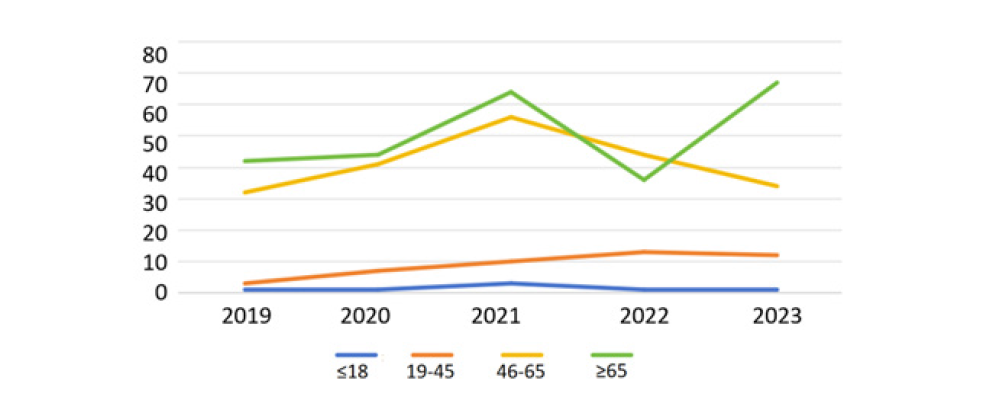
Clinically isolated CRPA strains were mainly derived from respiratory secretions, including sputum and bronchoalveolar lavage fluid (Figure 1). By age group, patients aged ≥66 years accounted for the largest proportion with obvious fluctuations. The number of patients aged 19–45 years increased yearly, while those aged ≤18 years was the smallest and remained stable. The number of patients aged 46–65 years peaked in 2021 and then decreased (Figure 2).
Figure 1:Source of bacterial specimens from CRPA-infected patients
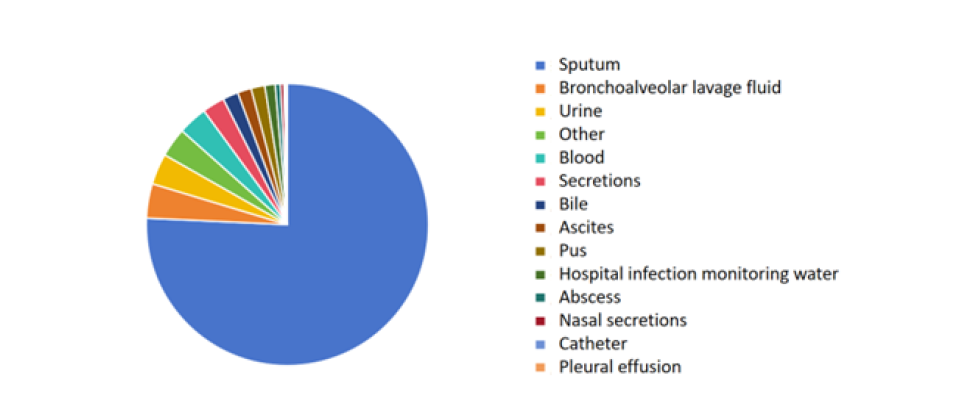
Figure 2:Analysis of population trends by age group, 2019–2023.
Comparison of blood parameters and CRP levels between male and female patients
WBC count and CRP levels were significantly different between male and female patients (P<0.05), with lower values in the female group. There were no significant differences in neutrophil count, lymphocyte count, or monocyte count between the two groups (P>0.05) (Table 1).
Table 1:Comparison of WBC count, neutrophil count, lymphocyte count, monocyte count and CRP levels between male and female patients, the data were expressed with [M(P25, P75), ×109 /L /mg/L].

Distribution Comparison of blood parameters and CRP levels between male and female patients
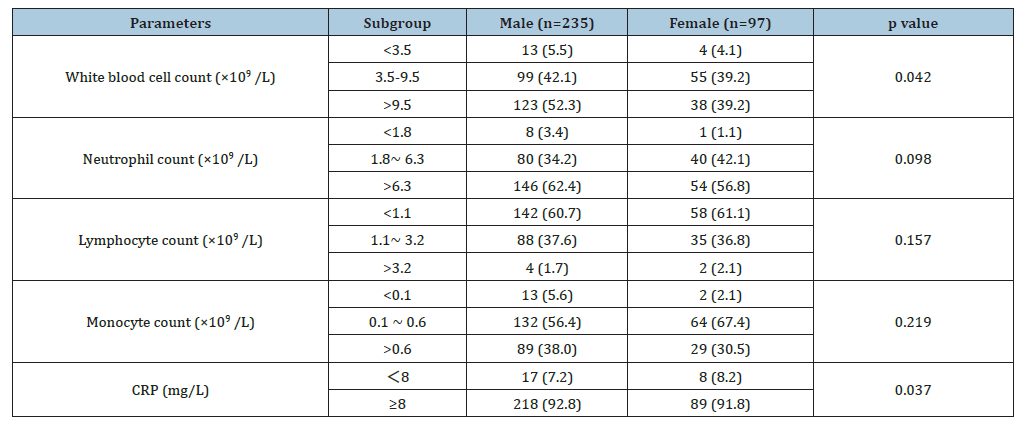
The distribution of WBC count and CRP levels differed significantly between males and females (P<0.05). No significant differences were found in the distribution of neutrophil count, lymphocyte count, or monocyte count (P>0.05) (Table 2).
Table 2:Distribution Comparison of WBC Count, Neutrophil Count, Lymphocyte Count, Neutrophil Percentage and CRP Levels Between Male and Female Patients [n (%)].
Early diagnostic value of combined WBC and neutrophil count for CRPA infection
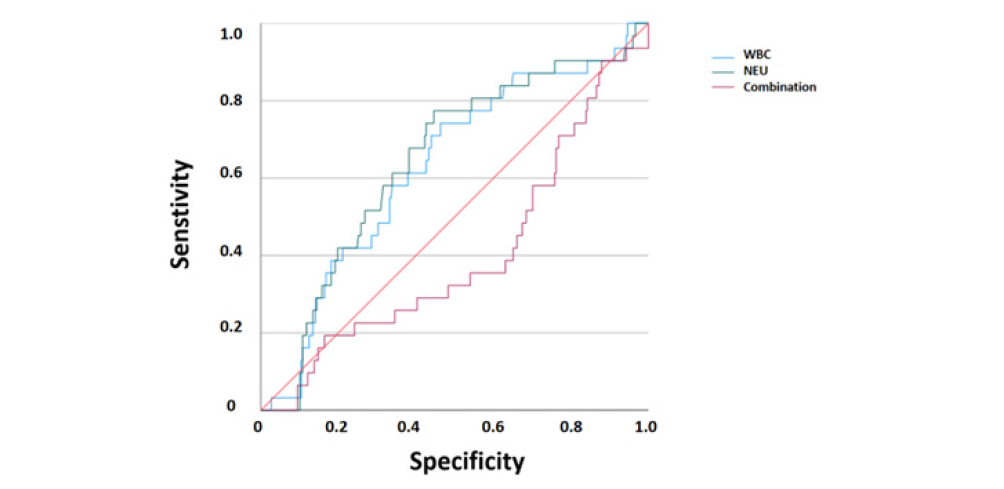
Using white blood cell count and neutrophil count as combined diagnostic indicators to form a composite predictor, and given the multiple options for connecting parameters in combined diagnostics, the aforementioned indicators’ combined diagnosis was achieved by constructing a receiver operating characteristic (ROC) curve. Results indicated that the area under the curve (AUC) for the combined detection of white blood cell count and neutrophil count was smaller than that for single detection (P>0.05) (Table 3 and Figure 3).
Table 3:Diagnostic value of WBC count, neutrophil count, and their combination for early CRPA infection.

Figure 3:ROC curve for the diagnostic value of combined detection of white blood cell count, neutrophil count, and c-reactive protein in the early diagnosis of CRPA infectious diseases.
Discussion
The increasing prevalence of carbapenem-resistant Pseudomonas aeruginosa has become a significant public health concern worldwide. Consistent with previous reports, the present study demonstrated that respiratory tract specimens constituted the primary source of CRPA isolates [9], highlighting the respiratory system as the most common site of infection. Furthermore, elderly patients accounted for the largest proportion of cases, supporting the notion that advanced age is an important risk factor for CRPA infection due to age-related immune dysfunction, multiple comorbidities and frequent healthcare exposure.
A major finding of this study was the observation of significant sex-related differences in inflammatory biomarkers. Female patients exhibited lower WBC counts and CRP levels than male patients. These findings may reflect biological differences in immune regulation and inflammatory responses between sexes. Previous studies have suggested that sex hormones influence both innate and adaptive immunity, potentially contributing to variations in host responses to bacterial infections [10,11]. Nevertheless, because potential confounding factors such as comorbidities and disease severity were not analyzed in the present study, these observations should be interpreted cautiously.
The present study also explored the clinical performance of routine inflammatory markers. Although WBC count and neutrophil count demonstrated statistically significant discriminatory ability, their AUC values remained relatively modest, indicating limited standalone clinical utility. Furthermore, combined assessment of these parameters did not improve overall performance. These findings suggest that routine hematological indicators may reflect inflammatory status rather than serve as highly accurate diagnostic markers for CRPA infection.
CRP remains one of the most widely used inflammatory biomarkers in clinical practice. The significantly elevated CRP levels observed in CRPA-infected patients further support its role as a marker of systemic inflammatory response. However, CRP is not pathogen-specific and may be elevated in numerous infectious and non-infectious conditions. Therefore, CRP should be interpreted in conjunction with microbiological findings and clinical presentation.
Several limitations should be acknowledged. First, this was a single-center retrospective study, which may limit the generalizability of the findings. Second, no non-CRPA control group was included, restricting the ability to evaluate the true diagnostic value of the investigated biomarkers. Third, potential confounding factors such as underlying diseases, infection severity, antibiotic exposure, and clinical outcomes were not incorporated into the analysis.
Future multicenter prospective studies with larger sample sizes and appropriate control populations are warranted. Integration of conventional inflammatory markers with microbiological, molecular and clinical parameters may facilitate the development of more accurate diagnostic and prognostic models for CRPA infection.
Conclusion
This five-year retrospective study demonstrated that respiratory tract specimens represented the predominant source of CRPA isolates and that elderly individuals constituted the most affected patient population. Significant sex-related differences were observed in WBC count and CRP levels, suggesting variations in inflammatory responses among CRPA-infected patients. Although routine inflammatory markers may provide useful information regarding infection-associated inflammation, their discriminatory performance remains limited. Further multicenter studies incorporating appropriate control groups and additional biomarkers are required to establish their diagnostic and prognostic value in CRPA infection.
Author Contributions
Conceptualization: D.Y. and I.S.S.; Methodology: D.Y., J.S.L and H.R.S.; Resources: D.Y.; Investigations: D.Y. and I.S.S.; Formal analysis: D.Y. and I.S.S.; Supervision: D.Y.; Writing—original draft: D.Y., and I.S.S.; Writing—review and editing: D.Y. and I.S.S. All authors have read and agreed to the published version of the manuscript.
Conflict of Interest Statement
The authors declare no conflicts of interest. The authors declare that the research was conducted in the absence of any commercial or financial relationships that could be construed as a potential conflict of interest.
References
- Ping H, Wei Z, Chunmei L, et al. (2025) Analysis of Factors Associated with Hospital-Acquired Infection and Prognosis in Carbapenem-Resistant Pseudomonas aeruginosa. Pharmaceutical Research 44(3): 282-288.
- Xiaoyi L (2023) Detection of Pseudomonas aeruginosa in Hospitals and Analysis of Antimicrobial Resistance from 2019 to 2021. Clinical Medical Research and Practice 8(28): 94-97.
- Juan C, Peña C, Oliver A (2017) Host and pathogen biomarkers for severe Pseudomonas aeruginosa infections. The Journal of Infectious Diseases 215: 44-51.
- Cai B, Echols R, Magee G, Morgan G, Ariyasu M, et al. (2017) Prevalence of Carbapenem-resistant gram-negative infections in the United States predominated by Acinetobacter baumannii and Pseudomonas aeruginosa. Open Forum Infect Dis 4(3): 1-7.
- Shuang L, Jia X, Li C, Zou H, Liu H, et al. (2018) Carbapenem-resistant and cephalosporin-susceptible Pseudomonas aeruginosa: A notable phenotype in patients with bacteremia. Infection and Drug Resistance: 1225-1235.
- Luoyun L (2024) Analysis of the clinical significance of c-reactive protein and complete blood count testing. Chinese Journal of Modern Drug Application 18(17): 89-91.
- Zhang L (2012) Clinical significance of c-reactive protein and complete blood count assays. Contemporary Medicine 18(36): 93-94.
- Yanyuan X (2024) Analysis of the effectiveness of whole blood c-reactive protein combined with complete blood count in diagnosing bacterial infectious diseases. Smart Health 10(25): 105-107.
- Kothari A, Kumar SK, Singh V, Prashant Kumar, Karanvir Kaushal, et al. (2022) Association of multidrug resistance behavior of clinical Pseudomonas aeruginosa to pigment coloration. Eur J Med Res 27(1): 120.
- Niggli C, Vetter P, Hambrecht J, Pape H C, Mica L, et al. (2025) Sex differences in the time trends of sepsis biomarkers following polytrauma. Sci Rep (15): 2398.
- Peng YL, Wang HM, Li C, Zhang JS, Qi LF (2024) Clinical characteristics and risk factors of carbapenem-resistant Pseudomonas aeruginosa infection in children. Zhongguo Dang Dai Er Ke Za Zhi 26(11): 69-75.
© 2026 Dong Yang. This is an open access article distributed under the terms of the Creative Commons Attribution License , which permits unrestricted use, distribution, and build upon your work non-commercially.
Editor In Chief







.jpg)































Signup for Newsletter

Quick Links
 Editorial Board Registrations
 Submit your Article
 Best Paper of the Volume
 Reprints
 Refer a Friend
 Advertise With Us
Our Recent Edition
.jpg)



Top Editors




.jpg)

















.bmp)
.jpg)
.png)
.jpg)













.jpg)






.png)

.png)




.png)




Financial Support

Sponsors

Latest e-Books

Latest Video

 a Creative Commons Attribution 4.0 International License. Based on a work at www.crimsonpublishers.com.
Best viewed in
a Creative Commons Attribution 4.0 International License. Based on a work at www.crimsonpublishers.com.
Best viewed in 
 | Above IE 9.0 version