

- About Us
- Information
-

The Author ensures that the research has been conducted responsibly and ethically with adherence to all relevant regulations. read more..
- For Authors
- For Reviewer
- Manuscript Guidelines
- Membership
- Publication Ethics
-
- Journals
- Reprints
- e-Books
- Videos
- Policies
- Contact Us
 COVID-19
- Submissions



Full Text
Annals of Chemical Science Research
Application of Neural Networks for Modeling Detonation Characteristics of High-Energy Materials
Abrukov VS*, Anufrieva DA, Kuzmin SS and Saperov DA
I.N. Ulyanov Chuvash State University, Russia
*Corresponding author:Abrukov VS, I.N. Ulyanov Chuvash State University, Cheboksary, Russia
Submission: April 29, 2026;Published: May 25, 2026

Volume5 Issue4May 22, 2026
Abstract
Machine learning methods, particularly neural networks, offer the ability to identify complex nonlinear relationships between detonation characteristics, structure, and composition of HEMs. This work employs a novel approach a cascade of neural networks to improve model quality and enable comprehensive analysis of HEM characteristics.
Keywords:Machine learning; Neural networks; High-energy materials; Detonation characteristics
Introduction
Modern challenges in the study of high-energy materials (HEMs) require effective methods for predicting performance characteristics. Traditional approaches based on experimental studies and theoretical calculations are often resource-intensive. Machine learning methods, particularly neural networks (NNs), offer the ability to identify complex nonlinear relationships between detonation characteristics, structure, and composition of HEMs [1-3]. This work employs a novel approach a cascade of neural networks to improve model quality, to obtain very smooth goal function dependences and enable comprehensive analysis of HEM characteristics.
Materials and Methods
The study was conducted on a dataset comprising 32 individual and composite explosives. For each HEM, 7 physicochemical parameters were considered: density, oxygen balance, nitrogen content, total nitrogen and oxygen content, standard enthalpy of formation, melting point, and decomposition temperature point.
A cascade neural network method (sequential approximation) was used to predict four target variables: detonation velocity, detonation pressure, impact sensitivity, and friction sensitivity. The method proceeds as follows:
The first neural network (NN1) is trained directly on experimental data: 7 HEM descriptors are input, and one detonation characteristic is output. The values obtained from NN1 are used as output targets for training the second neural network (NN2). The third cascade level (NN3) is trained on the output data of NN2, resulting in a maximally smooth dependence. Each subsequent network uses the previous network’s output as target values, equivalent to sequential filtering of high-frequency noise. The final model produces a smooth mapping with RMSE below 10-5.
For objective validation, the dataset was divided into training (80%) and test (20%) sets. Training was stopped when the minimum validation error was reached. Five-fold crossvalidation confirmed stability (mean R² for detonation velocity: 0.994±0.003).
Results and Discussion
The constructed models demonstrate high quality (Table 1).
Table 1:1Models quality metrics.
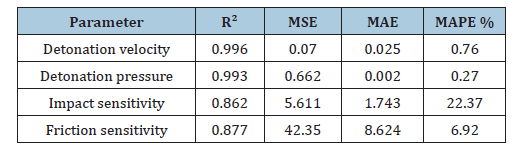
Comparison with alternative methods [4-6] shows typical R² values of ~0.95-0.99, while our cascade approach achieves R² ≈ 0.996 and 0.993 for detonation velocity and pressure, confirming its high quality.
Analysis of physical regularities: The models reveal fundamental explosion physics: monotonic increase of detonation velocity and pressure with density (following classical detonation equations [7,8]) – Figures 1 & 2, dependence of detonation velocity on enthalpy of formation – Figure 3, dependence of detonation velocity on decomposition temperature – Figure 4, dependence of impact sensitivity on nitrogen content and decomposition temperature – Figures 5 & 6.
Figure 1:The result of calculation (a) and the dependence of detonation velocity on density (b).
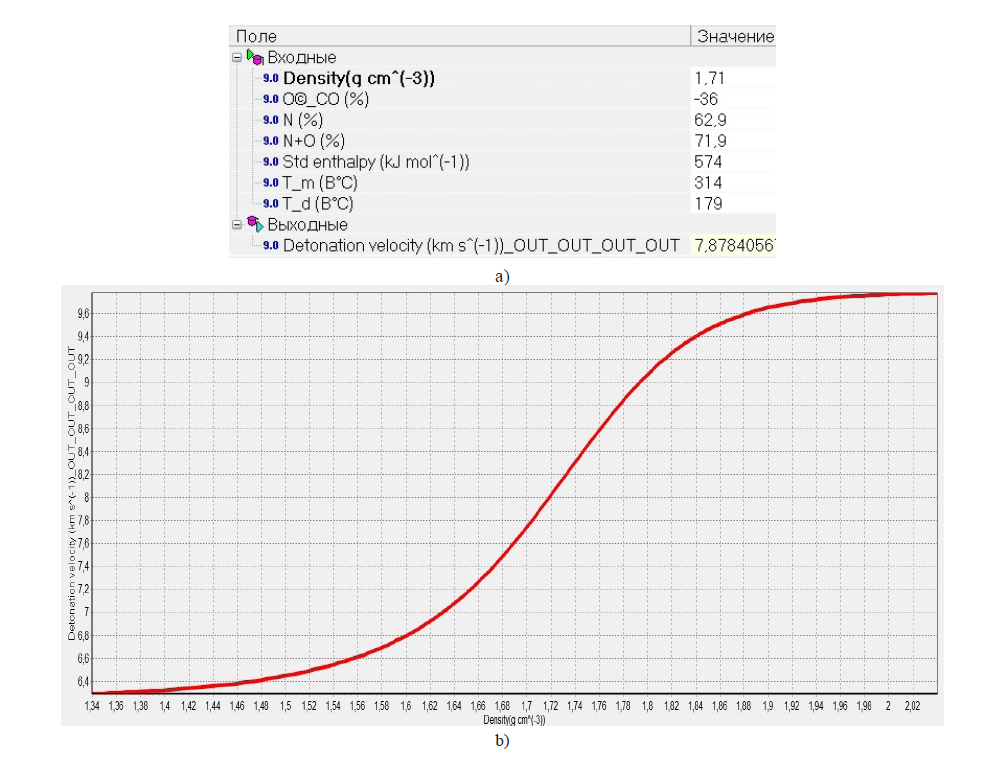
Figure 2:The result of calculation (a) and the dependence of detonation pressure on density (b).
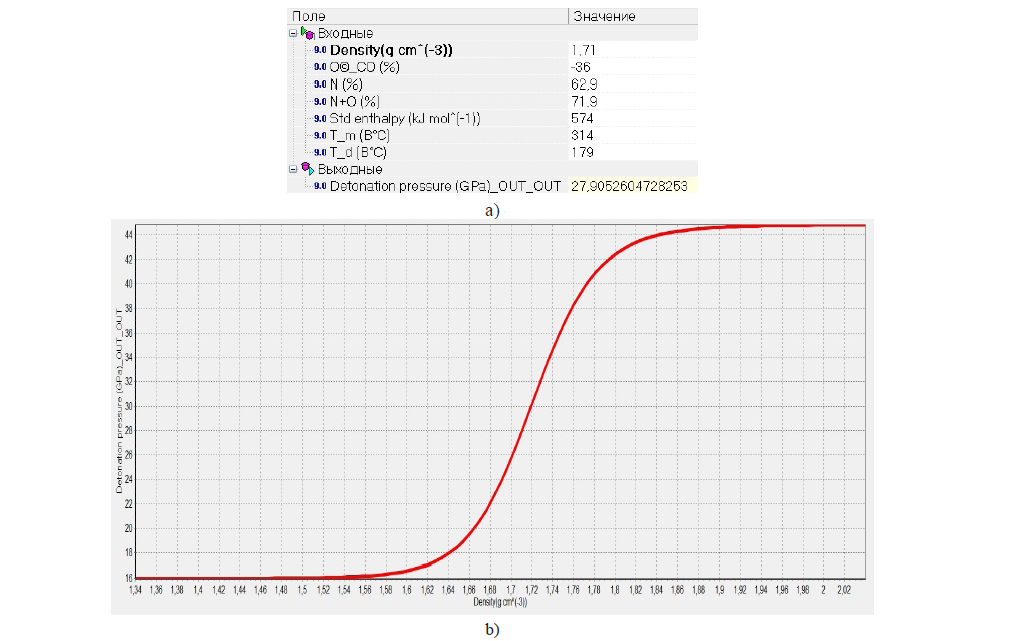
Figure 3:The result of calculation (a) and the dependence of detonation velocity on enthalpy of formation (b)
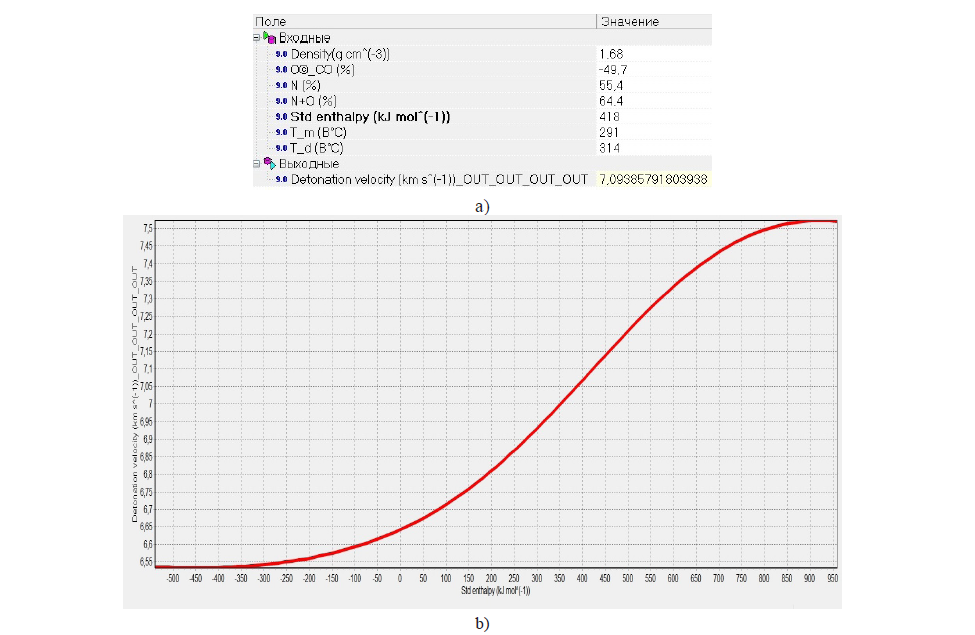
Figure 4:The result of calculation (a) and the dependence of detonation velocity on decomposition temperature (b).
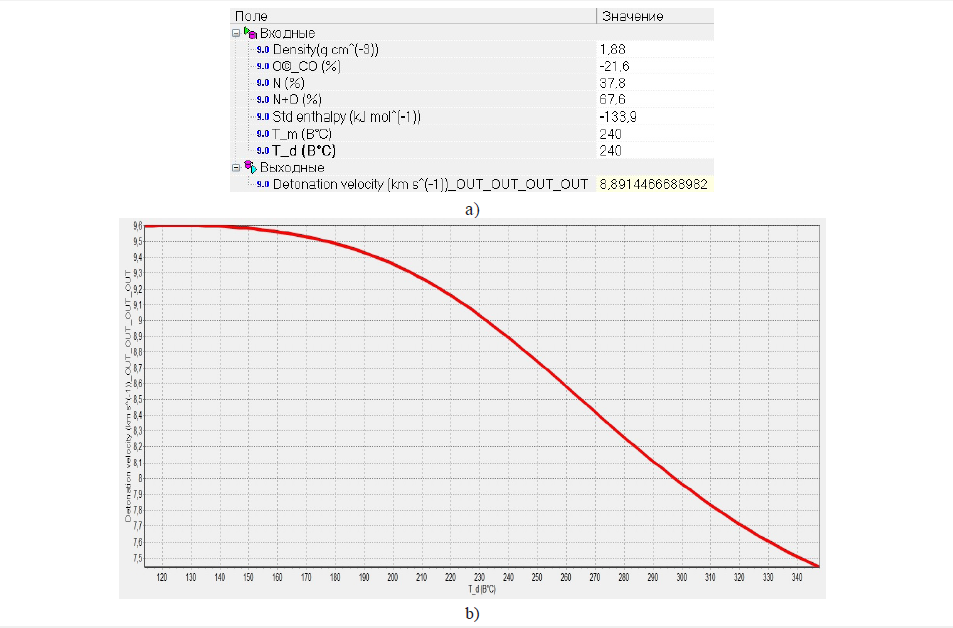
Figure 5:The result of calculation (a) and the dependence of impact sensitivity on nitrogen content (b).
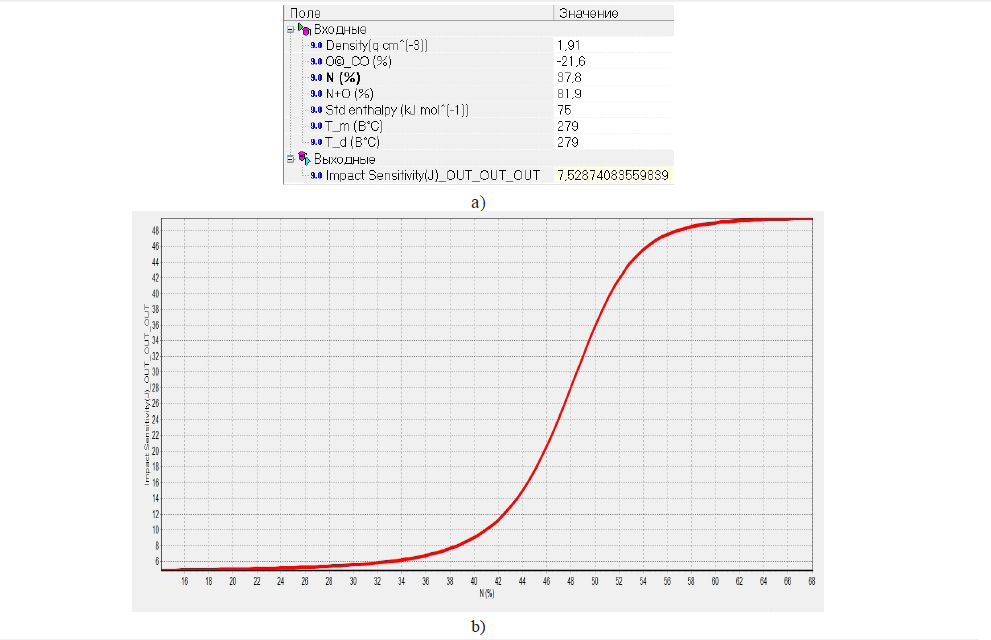
Figure 6:The result of calculation (a) and the dependence of impact sensitivity on decomposition temperature (b).
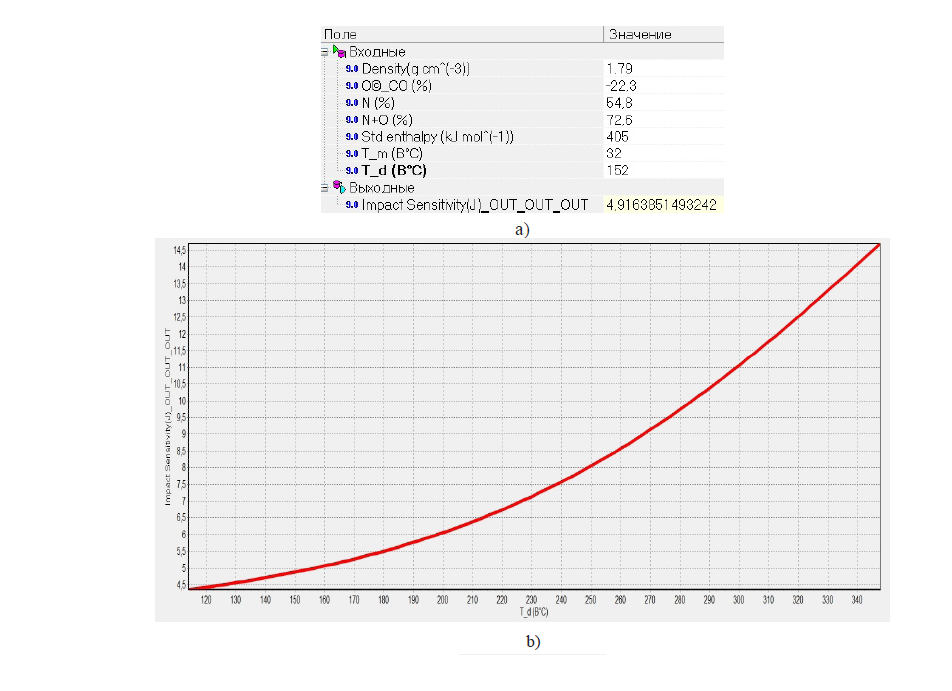
Analysis shows maximum influence on detonation velocity/ pressure from density and oxygen balance, while sensitivity depends most on total nitrogen and oxygen content and decomposition temperature, agreeing with physicochemical concepts.
Results and Discussion
The cascade neural network approach effectively computes HEM detonation characteristics with high accuracy (R² > 0.99 for detonation velocity and pressure). The models adequately reflect fundamental regularities of explosive physics. For sensitivity characteristics, satisfactory results (R² > 0.86) were obtained; lower accuracy is explained by measurement methodology dependence. Future work involves database expansion and creating a “High- Energy Materials Genome” [9-15].
References
- Mukhutdinov AR et al. (2021) Information Technologies and Computing Systems 4: 83-90.
- Perederin Yu V, Popok NI (2019) Chemical Physics and Mesoscopy 21(2): 245-253.
- Lyasheva SA et al. (2015) Bulletin of Technological University 18(15): 226-229.
- Elton D, Boukouvalas Z, Butrico MS, Fuge MD, Chung PW (2018) Applying machine learning techniques to predict the properties of energetic materials. Scientific Reports 8(1): 9059.
- Elton D, Boukouvalas Z, Fuge MD, Chung PW (2019) Deep learning for molecular design—a review of the state of the art. Molecular Systems Design & Engineering 4: 828-849.
- Liu WH, Liu QJ, Liu FS, Liu ZT (2025) Machine learning approaches for predicting impact sensitivity and detonation performances of energetic materials. Journal of Energy Chemistry 102: 161-171.
- Zeldovich Ya B, Raizer Yu P (1966) Physics of Shock Waves, Nauka.
- Fickett W, Davis WC (2000) Detonation: Theory and Experiment, Dover.
- Abrukov VS, Karlovich EV, Afanasyev VN, Semenov YV, Abrukov Victor (2010) Creation of propellant combustion models by means of data mining tools. International Journal of Energetic Materials and Chemical Propulsion 9(5): 385-396.
- Chandrasekaran N, Abrukov VS, Anufrieva DA, Oommen C, Sanal Kumar VR, et al. (2019) Prediction of Detonation Velocity and N−O Composition of High Energy C−H−N−O Explosives by Means of Artificial Neural Networks. Propellants, Explosives, Pyrotechnics 44(5): 579-587.
- Pang W, Abrukov VS, Anufrieva DA, Chen D (2023) Burning rate prediction of solid rocket propellant (SRP) with high-energy materials genome (HEMG). Crystals 13(2): 237-252.
- Abrukov VS.
- Doherty RM, Abrukov VS, Boukouvalas Z, Baek SS, Terreux R (2026) Application of AI and ML to novel energetic materials. Energetic Materials and Techniques: Advances in Chemical Propulsion and Power Generation 1: 3-18.
- Abrukov VS, Pang W, Anufrieva D, Sapyorov D (2026) Neural networks in the development of high-energy materials genome. Energetic Materials and Techniques: Advances in Chemical Propulsion and Power Generation 1: 57-88.
- Abrukov V, Pang W, Anufrieva D (2024) Methodology for studying combustion of solid rocket propellants using artificial neural networks. Ann Adv Chem 8: 001-007.
© 2026 Abrukov VS. This is an open access article distributed under the terms of the Creative Commons Attribution License , which permits unrestricted use, distribution, and build upon your work non-commercially.
Editor In Chief







.jpg)































Signup for Newsletter

Quick Links
 Editorial Board Registrations
 Submit your Article
 Best Paper of the Volume
 Reprints
 Refer a Friend
 Advertise With Us
Our Recent Edition
.jpg)



Top Editors




.jpg)

















.bmp)
.jpg)
.png)
.jpg)













.jpg)






.png)

.png)




.png)




Financial Support

Sponsors

Latest e-Books

Latest Video

 a Creative Commons Attribution 4.0 International License. Based on a work at www.crimsonpublishers.com.
Best viewed in
a Creative Commons Attribution 4.0 International License. Based on a work at www.crimsonpublishers.com.
Best viewed in 
 | Above IE 9.0 version