

- About Us
- Information
-

The Author ensures that the research has been conducted responsibly and ethically with adherence to all relevant regulations. read more..
- For Authors
- For Reviewer
- Manuscript Guidelines
- Membership
- Publication Ethics
-
- Journals
- Reprints
- e-Books
- Videos
- Policies
- Contact Us
 COVID-19
- Submissions



Full Text
Annals of Chemical Science Research
Synthesis, Structural Elucidation, and Spectroscopic Analysis of Aromatic Schiff Bases Derivatives of 4-Hydroxybenzaldehyde
Sidra Bibi#, Mian Gul Sayed#*, Rahim Shah#*, Komal Hussain, Humaira Khan and Khushnuma Bibi
Department of Chemistry, University of Swat, Pakistan
#These authors are equally contributed in this article
*Corresponding author:Sayed M G and Shah R, Department of Chemistry, University of Swat, Swat 19130, Khyber Pakhtunkhwa, Pakistan
Submission: April 15, 2026;Published: May 22, 2026

Volume5 Issue4May 22, 2026
Abstract
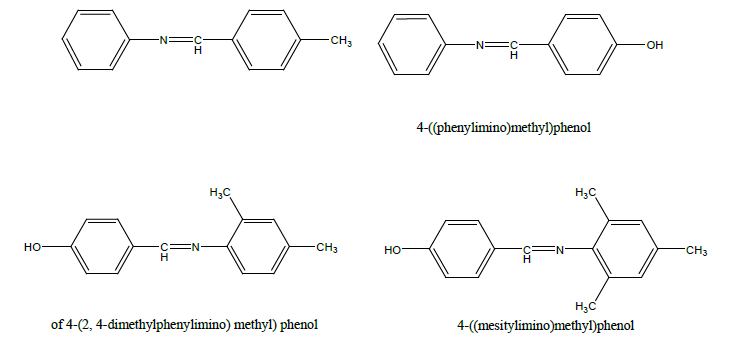
Schiff bases (imines) are an important class of organic compounds formed by the condensation of primary amines with carbonyl compounds and are widely recognized for their structural versatility and broad biological relevance. In this study, a series of aromatic Schiff bases were synthesized via the condensation of 4-hydroxybenzaldehyde with aniline, 2,4-dimethylaniline and 2,4,6-trimethylaniline under reflux conditions in methanol. The reactions proceeded smoothly, affording the desired imines in moderate to good yields (56-73%). The synthesized compounds, namely 4-((phenylimino)methyl) phenol, 4-((2,4-dimethylphenylimino)methyl)phenol, and 4-((mesitylimino)methyl)phenol were isolated as crystalline solids and characterized comprehensively. Structural confirmation was achieved using melting point analysis, elemental analysis, 1H and 13C NMR spectroscopy, and mass spectrometry all of which were consistent with the proposed molecular structures. The influence of aromatic substitution on reaction yield and physicochemical properties was also observed. Given the well-documented pharmacological and functional significance of Schiff bases, these synthesized imines derivatives may serve as useful intermediates or scaffolds for future studies in medicinal chemistry and materials science..
Keywords:Schiff bases; Aniline; Aldehyde; Spectroscopy and biological activities
Introduction
Schiff base compounds containing an imine group (-RCN-), are usually formed by the condensation of a primary amine with an active carbonyl group (aldehydes or ketones) [1]. Aldehyde react very easily with primary amines to form Schiff bases, but this process is not easy for ketones. In order to obtain Schiff bases from ketones, it is necessary to pay attention to factors, such as catlalyst, pH rang, selection of solvent and temperature [2]. Aliphatic ketones react with amines to form imines more slowly than aldehydes; therefore, higher reaction temperatures and longer reaction time are required. Aromatic ketones are less reactive than aliphatic ones and require harsh conditions to be converted into imines [3]. imines are important intermediates and multipurpose starting materials for the synthesis of many reactions such as Munich bases, indoles, beta lactam, pyrimidine derivatives [4]. Many compounds, well known or less are treated as the therapeutic agents. Among them, there is a specific group of molecules named commonly as Schiff bases, chemically imines [5]. In the chemistry of vision, an imine linkage between the protein opsin in the retina of the eye and aldehyde derived from vitamins play in important role [6]. Their most important medical applications include: antibacterial and antifungal (including anti-yeast) activity, antiviral, antitumor, anti-inflammatory, antipyretic, antimalarial, anticancer, anesthetic, oxytocinimitating and oxytocin-inhibiting activity, as well as the selective inhibition of human tyrosine phosphatase 1B (PTP1B) or TCPTP and SHP-1 tyrosine phosphatases [7]. Pyrimidine exhibits wide occurrence in nature as a constituent of nucleic acids, thymine, and many other natural and synthetic compounds including drugs [8]. In the case of benzylidene aniline-type imine dyes, both intramolecular proton transfer leading to enol-imine/ keto-amine tautomer’s and (E)-(Z) isomerization around the imino group (C=N) have been found to be relevant in determining solvatochromism and these processes are well known to be strongly dependent on the specific substituents present in the aromatic rings [9]. According to recent estimates, about 3.57 million of the 4.95 million deaths worldwide in 2019 were caused by infection that are resistant antimicrobial (antibiotic) drugs. This number is higher than deaths from diseases like malaria or AIDS. In 2017, the World Health Organization (WHO) identified antibiotic-resistant germs from 12 bacterial families as a serious threat to global public health. They grouped these germs into three priority levels: moderate, high and critical [10]. During the (COVID-19), the global scientific community is focused on developing drugs or vaccine to fight the virus. Due to growing interest in fighting infection, Schiff bases, also known as azomethine compounds, are being extensively studied to see if they have prevented or treat microbial infection [11]. Ultrasonication works on acoustic cavitation, where tiny bubbles form, grow and burst, creating very high temperature and pressure in small spots. These short‑lived micro‑environments greatly boost mass transfer, molecular collisions and reaction speeds without raising the overall reaction temperature [12]. Schiff bases have a conjugated aromatic ring and a C=N double bond, which gives them strong color and optical properties. Because of this, they are useful as organic dyes, luminescent compounds, fluorescent labels and parts of OLED displays [13]. They are attractive because they are easy to make, produce well, dissolve easily and are cost‑effective, also showing optoelectronic behavior. In optics, Schiff bases show chemical, electro‑optical actions, laser effects, optical switching and photo‑electric quantum properties with organic chromophores [14]. The active part of Schiff bases is the azomethine (‑C=N‑) group, which is important for disinfection, analysis, magnetism, free‑radical scavenging, anti‑fungal activity, biochemical reactions and bioorganometallic modeling. Removing wrinkles, nicotinamide can slow skin aging [15]. Schiff synthesis involving benzaldehyde whose IUPAC name is benzene carbaldehyde. This aromatic aldehyde has an almond color and occurs naturally in the kernels of stone fruits (apricots, cherries and peaches), almond oil and cassia oil. Also, it serves as a synthetic intermediate in the manufacture of ephedrine, pseudoephedrine and methamphetamine [16].
Chemical and Material
All the chemicals used, including Aniline, Benzaldehyde, 4-hydroxy benzaldehyde, 2,4-dimethylanaline,2,4, 6-trimethylanaline,2,4,6-trimrthylbenzaldehyde,2,4-dimethyl benzaldehyde and acetic acid were purchased from Sigma Aldrich and utilized without further purification. In contrast, solvents such as ethyl acetate, methanol, dichloromethane and n-hexane underwent weekly distillation or purification upon showing discoloration. The study employed various instruments for sample preparation and analysis, including a Retsch Mixer Mill MM200 for grinding, a Perkin Elmer Lambda 850 spectrophotometer, a Varian 400 MHz spectrometer for ¹H NMR spectra, and an ABI 4700 Proteomics Analyzer for EI+-MS.
Synthesis of 4-((phenylimino) methyl) phenol
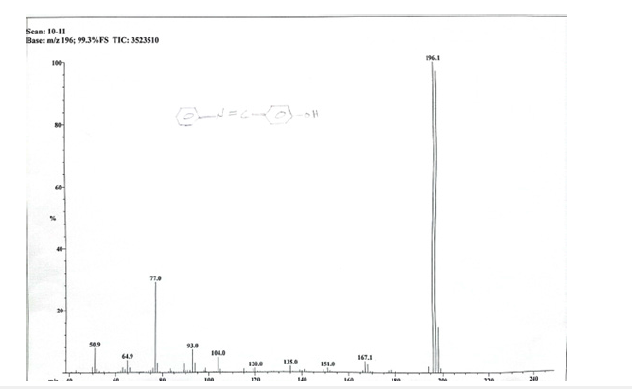
A mixture of 4-hydroxy benzaldehyde (0.61g) and aniline (0.565ml) was combined in a 250ml round-bottom flask with 25ml of methanol. The reaction was carried out at 64.7 °C for 8 hours. The progress of the reaction was monitored using TLC and a UV lamp. The mixture was cooled and transferred to a separating funnel after 8 hours, where it was mixed with water and ethyl acetate. This resulted in the formation of two layers, with the organic layer being separated and collected in a conical flask. The solvent was then evaporated, and the resulting mixture was re-crystallized to form crystals (Figures 1 & 2).
Figure 1:1H NMR Spectrum of 4-((phenylimino) methyl) phenol.
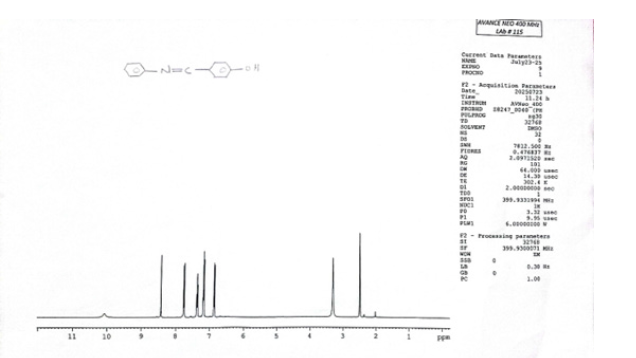
Figure 2:13C NMR Spectrum of 4-((phenylimino) methyl) phenol.
Characterization:
Colour: Dark Green
Yield: 56%
m.pt: 154-156 °C
Molecular formula: (C13H11NO)
Elemental analysis: C, 79.16%; H, 5.62%; N, 7.10%; O, 8.11%
1H NMR (400 MHz, CDCl3) δ (ppm):
δ − 6.7-7.1 (ortho and meta 4H-Phenol), 7.29-7.62 (ortho, meta
and pera 5H benzyl), 5.0 (s, OH),8.39 (1H imine).
MS (ESI) exact mass =197.1: calcd m/z for [M + H+], 197.2
Synthesis of 4-((2, 4-dimethylphenylimino) methyl) phenol
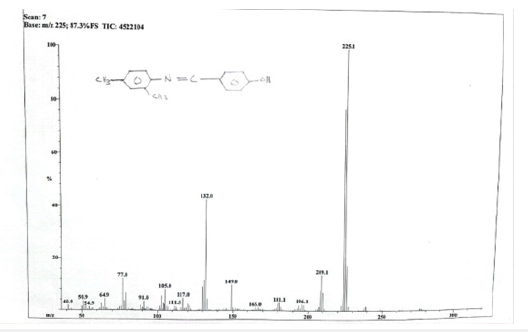
A mixture of 4-hydroxy benzaldehyde (0.61g) and 2,4-dimethyl aniline (0.617ml) was combined in a 250ml round-bottom flask with 25ml of methanol. The reaction was carried out at 64.7 °C for 6 hours. The progress of the reaction was monitored using TLC and a UV lamp. After the reaction was complete, the mixture was cooled and transferred to a separating funnel, where it was mixed with water and ethyl acetate. This resulted in the formation of two layers, with the organic layer being separated and collected in a conical flask. The solvent was then evaporated, and the resulting mixture was re-crystallized to form crystals (Figures 3 & 4).
Figure 3:1H NMR Spectrum of 4-((2,4-dimethylphenylimino)methyl)phenol.
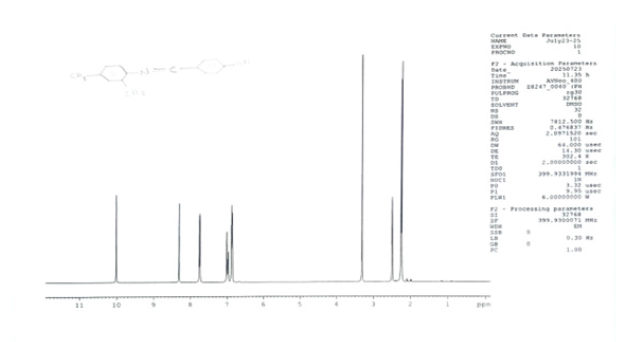
Figure 4:13C NMR Spectrum of 4-((2,4-dimethylphenylimino)methyl)phenol.
Characterization:
Colour: Brown
Yield: 73%
m.pt: 152-155 °C
Molecular formula: (C15H15NO)
Elemental analysis: C, 79.97%; H, 6.71%; N, 6.22%; O, 7.10%
1H NMR (400 MHz, CDCl3) δ (ppm):
δ − 6.76-7.45 (ortho and meta 4H-Phenol), 6.9-7.0(ortho and
meta 3H benzyl), 5.0 (s, OH),8.39 (1H imine), 2.35(2methyl,6H).
MS (ESI) exact mass =225.1: calcd m/z for [M + H+], 225.3
Synthesis of 4-((Mesitylimino) methyl) phenol
A mixture of 4-hydroxy benzaldehyde (0.202ml) and 2,4,6-trimethyl aniline (1.404ml) was combined in a 250ml roundbottom flask with 25ml of methanol. The reaction was carried out at 64.7 °C for 7 hours. The progress of the reaction was monitored using TLC and a UV lamp. After the reaction was complete, the mixture was cooled and transferred to a separating funnel, where it was mixed with water and ethyl acetate. This resulted in the formation of two layers, with the organic layer being separated and collected in a conical flask. The solvent was then evaporated, and the resulting mixture was re-crystallized to form crystals (Figures 5-7).
Figure 5:1H NMR Spectrum of 4-((mesitylimino) methyl) phenol.
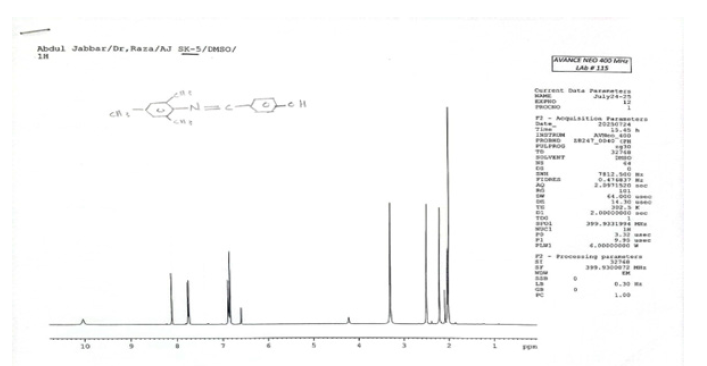
Figure 6:13C NMR Spectrum of 4-((mesitylimino) methyl) phenol.
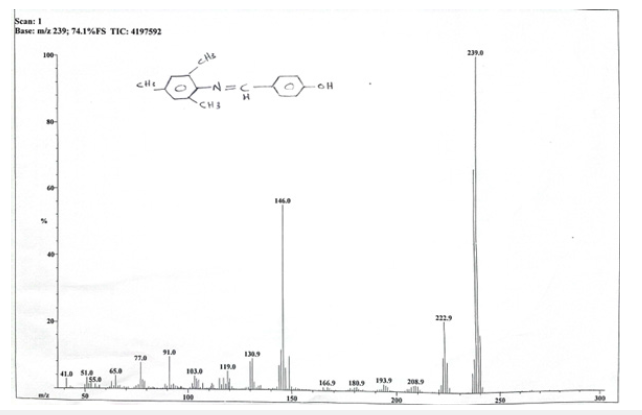
Figure 7:
Characterization:
Colour: Pale Yellow
Yield: 69%
m.pt: 134-136 °C
Molecular formula: (C16H17NO)
Elemental analysis: C, 80.30%; H, 7.16%; N, 5.85%; O, 6.69%
1H NMR (400 MHz, CDCl3) δ (ppm):
δ − 6.76-7.45 (ortho and meta 4H-Phenol), 6.7 (meta,3H
benzyl), 5.0 (s, OH),8.39 (1H imine), 2.35 (3methyl,9H).
MS (ESI) exact mass = 239.1: calcd m/z for [M + H+], 239.3
Conclusion
In conclusion, the present study successfully demonstrates the synthesis of a series of aromatic Schiff bases through the condensation reaction of 4-hydroxybenzaldehyde with differently substituted anilines under controlled reflux conditions. The synthetic approach proved to be simple, efficient and reproducible, yielding the target imine compounds in moderate to good yields. Comprehensive characterization using melting point determination, elemental analysis, 1H and 13C NMR spectroscopy, and mass spectrometry confirmed the formation and structural integrity of the synthesized Schiff bases. Variations in aromatic substitution were found to influence the reaction time, yield and physical properties of the products, highlighting the role of steric and electronic effects in imine formation. Owing to their wellknown chemical versatility and broad spectrum of biological and functional applications, the synthesized Schiff bases may serve as promising building blocks for the development of biologically active molecules or advanced functional materials. This work provides a useful foundation for further investigations into structure–property relationships and potential applications of Schiff base derivatives.
Acknowledgments
Department of Chemistry, University of Swat, Swat, Pakistan.
Conflict of Interest
The authors declare no conflict of interest..
Funding
No Financial Funding is received for the title study from any funding agency.
References
- Dos Santos JE, Dockal ER, Cavalheiro ET (2005) Synthesis and characterization of Schiff bases from chitosan and salicylaldehyde derivatives. Carbohydrate Polymers 60(3): 277-282.
- Subasi NT (2022) Overview of schiff bases. Schiff Base in Organic, Inorganic and Physical Chemistry.
- Qin W, Long S, Panunzio, Biondi S (2013) Schiff bases: A short survey on an evergreen chemistry tool. Molecules 18(10): 12264-12289.
- Berber N (2020) Preparation and characterization of some Schiff base compounds. Adıyaman University Journal of Science 10(1): 179-188.
- Sykula ADA (2018) Schiff bases as important class of pharmacological agents. J Pharm Pharmacol 6: 989-1009.
- Sangle SL (2023) Introduction to Schiff base. Schiff base in organic, inorganic and physical chemistry. Intech Open: London, UK, pp. 1-13.
- Raczuk E, Dmochowska B, Samaszko-Fiertek J, Madaj J, et al. (2022) Different Schiff bases-structure, importance and classification. Molecules 27(3): 787.
- Bryndal I, Stolarczyk M, Mikolajczyk A, Krupinska M, Pyra A, et al. (2024) Pyrimidine Schiff bases: Synthesis, structural characterization and recent studies on biological activities. International Journal of Molecular Sciences 25(4): 2076.
- Sıdır İ, Sıdır YG, Berber H, Ramos ML, Justino LLG, et al. (2025) Reversal in Solvatochromism, enol-imine/keto-amine tautomerism and (E)-(Z) photoisomerizations in a benzylidene aniline schiff base derivative in different solvents. Molecules 30(3): 745.
- Tunç T, Köse Y (2026) Synthesis, antimicrobial evaluation, and molecular docking analysis of novel schiff bases derived from isatoic anhydride and salicylaldehyde. International Journal of Molecular Sciences 27(2): 742.
- Abedin MM, Tarun Kumar Pal, Md Najem Uddin, Mohammad Abdul Alim, Md Chanmiya Sheikh, et al. (2024) Synthesis, quantum chemical calculations, in silico and in vitro bioactivity of a sulfonamide-Schiff base derivative. Heliyon 10(14): e34556.
- Ghatbandhe N, Satpute G, Utane R (2025) Rapid and green synthesis of hydrazone Schiff bases using ultrasonication: comparative spectroscopic evaluation and structure–activity relationships. Journal of Applied Bioanalysis 11(16): 869-906.
- Rajadurai D, Al-Hussain SA, Elangovan N, Gomha SM, Sirajunnisa A, et al. (2026) Design, synthesis, and fluorescence properties of bis-Schiff base derivatives via spectroscopic, computational, and docking approaches. Journal of Fluorescence 36(3): 1879-1911.
- Ali AH, Jaseem AM, Hassan QMA, Emshary CA, Sultan HA, et al. (2026) Design, synthesis, structural characterization, and DFT approach of a new bis-Schiff base-derived sulfonyldianiline: Thermal and nonlinear optical performances in a fluid system. Journal of Molecular Structure 1360: 145604.
- Javid M, Masood MA, Yaqoob F, Sagheer M, Abbas MS, et al. (2026) Designing, synthesis, characterization, and in vitro antibacterial evaluation of novel nicotinamide-derived Schiff bases as potential therapeutic agents. Pakistan Journal of Chemistry 16(1-2): 45-64.
- Oladimeji O, Alozie M (2026) Chemical characterization and biological evaluation of two alkyl-substituted phenyl aldimines. J Pharm Res Sci Technol 10(1): 202.
© 2026 Mian Gul Sayed & Rahim Shah. This is an open access article distributed under the terms of the Creative Commons Attribution License , which permits unrestricted use, distribution, and build upon your work non-commercially.
Editor In Chief







.jpg)































Signup for Newsletter

Quick Links
 Editorial Board Registrations
 Submit your Article
 Best Paper of the Volume
 Reprints
 Refer a Friend
 Advertise With Us
Our Recent Edition

.jpg)



Top Editors




.jpg)

















.bmp)
.jpg)
.png)
.jpg)













.jpg)






.png)

.png)




.png)




Financial Support

Sponsors

Latest e-Books

Latest Video

 a Creative Commons Attribution 4.0 International License. Based on a work at www.crimsonpublishers.com.
Best viewed in
a Creative Commons Attribution 4.0 International License. Based on a work at www.crimsonpublishers.com.
Best viewed in 
 | Above IE 9.0 version