

- About Us
- Information
-

The Author ensures that the research has been conducted responsibly and ethically with adherence to all relevant regulations. read more..
- For Authors
- For Reviewer
- Manuscript Guidelines
- Membership
- Publication Ethics
-
- Journals
- Reprints
- e-Books
- Videos
- Policies
- Contact Us
 COVID-19
- Submissions



Full Text
Annals of Chemical Science Research
Application and Optimization of Oxygen-Free Hydraulic Jet Ice-Melting Technology in External Ice-Melting Systems
Nan Qu1*, Yi Han2 and Zheng Xu1
1School of Energy and Environmental Engineering, University of Science and Technology Beijing, China
2School of Materials Science and Engineering, University of Science and Technology Beijing, China
*Corresponding author:Nan Qu, School of Energy and Environmental Engineering, University of Science and Technology Beijing, China
Submission: March 10, 2026;Published: March 17, 2026

Volume5 Issue4March 17, 2026
Abstract
The traditional bubble melting ice technology is limited by the problems of dissolved oxygen corrosion, high energy consumption, and uneven temperature field, which restrict the long-term performance and economic benefits of external melting ice storage systems. This study proposes and validates a novel enhanced ice melting scheme based on anaerobic hydraulic jet disturbance. The influence of design parameters of the water distribution system (nozzle diameter, outlet flow velocity, spacing) on the melting process of the bottom ice coil was systematically studied through ANSYS Fluent numerical simulation. The results indicate that hydraulic jets can form effective directional vortices in the ice storage tank, significantly enhancing fluid disturbance and heat transfer around the ice coil. Orthogonal experiments and range analysis revealed that the primary and secondary order of the influence of various parameters on the average melting rate is nozzle diameter>outlet flow velocity>spacing, and obtained the optimal parameter combination of nozzle diameter of 16mm, spacing of 100mm and outlet flow velocity of 20m/s. At this time, the average melting rate can reach 4-5 kg/(m2·s). This case proves that anaerobic hydraulic jet ice melting technology has significant advantages in improving ice melting efficiency, eliminating oxygen corrosion, and reducing system energy consumption, providing new ideas for the optimization design and operation of large-scale external ice melting systems.
Keywords:Ice storage; External melting; Hydraulic jet; Numerical simulation; Enhanced heat transfer; Orthogonal test
Introduction
As an efficient energy storage and transfer solution, ice thermal storage technology demonstrates significant practical value amid global energy consumption growth and increasingly pronounced peak-valley load disparities in power grids [1]. Utilizing ice as a cost-effective and eco-friendly medium, this technology provides distinct advantages for building thermal energy storage applications [2]. Compared to conventional battery storage systems [3], ice thermal storage systems achieve a service life of 15-25 years [4] with coefficient of performance (COP) typically exceeding standard air conditioning systems [5]. The technology operates by generating ice during nighttime off-peak hours to store cooling capacity, then releasing stored cold through ice melting during daytime peak hours to supply cooling services for building HVAC systems. This approach not only reduces users cooling electricity costs but also alleviates peak load pressure on power grids, enhancing system stability and economic efficiency [6-10]. The externally melting ice thermal storage system represents a widely adopted implementation, featuring ice layer storage in ice storage tanks and heat release through ice melting. However, traditional melting methods predominantly employ compressed air bubble disturbance to accelerate fluid convection within the tanks, thereby speeding up ice melting rates [11]. Dissolved oxygen in high-pressure air accelerates corrosion of galvanized coils in storage tanks, causing “white rust” formation that shortens equipment lifespan and increases maintenance costs. Moreover, the compressed air at temperatures far exceeding ambient conditions not only consumes stored cooling capacity but also drains electrical energy from the blower. The bottom-up air agitation process is unidirectional and causes rapid mixing of gas-liquid phases through short pathways, which fails to uniformly disturb the temperature field in the ice storage tank, resulting in low ice-melting efficiency. During the initial phase, the tank completes natural ice melting through the static water within the tank under undisturbed and unheated conditions. In the mid-to-late stages of melting, thermal convection causes the bottom temperature to drop, making ice pipe melting difficult. This often leads to the formation of “millennium ice” [11] in the next ice-making cycle, causing stress deformation in adjacent pipe sections due to ice formation connections.
To address the corrosion, high energy consumption, and uneven temperature distribution issues in traditional bubble icemelting methods, developing an oxygen-free hydraulic jet icemelting approach has become a key focus for optimizing external ice-melting systems. This study employs a water distribution system to implement water-jet disturbance ice-melting, replacing gas bubbles with hydraulic jets. This method not only eliminates dissolved oxygen corrosion but also enhances heat transfer efficiency through optimized jet parameters. Through numerical simulations, we systematically investigate how water distribution system design parameters affect ice-melting performance. The results demonstrate that under identical operating conditions, the oxygen-free hydraulic jet method significantly outperforms traditional gas-bubble methods in heat transfer uniformity, icemelting rate, and system energy consumption. These findings provide theoretical guidance for optimizing large-scale external ice-melting systems.
Simulation and Analysis of Jet Disturbance on Ice Melting
This study investigates a typical external ice storage tank structure with staggered ice coils. To focus on core physical mechanisms and control computational scale, we developed a two-dimensional symmetrical periodic model in ANSYS Fluent based on structural symmetry, representing a single ice coil and its surrounding flow field. The model simulates the bottom-up hydraulic jet melting process on the outer wall of an elliptical tube (70-80mm outer diameter, 24mm initial ice thickness), with nozzles centrally positioned between adjacent coils to avoid direct jet impact. The multiphase flow model employing the enthalpy-porosity method couples’ mass, momentum, and energy conservation equations to accurately describe heat transfer and flow during solid-liquid phase transitions. Using orthogonal experiments, we systematically evaluated three key water distribution parameters nozzle diameter, outlet velocity, and nozzle spacing on ice melting performance. The average ice melting rate on the tube’s outer wall served as the core evaluation metric, with significant parameter identification through range analysis to optimize the water distribution scheme (Figure 1).
Figure 1:Symmetric model of ice coil..


Results and Discussion
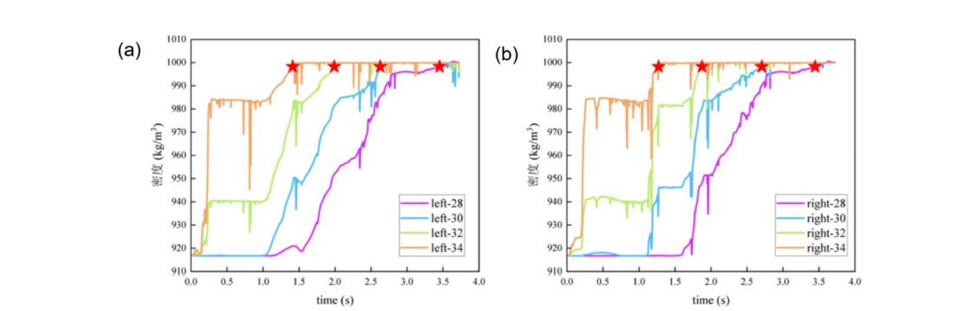
Through systematic analysis of numerical simulation results, this study clearly demonstrates the advantages of the oxygenfree hydraulic jet ice-melting scheme and the influence patterns of its key parameters. The simulation results indicate that the hydraulic jet can form intense directional vortex structures in the vertical direction of the ice storage tank. This vortex continuously erodes the surface of the ice coil, effectively disrupting the thermal boundary layer near the solid-liquid interface, thereby significantly enhancing convective heat transfer intensity at the ice-water interface. Compared to traditional methods relying on natural convection or simple overall circulation, this active and directional flow disturbance exhibits notable advantages in strengthening heat transfer mechanisms (Figures 2 & 3).
Figure 2:Ice melt: (a) Temperature cloud map; (b) Density cloud map (t=1.04 s).
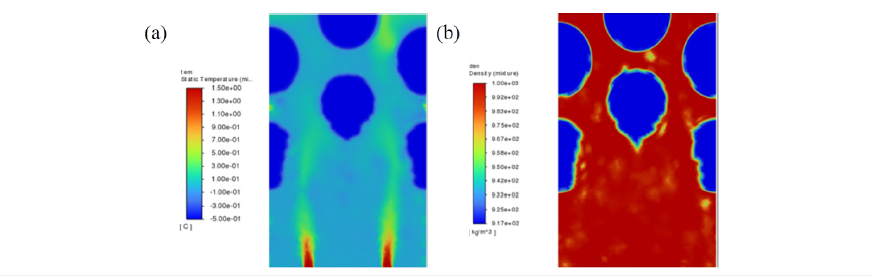
Figure 3:Density curve diagram of ice melting process simulation: (a) Schematic diagram of density monitoring points; (b) Monitoring of ice layer on the left side of the coil; (c) Monitoring of ice layer on the right side of the coil (nozzle diameter 14mm, nozzle spacing 100mm, initial water velocity 10m/s) (stars in the figure indicate ice melted into water).
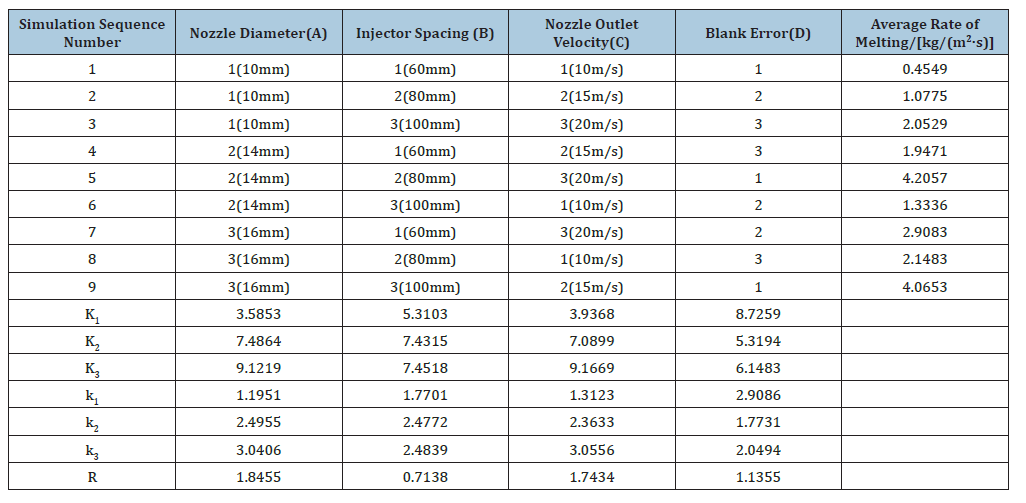
Through orthogonal simulation and range analysis, the primary and secondary order of influence of three key water distribution parameters nozzle diameter, outlet velocity, and nozzle spacing on average ice-melting rate was determined as: nozzle diameter> outlet velocity> nozzle spacing. This sequence indicates that in the study system, the initial momentum carried by the jet (primarily determined by diameter and velocity) is the dominant factor in ice-melting effects, with greater influence than nozzle distribution density. Comprehensive analysis yielded the optimal parameter combination for maximizing average icemelting rate: nozzle diameter 16mm, spacing 100mm and outlet velocity 20m/s. Under these optimized conditions, the simulated average ice-melting rate reached approximately 4-5kg/(m²·s), achieving significant improvement compared to undisturbed or low-efficiency disturbance conditions. This technical solution fundamentally eliminates metal corrosion risks caused by dissolved oxygen introduced through air injection, while avoiding energy consumption and thermal pollution associated with compressed air systems, thereby enhancing overall system efficiency. Additionally, the optimized jet can form a more uniform and intensified flow field, effectively preventing the formation of localized “millennium ice,” improving cold storage release efficiency and system operational reliability (Table 1).
Table 1:Orthogonal simulation result data table.
Conclusion and Outlook
This case study successfully validates the feasibility and significant advantages of anaerobic hydraulic jet ice-melting technology in external ice-melting systems through numerical simulation. The technology not only addresses the inherent issues of corrosion, high energy consumption, and uneven efficiency in traditional bubble ice-melting methods, but also achieves a substantial improvement in ice-melting performance through parameter optimization.
Outlook: This study represents a numerical validation at the laboratory stage. Future work may focus on: 1) establishing experimental platforms for empirical research to validate simulation accuracy; 2) conducting three-dimensional transient simulations of full-scale ice storage tanks to more accurately reflect system dynamics. The anaerobic hydraulic jet ice-melting technology provides a promising solution for developing future green, efficient, and long-lasting ice storage systems.
References
- Momeni M, Askar S, Fartaj A (2023) Thermal performance evaluation of a compact two-fluid finned heat exchanger integrated with cold latent heat energy storage. Appl Therm Eng 230: 120815.
- Sepehri A, Nelson B (2019) Energy and emissions analysis of ice thermal energy storage in the western US. Energy Build 202: 109393.
- Chong LW, Wong YW, Rajkumar RK, Risa D, Rajpartiban KR (2016) Hybrid energy storage systems and control strategies for stand-alone renewable energy power systems. Renew Sustain Energy Rev 66: 174-189.
- Liu Z, Quan Z, Zhao Y, Zhang W, Yang M, et al. (2023) Dynamic modelling and performance prediction of a novel direct-expansion ice thermal energy storage system based multichannel flat tube evaporator plus micro heat pipe arrays storage module. Renew Energy 217: 119153.
- Braun JE (1990) Reducing energy costs and peak electrical demand through optimal control of building thermal storage. ASHRAE Trans 96(2).
- Hoseini Rahdar M, Emamzadeh A, Ataei A (2016) A comparative study on PCM and ice thermal energy storage tank for air-conditioning systems in office buildings. Appl Therm Eng 96: 391-399.
- Sanaye S, Shirazi A (2013) Four E analysis and multi-objective optimization of an ice thermal energy storage for air-conditioning applications. Int J Refrig 36(3): 828-841.
- Sanaye S, Hekmatian M (2016) Ice thermal energy storage (ITES) for air-conditioning application in full and partial load operating modes. Int J Refrig 66: 181-197.
- Hoseini Rahdar M, Heidari M, Ataei A, Choi JK (2016) Modeling and optimization of R-717 and R-134a ice thermal energy storage air conditioning systems using NSGA-II and MOPSO algorithms. Appl Therm Eng 96: 217-227.
- Sanaye S, Shirazi A (2013) Thermo-economic optimization of an ice thermal energy storage system for air-conditioning applications. Energy Build 60: 100-109.
- Bi Y, Yu M, Wang H, Huang J, Lyu T (2019) Experimental investigation of ice melting system with open and closed ice-storage tanks combined internal and external ice melting processes. Energy Build 194: 12-20.
© 2026 Nan Qu. This is an open access article distributed under the terms of the Creative Commons Attribution License , which permits unrestricted use, distribution, and build upon your work non-commercially.
Editor In Chief







.jpg)































Signup for Newsletter

Quick Links
 Editorial Board Registrations
 Submit your Article
 Best Paper of the Volume
 Reprints
 Refer a Friend
 Advertise With Us
Our Recent Edition

.jpg)



Top Editors




.jpg)

















.bmp)
.jpg)
.png)
.jpg)













.jpg)






.png)

.png)




.png)




Financial Support

Sponsors

Latest e-Books

Latest Video

 a Creative Commons Attribution 4.0 International License. Based on a work at www.crimsonpublishers.com.
Best viewed in
a Creative Commons Attribution 4.0 International License. Based on a work at www.crimsonpublishers.com.
Best viewed in 
 | Above IE 9.0 version