

- About Us
- Information
-

The Author ensures that the research has been conducted responsibly and ethically with adherence to all relevant regulations. read more..
- For Authors
- For Reviewer
- Manuscript Guidelines
- Membership
- Publication Ethics
-
- Journals
- Reprints
- e-Books
- Videos
- Policies
- Contact Us
 COVID-19
- Submissions



Full Text
Advancements in Civil Engineering & Technology
Hydraulic Durability of Wicking Geotextiles under Environmental Cycles and Soil-Geotextile Interaction: A Mini Review
Muhammad Shahbaz*, Naveed Ahmad, Muhammad Shahroz Khalid and Shujahat Anwar
College of Civil and Transportation Engineering, Shenzhen University, China
*Corresponding author:Muhammad Shahbaz, College of Civil and Transportation Engineering, Shenzhen University, Shenzhen 518060, China
Submission: August 18, 2026;Published: August 28, 2026

ISSN: 2639-0574 Volume7 Issue 2
Abstract
Wicking geotextiles are a relatively recent class of geosynthetics designed to provide separation and reinforcement while removing moisture under unsaturated conditions. Their hydraulic benefit comes from hydrophilic or hygroscopic fibers, commonly with grooved or multichannel cross-sections, that can generate capillary suction and transmit water laterally toward an exposed boundary where evaporation occurs. This behavior directly addresses a well-known limitation of conventional permeable geosynthetics: when a hydrophobic geotextile or geo-composite is placed beneath an unsaturated fine soil, it can form a capillary break and temporarily store water at the interface rather than drain it. The durability question is therefore not simply whether a virgin product has adequate saturated permittivity or transmissivity. It is whether the geotextile can retain capillary uptake, in-plane transport and soil-filter compatibility after cycles of rainfall and drying, changes in temperature and relative humidity, freezing and thawing, trafficinduced compression, fines migration, and possible physical clogging. This mini review synthesizes evidence from unsaturated geotextile hydraulics, wicking geotextile laboratory tests, field pavement and railway applications, and geotextile clogging studies. The literature indicates that wicking geotextiles can reduce moisture content in aggregate bases, silty sands, silts, and cold-region embankments, but performance is strongly conditioned by soil fines content, soil-water retention behavior, contact quality, exposed drainage length, atmospheric demand, installation configuration, and environmental cycling history. Recent freeze-thaw studies show measurable deterioration of wicking height after repeated cycles, while field monitoring shows that low temperature can reduce evaporation-driven removal even when the geotextile remains functional. Standardized, soil-specific durability protocols that couple hydraulic, mechanical, thermal, and clogging actions remain the main research need.
Keywords:Wicking geotextile; Unsaturated drainage; Hydraulic durability; Freeze-thaw; Wettingdrying; Capillary barrier; Soil-geotextile interaction; Clogging; Pavement drainage; Railway embankment
Introduction
Conventional geotextile drainage design is usually framed around saturated or nearsaturated flow, using properties such as permittivity, transmissivity, apparent opening size and clogging resistance. Yet pavement bases, railway sub-ballasts, embankment fills and covers spend much of their service life in an unsaturated state. Under these conditions, the hydraulic conductivity of geotextiles can fall sharply as suction increases, and a geotextile below a fine-grained soil can behave as a capillary barrier rather than as a drain. This phenomenon has been documented in foundational studies of unsaturated nonwoven geotextiles and geosynthetic capillary barriers [1-3].
Wicking geotextiles, also described in parts of the literature as enhanced lateral drainage geotextiles, were developed to overcome this limitation. Instead of waiting for gravity drainage after saturation, they use wettable yarns or treated fibers to absorb liquid water, maintain flow pathways at suction levels relevant to unsaturated soils and move moisture in-plane toward daylighted edges or other atmospheric boundaries [4-6]. The hydraulic durability of a wicking geotextile is defined here as the retention of this water-removal function after realistic environmental cycles and soil interaction. It includes at least five coupled components:
A. Capillary uptake durability: Retention of wettability,
contact angle, sorptivity, and vertical or horizontal wicking
height.
B. In-plane transport durability: Retention of unsaturated
in-plane hydraulic conductivity or transmissivity over the
expected suction range.
C. Cross-plane and filtration durability: Retention of soil
compatibility, apparent opening size function, permittivity, and
resistance to blinding or internal clogging.
D. Boundary-condition durability: Retention of water
removal under realistic temperature, relative humidity, wind,
rainfall, groundwater, and freeze-thaw conditions.
E. Mechanical survivability: Resistance to installation
damage, traffic or ballast compression, splice losses, tensile
strain and soil intrusion that can change pore and groove
geometry.
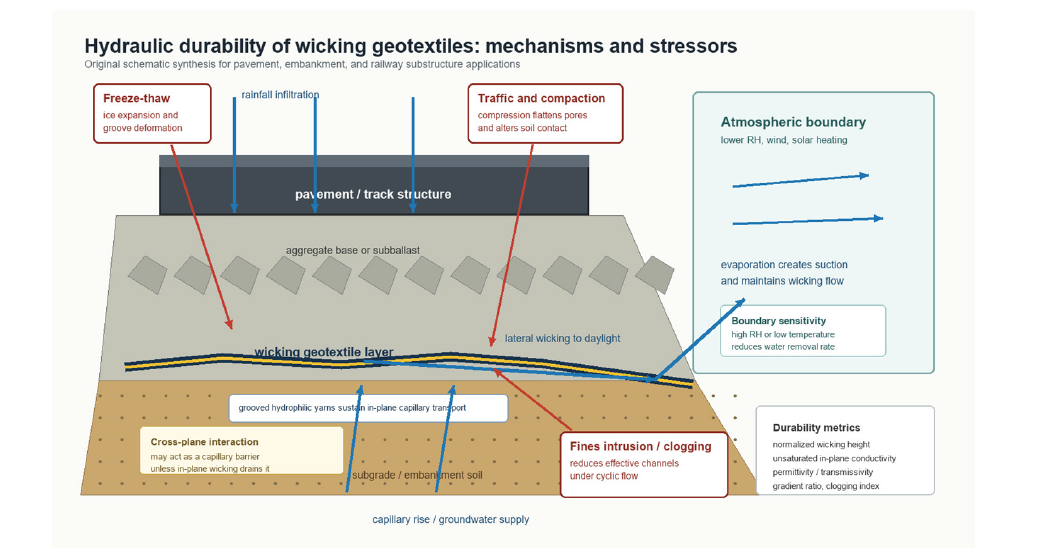
This review focuses on hydraulic performance rather than tensile reinforcement alone, although mechanical and hydraulic effects cannot be fully separated in road and rail applications (Figure 1).
Figure 1:Original schematic synthesis of the coupled mechanisms controlling wicking geotextile hydraulic durability. Rainfall, capillary rise, and groundwater fluctuations provide water; the wicking geotextile must sustain capillary uptake and in-plane transport to an exposed atmospheric boundary. Freeze-thaw cycling, traffic/ compaction, fines intrusion and clogging can reduce performance.
Mechanisms Controlling Hydraulic Durability
Unsaturated geotextile hydraulics
The starting point is the water-retention behavior of the geotextile itself. Iryo and Rowe [1] showed that unsaturated hydraulic behavior of nonwoven geotextiles can be described using water-retention and hydraulic-conductivity functions, conceptually analogous to unsaturated soil functions. Bouazza et al. [7] and Nahlawi et al. [8] further demonstrated that nonwoven geotextiles exhibit direction-dependent water-retention behavior and hysteresis. This is important because a geotextile can be very permeable when saturated yet poorly conductive at even modest suction.
Geosynthetic capillary-barrier studies explain why the interface can become a moisture storage zone. McCartney and Zornberg [2] observed water accumulation above geosynthetic drainage layers during infiltration and evaporation cycles, while Zornberg et al. [3] summarized the broader state of knowledge for geosynthetic capillary barriers. These studies are not about wicking products specifically, but they establish the physical problem that wicking geotextiles are intended to solve.
Wicking fiber architecture
Most early wicking geotextile studies examined woven products incorporating hydrophilic/hygroscopic grooved yarns. These yarns behave as arrays of small capillary channels. When the contact angle is low and the effective groove radius is small, capillary pressure can be high enough to draw water from unsaturated soil and sustain lateral transport. Guo et al. [9] quantified waterremoval rates under controlled temperature and relative humidity and Wang et al. [10] showed that the product could remove water from soil near optimum moisture content, not only from saturated soil.
The anisotropy is central. Lin et al. [6] concluded from numerical and experimental evidence that a wicking geotextile can function as a capillary barrier in the cross-plane direction while still providing in-plane lateral drainage. Recent nonwoven wicking geotextiles add another pathway: chemical treatment can increase wetting and water retention in nonwoven fiber networks. Jarjour et al. [11] reported that a chemically treated wicking nonwoven maintained higher in-plane water content and drainage capacity than a conventional nonwoven over a broad suction range.
Atmospheric demand and evaporation boundary
Wicking does not end at uptake. Water must be removed from the geotextile at an exposed boundary; otherwise, the fabric can approach local equilibrium and the suction gradient weakens. Guo et al. [9] found that water-removal rate increased with temperature and decreased with relative humidity. Liu et al. [12] in a concrete pavement field study, observed that wicking performance decreased at lower temperatures because evaporation was reduced and soil water retention increased. Thus, the same geotextile can show different hydraulic durability in a dry, warm shoulder than beneath snow cover or in a humid shaded slope.
Soil-Geotextile coupling
The soil controls both water supply and pore blockage risk. Coarse granular soils may provide larger pores and easier drainage but weaker capillary contact; silty or fine soils provide capillary water but can reduce flow by particle intrusion. Guo et al. [13] observed an effective drainage influence distance of about 200mm above a wicking geotextile in an aggregate base with 10% fines. Zaman et al. [14,15] showed that moisture reduction in silty sands decreased as fines content increased, while a non-wicking woven geotextile tended to obstruct moisture movement. Lin and Zhang [16] found that clogging was not a major concern in their tests for soils with fines content lower than 14.5%, but splice details reduced drainage efficiency.
General geotextile filter literature also matters. Koerner and Koerner [17] reviewed field failures linked to poor filter design, atypical soils, unusual permeants, and improper installation. Miszkowska et al. [18] showed that physical clogging and cyclic water flow can reduce nonwoven geotextile permeability, and Markiewicz et al. [19] linked gradient ratio behavior to physical clogging in soil-geotextile systems. These studies warn that wicking geotextile durability should be assessed in contact with the actual project soil, not only in clean-water capillary tests.
Evidence under Environmental Cycles
Rainfall, drying and temperature variation
Laboratory and field evidence consistently shows that wicking geotextiles reduce water content after rainfall-like wetting. Wang et al. [10] used a physical model test box and found that the geotextile wicked water from soil even when moisture content was close to optimum. Guo et al. [13] used soil column tests to identify a finite influence zone above the geotextile. Liu et al. [12] monitored three concrete pavement test sections for more than two years and found that wicking geotextiles reduced volumetric water content in aggregate base more than a conventional nonwoven geotextile, although performance decreased with higher fine-particle content and colder conditions.
The installation boundary is decisive. Guo et al. [20] compared embedded and surface-exposed configurations in silt under simulated rainfall. The surface-exposed wicking geotextile delayed saturation more effectively and promoted drainage through the evaporation pathway, while the embedded configuration mainly acted as a capillary barrier. This finding is one of the clearest demonstrations that wicking geotextiles should be designed as a soil-geotextile-atmosphere system, not simply as buried fabric.
Freeze-Thaw cycling and cold regions
Cold-region applications motivated much of the early work. Henry and Holtz [21] showed that geo-composite capillary barriers could reduce frost heave under certain suction conditions but that moistened geotextiles containing soil fines did not reliably reduce heave. Zhang et al. [22] later reported use of wicking fabric to mitigate frost boils in Alaskan pavements and Lin et al. [23] evaluated longterm performance at the Dalton Highway Beaver Slide site using monitoring and fabric inspection after years in service. Zornberg et al. [5] integrated such case histories into a broader roadway review of enhanced lateral drainage geosynthetics. Recent work has moved from field proof-of-concept to controlled durability conditioning. You et al. [24] tested a self-developed wicking geotextile in coarsegrained railway soils after 0, 1, 3, 5 and 10 freeze-thaw cycles. Maximum liquid vertical wicking height increased with initial water content, decreased with fine content, and deteriorated with increasing freeze-thaw cycles. The reported decline was rapid at first and then tended toward stabilization, with microstructural damage to wicking fibers identified as a plausible mechanism.
Jiang et al. [25] reported in situ monitoring along the Harbin- Yichun railway under rainfall infiltration and freezing-thawing. Wicking geotextiles delayed freezing/thawing because of thermal insulation effects, but extreme cold still produced deep freezing. The upper wicking layer was more effective at preventing water infiltration before seepage, while a lower layer reduced maximum volumetric-water-content variation in the embankment by a modest amount. This supports a configuration-dependent view: in cold regions, hydraulic durability is tied to placement relative to infiltration fronts, freezing fronts, and evaporation or drainage boundaries.
Wetting-Drying, weathering, and chemical exposure
Direct, standardized wetting-drying durability data for wicking geotextiles remain limited. The available studies indirectly cover repeated precipitation and drying in field monitoring [12], rainfall infiltration [20], and water-retention hysteresis [1,7,8,11]. However, few studies isolate wet-dry cycle count, drying temperature, salt/ deicer chemistry, ultraviolet exposure of daylighted tails and long-term changes in hydrophilic treatment. This is a notable gap because field performance depends on exposed geotextile ends, which may experience solar radiation, oxidation, abrasion, sediment deposition, vegetation, maintenance disturbance, and chemical runoff.
Synthesis of critical environmental deterioration mechanisms
The available evidence suggests that environmental effects on wicking geotextiles can be separated into material-level deterioration, soil–geotextile interface deterioration and temporary boundary-condition limitations. These mechanisms should not be treated as equally severe. Among the mechanisms investigated directly to date, freeze–thaw cycling provides the clearest evidence of progressive material-level deterioration. You et al. [24] observed a progressive decrease in maximum liquid vertical wicking height with increasing freeze-thaw cycles and associated the deterioration with changes in the microstructure of the wicking fibers. However, system-scale performance also depends on soil and boundary conditions. Large-scale pavement experiments by Gonnabathula et al. [26] showed that a wicking geotextile continued to redistribute and remove water during two controlled freeze-thaw cycles, demonstrating that freeze-thaw exposure does not necessarily eliminate drainage function at low cycle numbers.
A second critical mechanism is the progressive modification of the soil-geotextile interface by fines migration and physical clogging. High fines contents can simultaneously increase capillary water availability and restrict hydraulic transport. Zaman et al. [14] observed decreasing moisture-reduction effectiveness with increasing fines content, while You et al. [24] similarly reported lower wicking heights as fine content increased. Evidence from conventional geotextile filtration further indicates that cyclic flow can promote physical clogging [18,19]. For wicking products, this mechanism is particularly important because particle intrusion or surface blinding may restrict not only cross-plane flow but also access of water to the capillary grooves responsible for lateral transport.
Temperature and relative humidity constitute a third category. Unlike freeze-thaw-induced microstructural damage or progressive clogging, unfavorable atmospheric conditions primarily reduce the instantaneous driving force for water removal. Low temperature and high relative humidity decrease evaporation from exposed geotextile boundaries and can therefore suppress drainage rates without necessarily representing permanent material deterioration [9,12]. Performance may consequently recover when atmospheric demand increases, provided that the wicking pathways and exposed boundaries remain intact.
Based on the present literature, freeze-thaw cycling therefore represents the most clearly documented direct materialdeterioration mechanism, whereas fines migration and clogging represent the principal soil-dependent progressive interface risk. Low temperature and high relative humidity are important operational limitations because they reduce evaporation-driven drainage, but they should be distinguished from permanent deterioration. The long-term effects of repeated wetting-drying, salt or deicer exposure, ultraviolet weathering of daylighted portions, and simultaneous environmental and mechanical loading remain insufficiently quantified. These unresolved coupled actions should therefore receive priority in future durability studies.
Soil-Geotextile Interaction
Recent research has broadened the understanding of wicking geotextiles from proof-of-concept drainage toward coupled hydraulic, mechanical, thermal and installation-dependent behavior. Bai et al. [27] demonstrated both drainage and capillaryrise restraint in compacted fine-grained soil, highlighting the dual drainage-barrier behavior of wicking geotextiles. Wang et al. [28] subsequently investigated a multilayer wicking fabric and characterized its water-retention behavior over a broad suction range, showing that drainage performance depends strongly on initial water content and the length of fabric available for evaporation. Guo et al. [29] extended the interaction framework to reinforced silt and demonstrated that compaction degree and reinforcement arrangement influence both drainage and mechanical response. Under cold-region conditions, Yang et al. [30] investigated the coupled thermal-hydraulic-mechanical response of silt containing different numbers of wicking-geotextile layers during freeze-thaw cycling. Gonnabathula et al. [26] further evaluated wicking geotextile under large-scale pavement freeze– thaw conditions and reported continued moisture redistribution and drainage during the imposed cycles. Most recently, Zou et al. [31] demonstrated that the effectiveness of a wicking geotextile in controlling capillary rise depends strongly on installation and discharge boundaries: an embedded layer may progressively accumulate water at the interface, whereas an exposed drainage boundary can sustain lateral capillary removal. Together, these studies emphasize that long-term performance is governed by the coupled soil-geotextile-environment system rather than by the geotextile material alone.
Soil-geotextile interaction has two faces. Beneficially, intimate contact allows the geotextile to access capillary water and can improve suction distribution, moisture uniformity and resilient modulus. Detrimentally, the same contact allows fines intrusion, clogging, pore compression and interfacial water accumulation if in-plane wicking is insufficient.
In pavement-scale studies, the wicking product often improves hydraulic and mechanical outcomes together. Zornberg et al. [5] summarized applications involving high groundwater, downward infiltration, frost heave, expansive clay and soft soil improvement. Biswas et al. [32] evaluated drainage benefits for flexible pavements over expansive soils. Guo et al. [13], Lin et al. [6] and Ma et al. [33] modeled or measured how moisture reduction increases suction and can improve subgrade support. The mechanism is not purely hydraulic: by reducing water content, the geotextile can alter effective stress, resilient modulus, pumping susceptibility, and frost susceptibility.
For durability assessment, the most important soil variables are fine fraction, gradation gap, plasticity, dispersivity, salinity or iron/organic content, compacted dry density, initial water content, suction range, and repeated loading. Zaman et al. [14] and You et al. [24] both show that fines content reduces wicking performance, although the threshold is test- and soil-specific. This means a single universal fines-content limit should not be used without verification. A practical durability program should test the candidate geotextile against the project soil under representative moisture, stress and cycling.
Importantly, these variables should not be interpreted independently because fines content, moisture state, compaction and interface conditions act simultaneously. Increasing fines content can improve capillary continuity and the availability of water at the soil–geotextile interface, but it can also increase soilwater retention and reduce the rate at which moisture is released to the wicking layer. Zaman et al. [14] reported decreasing moisture reduction with increasing fines content in silty sands, whereas You et al. [24] showed that wicking performance was jointly controlled by fines content, initial water content, and freeze–thaw history. Thus, the effect of fines depends not only on their percentage but also on the hydraulic state of the surrounding soil.
Compaction introduces an additional interaction. Changes in compacted density modify soil pore structure, soil-geotextile contact, water retention and the mechanical confinement acting on the geotextile. Recent experiments on wicking geotextilereinforced silt demonstrated that compaction degree and reinforcement configuration significantly influence the coupled drainage and mechanical response of the soil-geotextile system [29]. Consequently, a denser interface may provide improved physical contact while simultaneously changing pore-water redistribution and the hydraulic gradient supplying water to the wicking yarns. These coupled effects become particularly important under repeated loading or environmental cycling, where particle rearrangement and fines migration may progressively modify the interface.
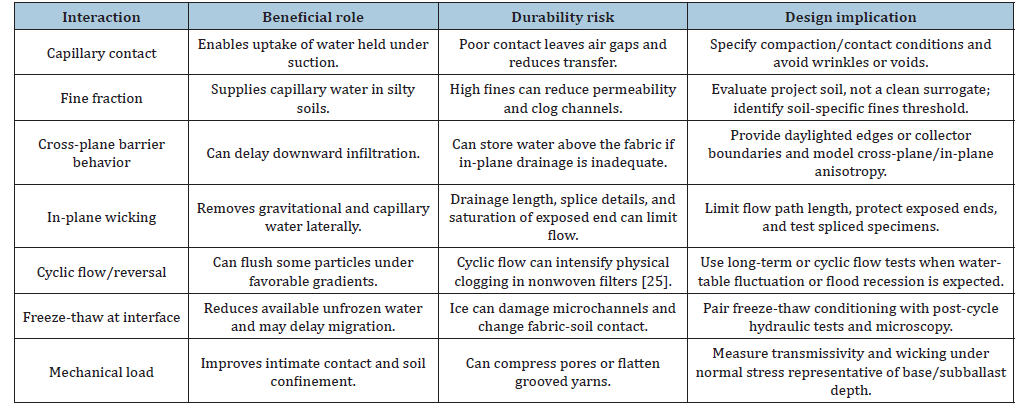
Installation and drainage boundaries further interact with these soil-related variables. Zou et al. [31] recently showed that an embedded wicking geotextile in silt initially behaved as a capillary barrier, but restricted lateral discharge promoted progressive interfacial water accumulation. In contrast, a surface-exposed configuration maintained lateral drainage and more effectively restricted long-term capillary rise. Therefore, fines content, compaction, soil suction, initial water content, normal stress and drainage-boundary configuration should be considered as a coupled system rather than as isolated design parameters. This also explains why a fines-content threshold obtained for one soil and one test configuration should not be transferred directly to another soil-geotextile system without validation (Tables 1-3).
Table 1:Evidence Map for Wicking Geotextile Hydraulic Performance
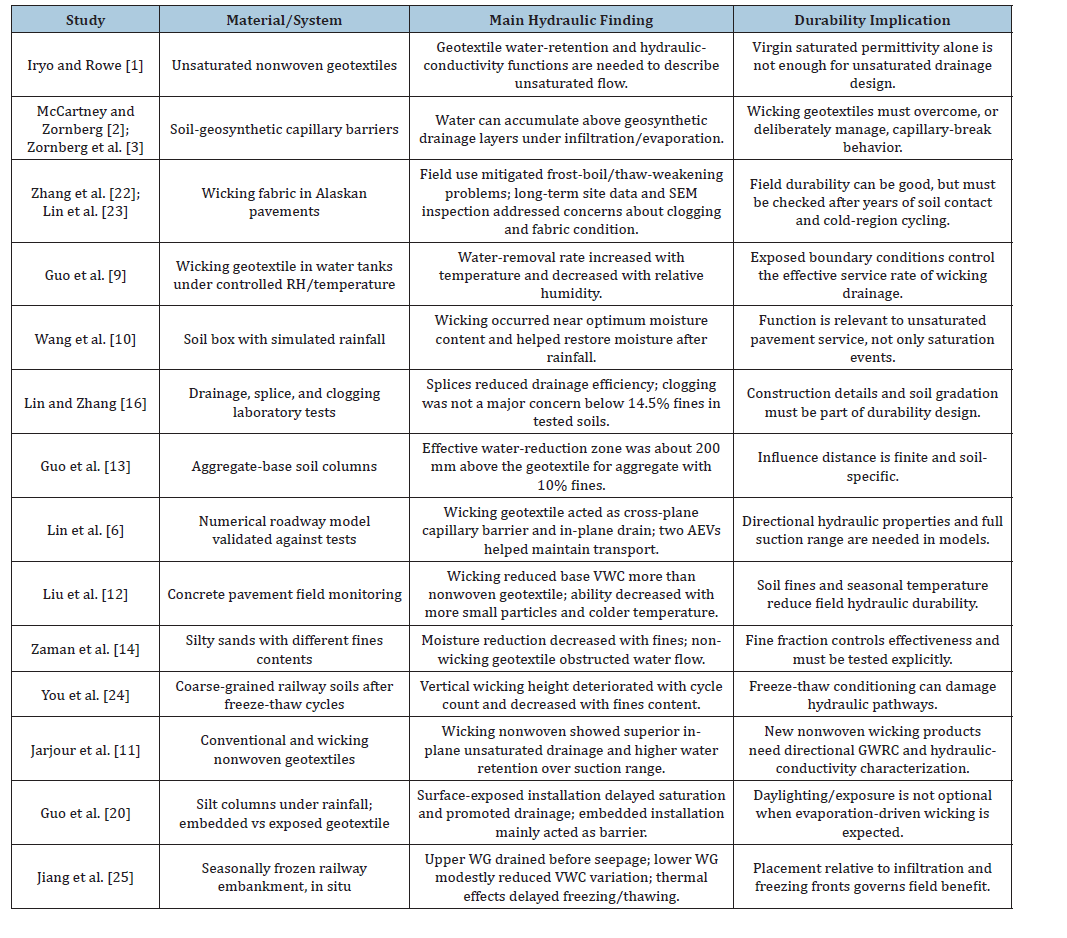
Table 2:Environmental Cycles, Failure Modes, and Suggested Metrics.
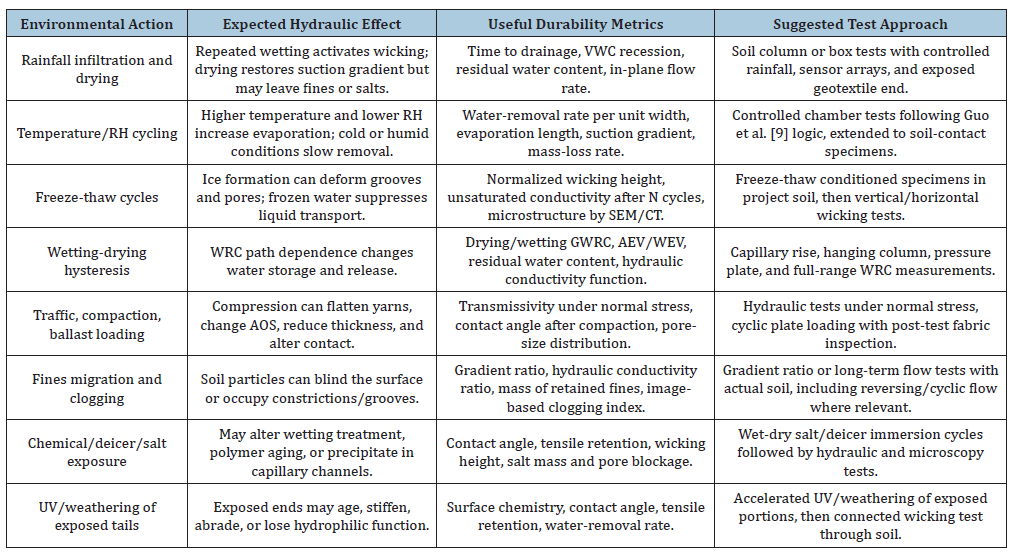
Table 3:Soil-Geotextile Interaction Mechanisms and Design Implications.
Test Methods and Design Considerations
A durability-oriented testing program should begin with a clean, virgin characterization but should not end there. At minimum, the geotextile should be characterized for apparent opening size, permittivity, in-plane transmissivity, mass per unit area, thickness under stress, contact angle/wettability, capillary rise or wicking height, and geotextile water-retention curve in relevant directions. ASTM D4491, ASTM D4716, ASTM D4751, ASTM D5101 and ASTM D5567 are useful anchors for conventional hydraulic/filter behavior, while capillary-rise, hanging-column, pressure-plate and chilled-mirror methods are needed for unsaturated response.
For wicking products, the following additions are recommended:
a) Report hydraulic properties as functions of suction, not as
single saturated values.
b) Test in-plane and cross-plane directions separately.
c) Include actual project soil and compacted density,
including fines and plasticity effects.
d) Condition specimens under project-relevant cycles:
freeze-thaw, wet-dry, rainfall-drying, traffic stress, and chemical
exposure.
e) Keep one end exposed in tests intended to represent
evaporation-driven wicking.
f) Compare intact, spliced, compacted, and soilcontaminated
specimens.
g) Use sensor-based soil columns to determine influence
distance and moisture redistribution.
h) Inspect fibers and pores after conditioning using optical
microscopy, SEM, CT, or image analysis.
Hydraulic durability can be expressed by retention factors, for
example:
R_H = H_N / H_0
where H_0 is the initial wicking height or water-removal rate and H_N is the value after N environmental cycles in soil contact. Similar retention ratios can be defined for in-plane hydraulic conductivity, transmissivity under stress, permittivity, or time required to return a soil layer to a target VWC. The advantage of retention factors is that they allow different products and conditioning levels to be compared without assuming the same initial capacity.
Research Gaps
The literature now supports the core mechanism and several field applications, but important durability gaps remain.
First, freeze-thaw evidence is growing but still product- and soil-specific. You et al. [24] show deterioration after cycles; Jiang et al. [25] show field configuration effects. More work is needed to link cycle severity, ice content, confining stress and yarn microstructure to long-term in-plane conductivity.
Second, wetting-drying durability is underdeveloped. Existing rainfall and field studies demonstrate service response, but standardized wet-dry aging with salts, deicers, UV exposure of daylighted tails, sediment deposition, and hydrophilic-treatment retention is rare.
Third, clogging criteria for wicking geotextiles are not yet mature. Conventional filter criteria do not fully address grooved yarns that must remain open for capillary flow. Gradient ratio, hydraulic conductivity ratio, and microscopy should be adapted to capture groove blockage and surface blinding.
Fourth, models need better hydraulic functions. Numerical simulations should include directional GWRCs, unsaturated hydraulic conductivity functions, temperature-dependent evaporation, freezing front movement and evolving clogging or damage terms where possible.
Finally, design should move from product qualification to system qualification. A wicking geotextile layer only works as intended when soil, fabric, boundary condition, and construction details are compatible.
Conclusion
Wicking geotextiles are promising because they target the unsaturated moisture regime in which conventional geotextile drains often underperform. Their hydraulic durability depends on retention of capillary uptake and in-plane transport, not merely on saturated permittivity.
Soil–geotextile interaction should therefore be treated as a coupled design condition. Fines may enhance the supply of capillary water while simultaneously increasing water retention and the potential for particle intrusion or clogging. Compaction may improve physical contact but also modify pore structure, suction, and hydraulic gradients. These effects interact further with initial water content, environmental cycling, mechanical stress, installation depth and the availability of an exposed drainage boundary. Consequently, soil-specific system testing is more defensible than adopting universal fines-content or drainageperformance limits.
Future specifications should require directional unsaturated hydraulic characterization, conditioning under realistic environmental cycles, project-soil clogging tests and postconditioning microscopy. This would convert wicking geotextile design from promising empirical practice into a more durable and mechanistic geotechnical technology.
References
- Iryo T, Rowe RK (2003) On the hydraulic behavior of unsaturated nonwoven geotextiles. Geotextiles and Geomembranes 21(6): 381-404.
- McCartney JS, Zornberg JG (2010) Effects of infiltration and evaporation on geosynthetic capillary barrier performance. Canadian Geotechnical Journal 47(11): 1201-1213.
- Zornberg JG, Bouazza A, McCartney JS (2010) Geosynthetic capillary barriers: Current state of knowledge. Geosynthetics International 17(5): 273-300.
- Azevedo M, Zornberg JG (2013) Capillary barrier dissipation by new wicking geotextile. In Advances in Unsaturated Soils, pp. 559-565.
- Zornberg JG, Azevedo M, Sikkema M, Odgers B (2017) Geosynthetics with enhanced lateral drainage capabilities in roadway systems. Transportation Geotechnics 12: 85-100.
- Lin C, Zhang X, Galinmoghadam J, Guo Y (2022) Working mechanism of a new wicking geotextile in roadway applications: A numerical study. Geotextiles and Geomembranes 50(2): 323-336.
- Bouazza A, Freund M, Nahlawi H (2006) Water retention of nonwoven polyester geotextiles. Polymer Testing 25(8): 1038-1043.
- Nahlawi H, Bouazza A, Kodikara J (2007) Characterisation of geotextiles water retention using a modified capillary pressure cell. Geotextiles and Geomembranes 25(3): 186-193.
- Guo J, Wang F, Zhang X, Han J (2017) Quantifying water removal rate of a wicking geotextile under controlled temperature and relative humidity. Journal of Materials in Civil Engineering 29(1): 04016181.
- Wang F, Han J, Zhang X, Guo J (2017) Laboratory tests to evaluate effectiveness of wicking geotextile in soil moisture reduction. Geotextiles and Geomembranes 45(1): 8-13.
- Jarjour J, Ibrahim A, Meguid MA (2025) Experimental and numerical investigation of the unsaturated behavior of conventional and wicking non-woven geotextiles. Geotextiles and Geomembranes 53(6): 1544-1557.
- Liu H, Han J, Al-Naddaf M, Parsons RL, Kakrasul JI (2022) Field monitoring of wicking geotextile to reduce soil moisture under a concrete pavement subjected to precipitations and temperature variations. Geotextiles and Geomembranes 50(5): 1004-1019.
- Guo J, Han J, Zhang X, Li Z (2019) Evaluation of moisture reduction in aggregate base by wicking geotextile using soil column tests. Geotextiles and Geomembranes 47(3): 306-314.
- Zaman MW, Han J, Mahadi MUK, Parsons RL (2024) Laboratory evaluation of wicking geotextile for moisture reduction in silty sands at different fines contents. Geotextiles and Geomembranes 52(6): 1180-1190.
- Zaman MW, Han J, Zhang X (2022) Evaluating wettability of geotextiles with contact angles. Geotextiles and Geomembranes 50(4): 825-837.
- Lin C, Zhang X (2018) Laboratory drainage performance of a new geotextile with wicking fabric. Journal of Materials in Civil Engineering 30(11): 04018293.
- Koerner RM, Koerner GR (2015) Lessons learned from geotextile filter failures under challenging field conditions. Geotextiles and Geomembranes 43(3): 272-281.
- Miszkowska A, Lenart S, Koda E (2017) Changes of permeability of nonwoven geotextiles due to clogging and cyclic water flow in laboratory conditions. Water 9(9): 660.
- Markiewicz A, Kiraga M, Koda E (2022) Influence of physical clogging on filtration performance of soil-geotextile interaction. Geosynthetics International 29(4): 356-368.
- Guo Y, Zou D, Hu M, Zhang X, Xu F, et al. (2026) Influence of wicking geotextile installation on moisture migration in silt under rainfall infiltration. Geotextiles and Geomembranes 54(1): 25-35.
- Henry KS, Holtz RD (2001) Geocomposite capillary barriers to reduce frost heave in soils. Canadian Geotechnical Journal 38(4): 678-694.
- Zhang X, Presler W, Li L, Jones D, Odgers B (2014) Use of wicking fabric to help prevent frost boils in Alaskan pavements. Journal of Materials in Civil Engineering 26(4): 728-740.
- Lin C, Presler W, Zhang X, Jones D, Odgers B (2017) Long-term performance of wicking fabric in Alaskan pavements. Journal of Performance of Constructed Facilities 31(2): D4016005.
- You Z, Xu J, Liu H, Zhang Z, Peng Y (2025) Experimental study on the wicking performance of a wicking geotextile in coarse-grained soils under freezing-thawing actions. Geotextiles and Geomembranes 53(6): 1388-1406.
- Jiang H, Tang P, Li T, Liu S, Liu Y, et al. (2026) In situ performance of wicking geotextile in seasonally frozen railway embankment. Geotextiles and Geomembranes 54(3): 549-559.
- Gonnabathula SSA, Biswas N, Ramineni K, Sadiq MF, Cetin B, et al. (2026) Evaluating the drainage performance of wicking geotextile under freeze–thaw conditions below pavement infrastructure. Transportation Research Record.
- Bai M, Liu ZB, Zhang SJ, Liu F, Lei SL (2021) Drainage performance and capillary rise restraint effect of wicking geotextile. Journal of Central South University 28(10): 3260-3267.
- Wang Y, Wu Y, Li X, Wei S, Yan H (2025) Experimental investigation of the capillary drainage performance of multilayer wicking fabric. Geotextiles and Geomembranes 53(5): 1168-1183.
- Guo Y, Xue Y, Zhang Y, Ruan W, Li Y, et al. (2025) Mechanical and deformation behavior of silt reinforced with wicking geotextile: An experimental study. Construction and Building Materials 482: 141721.
- Yang W, Bai Y, Wang M, Ma X, Wang S, et al. (2026) Thermal-hydraulic-mechanical evolution investigation of silt controlled by wicking geotextile under freeze–thaw cycles. Transportation Geotechnics 60: 101982.
- Zou D, Guo Y, Chen J, Li Y, Zhang, X, et al. (2026) Barrier-drainage performance of a wicking geotextile in controlling capillary rise in silt: Experimental evaluation. Geotextiles and Geomembranes 54(4): 679-691.
- Biswas A, Saha P, Khan MS, Kevern J, Bhandari A (2021) Evaluating the performance of wicking geotextile in providing drainage for flexible pavements built over expansive soils. Transportation Research Record 2675(8): 196-207.
- Ma C, Feng H, Wang C, Zhang N, Liu Y, et al. (2024) A numerical simulation of moisture reduction in fine soil subgrade with wicking geotextiles. Materials 17(2): 390.
© 2026 Muhammad Shahbaz. This is an open access article distributed under the terms of the Creative Commons Attribution License , which permits unrestricted use, distribution, and build upon your work non-commercially.
Editor In Chief







.jpg)































Signup for Newsletter

Quick Links
 Editorial Board Registrations
 Submit your Article
 Best Paper of the Volume
 Reprints
 Refer a Friend
 Advertise With Us
Our Recent Edition

.jpg)



Top Editors




.jpg)

















.bmp)
.jpg)
.png)
.jpg)













.jpg)






.png)

.png)




.png)




Financial Support

Sponsors

Latest e-Books

Latest Video

 a Creative Commons Attribution 4.0 International License. Based on a work at www.crimsonpublishers.com.
Best viewed in
a Creative Commons Attribution 4.0 International License. Based on a work at www.crimsonpublishers.com.
Best viewed in 
 | Above IE 9.0 version