

- About Us
- Information
-

The Author ensures that the research has been conducted responsibly and ethically with adherence to all relevant regulations. read more..
- For Authors
- For Reviewer
- Manuscript Guidelines
- Membership
- Publication Ethics
-
- Journals
- Reprints
- e-Books
- Videos
- Policies
- Contact Us
 COVID-19
- Submissions



Full Text
Advances in Complementary & Alternative medicine
NS1901F01, A Nitrate-Rich Amaranthus Preparation Improves Physical Performance, Muscle Growth and Exercise Endurance in Treadmill Trained Mice
Sameer Kamalakar Akolkar*, Madhukumar MS, Anirudh Ranga and Mohan Gowda CM
Natural & Essential Oils Private Limited, Mysuru, Karnataka, India
*Corresponding author:Sameer Kamalakar Akolkar, Natural & Essential Oils Private Limited, Mysuru, Karnataka, India
Submission: October 06, 2026;Published: October 22, 2026

ISSN: 2637-7802 Volume 9 Issue 4
Abstract
Nutritional strategies that enhance exercise tolerance and muscle function are of increasing interest. Nitric oxide mediated pathways have been implicated in the regulation of muscle contractility, oxygen utilization, and exercise performance. NS1901F01 is a standardized botanical preparation derived from Amaranthus dubius and Amaranthus tricolor aerial parts and containing 10% nitrate. This study evaluated the effects of 28 day NS1901F01 supplementation on exercise endurance and muscle growth in treadmill trained Swiss albino mice and assessed associated changes in serum nitric oxide, muscle weights, biochemical parameters, and acute oral tolerability. Male Swiss albino mice were allocated to negative control, exercise control, arginine (411mg/kg bw), or NS1901F01 (118.36 or 205.50mg/kg bw) groups (n=9/group). Treatment groups underwent treadmill training 5 days/week for 28 days. Exercise capacity was assessed by progressive treadmill exhaustion testing, including distance travelled, shock zone time, and shock frequency. Forelimb grip endurance, muscle weights, serum nitric oxide, metabolic and clinical biochemical parameters were also evaluated. Acute oral toxicity was assessed separately in female Sprague Dawley rats at 5000mg/kg.
Compared with exercise controls, NS1901F01 increased treadmill distance by 36.9% and 42.7% at the low and high doses, respectively, while reducing shock zone exposure and shock frequency. Grip endurance increased by 15.3% and 21.8%, respectively. Gastrocnemius and soleus weights increased, particularly at the high dose. Serum nitric oxide levels increased from 9.47 to 12.57 and 12.86ng/mL at the low and high doses, respectively. No treatment-related adverse biochemical or gross pathological findings were observed. A single 5000mg/kg bw oral dose produced no mortality or clinical toxicity. NS1901F01 improved treadmill endurance and forelimb muscle function in trained mice, accompanied by increased serum nitric oxide and muscle weights. These findings support further investigation of nitraterich Amaranthus preparations using direct measures of oxygen utilization, mitochondrial function, body composition, and muscle adaptation.
Keywords: NS1901F01; Amaranthus dubius; Amaranthus tricolor; Dietary nitrate; Nitric oxide; Endurance; Treadmill exercise
Abbreviations: ALP: Alkaline Phosphatase; ANOVA: Analysis of Variance; BW: Body Weight; CCSEA: Committee for Control and Supervision of Experiments on Animals; CM: Centimeter; HDL: High-Density Lipoprotein; IAEC: Institutional Animal Ethics Committee; LDL: Low-Density Lipoprotein; Min: Minute; OECD: Organisation for Economic Co-operation and Development; S: Second; SGOT: Serum Glutamic- Oxaloacetic Transaminase; SGPT: Serum Glutamic-Pyruvic Transaminase; TC: Total Cholesterol
Introduction
Physical performance during sustained exercise depends on the integrated function of muscle, cardiovascular oxygen delivery, substrate metabolism, and neuromuscular activity. Although exercise training induces adaptations that improve endurance and muscular performance, nutritional strategies that complement these adaptations remain of considerable interest. Dietary bioactives capable of influencing oxygen utilization, vascular function, muscle contractility, and fatigue-related processes have therefore been investigated as potential ergogenic interventions [1-3]. Nitric oxide is an important signaling molecule involved in vascular muscle function. In addition to the classical L-arginine-nitric oxide synthase pathway, nitric oxide bioavailability can be increased through the nitrate-nitrite-nitric oxide pathway. Dietary nitrate is sequentially reduced to nitrite and subsequently to nitric oxide, particularly under conditions of reduced oxygen availability and increased metabolic demand. Nitric oxide signaling influences vascular tone, muscle contractile function, cellular respiration, and muscle bioenergetics [1,4-6]. Dietary nitrate has consequently attracted substantial interest as a nutritional strategy for improving exercise performance.
A 2025 umbrella review of 20 systematic reviews involving 180 primary studies and 2672 unique participants reported improvements in time-to-exhaustion, total distance covered, muscular endurance, peak power output, and time to peak power; however, effects were not consistent across all performance outcomes, and the methodological quality of most underlying reviews was low or critically low [7]. Earlier systematic reviews and meta-analyses similarly reported improvements in time-toexhaustion, distance travelled, and selected measures of exercise capacity, although responses varied according to exercise modality, supplementation strategy, and participant characteristics [8,9]. The potential effects of nitrate-derived nitric oxide extend beyond cardiovascular responses to muscle function. Dietary nitrate has been shown to reduce the oxygen cost of exercise and increase exercise efficiency, potentially through effects on muscle bioenergetics and mitochondrial oxidative phosphorylation [5,6,10]. Nitric oxide related mechanisms may also influence muscle contractile properties and power production [11].
Consistent with these observations, systematic reviews and meta-analyses have reported improvements in selected measures of muscular endurance and muscle power following nitrate supplementation [12,13]. However, these effects are not universal. A recent dose-response study in resistance trained men demonstrated dose-dependent increases in circulating nitrate and nitrite without significant improvements in countermovement-jump, squat, or bench-press performance, emphasizing the influence of dose, exercise modality, training status, and supplementation protocol on the ergogenic response [14]. NS1901F01 is a test preparation investigated in the present study for its potential to support physical performance during repeated exercise. To provide complementary measures of functional performance, the experimental model incorporated both endurance and strength related endpoints.
Male Swiss albino mice received NS1901F01 at 118.36 and 205.50mg/kg Body Weight (bw) for 28 days, with treatment groups undergoing treadmill exercise five days per week. Exercise capacity was evaluated using a progressive treadmill exhaustion test, including distance travelled, running time, shock zone exposure, and shock frequency, while forelimb grip endurance was assessed as an indicator of muscle function. muscle weights, serum nitric oxide levels, lipid parameters, liver and kidney biochemical markers, body weight, food intake, and blood glucose were also evaluated. Accordingly, the present study investigated whether 28- day administration of NS1901F01 improves exercise endurance and muscle strength in treadmill trained mice and whether these functional effects are associated with changes in muscle weights and serum nitric oxide levels. Selected biochemical and organ weight parameters were additionally assessed to provide preliminary information on general tolerability during the intervention.
Materials and Methods
Plant material
NS1901F01 is a proprietary natural herbal preparation used in this study. It was prepared from the aerial parts of Amaranthus dubius and Amaranthus tricolor. It’s a aqueous extract, developed and named by Natural and Essential Oils Private Limited, Mysuru, India. NS1901F01 is phytochemically standardized to 10% nitrate by HPLC method [15].
Study 1: Endurance-efficacy study
Animals: Male Swiss albino mice (7-8 weeks old; 24-26g body weight), bred in-house, were used for the study. The animals were housed in standard polycarbonate cages under controlled environmental conditions, with a temperature of 22±3 °C, relative humidity of 30-70%, and a 12h light/12h dark cycle. The mice were provided with a standard laboratory diet (PURINA 5L79, PMI Nutritional, USA) and water ad libitum throughout the study. All experimental procedures were conducted following approval from the Institutional Animal Ethics Committee (IAEC) of Radiant Research Services Pvt. Ltd., Bengaluru, India (Approval No. RR/ IAEC/75-2020). The study was conducted in accordance with the guidelines of the Committee for the Control and Supervision of Experiments on Animals (CCSEA; Registration No. 1803/PO/ RcBi/S/2015/CCSEA).
Study design and experimental procedure: Animals were divided into five groups, with nine animals in each group. Group 1 served as the negative control, whereas Group 2 served as the exercise control (no treatment). Group 3 was treated with the reference standard, Arginine (411mg/kg bw; Avantor, India). Groups 4 and 5 received low (118.36mg/kg bw) and high (205.50mg/ kg bw) doses of NS1901F01, respectively, for 28 days (Table 1). Animals in Groups 2-5 were subjected to treadmill training 5 days per week for 28 days. Forelimb grip endurance was evaluated on Days 0 and 28. Body weight was recorded weekly, and feed intake was measured daily. Blood glucose levels were measured once weekly during the treatment period. On Day 29, blood samples were collected via the retro-orbital route for biochemical analysis, following which the animals were euthanized under anesthesia. The weighable organs, including the liver, heart, gastrocnemius, and soleus muscles, were isolated, collected, and weighed. Serum was separated from the collected blood samples and used for the estimation of various biochemical parameters.
Table 1:Study design.

Serum samples were analyzed for biochemical parameters, including liver and renal function markers such as SGOT (Cat. No. 31090172), SGPT (Cat. No. 31090216), ALP (Cat. No. 31070321), total protein (Cat. No. 30020037), urea (Cat. No. 31080381), and creatinine (Cat. No. 30020458), as well as lipid profile parameters, including triglycerides (Cat. No. 31100111), total cholesterol (Cat. No. 31070231), HDL (Cat. No. 32010207), and LDL (Cat. No. 31070139). All assay kits were procured from Agappe Diagnostics, India, and the analyses were performed according to the manufacturer’s instructions.
Fore limb grip endurance: Forelimb grip endurance was measured on days 0 and 28 using a stainless-steel grid to assess muscle strength. Grip endurance was assessed 1h after treatment. Each mouse was placed on the grid, and the grid was inverted to allow the animal to grip the steel bars. The time for which each animal maintained its grip on the inverted grid was recorded. The maximum duration for each trial was 6 min. Three trials were performed for each animal at 6 min intervals, and the mean duration of the three independent trials was calculated for each animal [16].
Exercise training: During the treatment period, the animals underwent treadmill exercise at a moderate intensity. The treadmill was operated at a maximum running speed of 20cm/s, with an electrical stimulus of 0.2mA and an inclination of 10°, for a total duration of 10min. The treadmill speed was manually increased by 5cm/s every 2min throughout the 10min exercise session. The animals were habituated to the treadmill procedure daily, 1h after dosing, approximately between 11:30AM and 2:30PM, for 5 days per week throughout the treatment period. The negative control group was not subjected to treadmill exercise [17].
Muscle endurance treadmill test: On the 28th day of treatment, all animals were subjected to a muscle endurance test using a motorized treadmill. The test was performed at a low-tomoderate intensity, with an initial speed of 5cm/s and a maximum running speed of 50cm/s. The treadmill was maintained at an inclination of 10°, and an electrical stimulus of 0.2mA was applied as an aversive stimulus. The treadmill speed was increased by 5cm/s every 2 min until a maximum speed of 50cm/s was reached. Animals were subjected to the treadmill test until exhaustion. The distance traveled (cm), time spent in the shock zone (s), number of shocks received, and total running time (min) were recorded for each animal in the respective treatment groups [18].
Study 2: Acute oral toxicity study
Animals: Female Sprague Dawley rats (9-10 weeks old; 166.54- 191.69g) were procured from Hylasco Biotechnology (Telangana, India). The animals were housed in standard polycarbonate cages under controlled environmental conditions, with a temperature of 20 °C -23 °C, relative humidity of 48-68%, and a 12h light/12h dark cycle. The rats were provided with a standard laboratory diet and water ad libitum throughout the study. All experimental procedures were conducted following approval from the Institutional Animal Ethics Committee (IAEC) of Vipragen Biosciences Pvt. Ltd., Mysuru, India (Approval No. VIP/IAEC/163/2019). The study was conducted in accordance with the guidelines of the Committee for the Control and Supervision of Experiments on Animals (CCSEA; Registration No. 1683/PO/RcBiBt/S/13/CPCSEA).
Study design and experimental procedure: The animals received a single dose of NS1901F01 by oral gavage following an overnight fasting period (approximately 17 and 16h for the initial and confirmatory tests, respectively), with free access to water. Food was provided approximately 3h after dosing. As testing at a dose level of 5000mg/kg bw requires only one step involving three animals (Annex 2, OECD 423) [19], the first animal was initially administered NS1901F01 at 5000mg/kg bw. As no mortality or signs of acute toxicity were observed, two additional naïve animals were subsequently administered the same dose as part of the confirmatory test. The dose volume was 10mL/kg bw (Table 2).
Table 2:Study design.

Morbidity/mortality, clinical signs and necropsy: All animals were observed twice daily for morbidity and mortality throughout the study period. Individual animals were monitored for clinical signs of toxicity at 30min and 1, 2, 3, and 4h post-dose on Day 0, and subsequently once daily throughout the 14day observation period. At the end of the observation period, all rats were subjected to necropsy on Day 14. The animals were euthanized by CO₂ asphyxiation in a designated euthanasia chamber. A detailed gross pathological examination of the external and internal organs was performed, and all observations were recorded.
Statistical analysis: The values were expressed as mean±SEM. Statistical differences between the treatment groups and the exercise control group were evaluated using one-way Analysis of Variance (ANOVA) followed by Dunnett’s multiple comparisons test. P value<0.05 was considered statistically significant.
Results
Effects of NS1901F01 on exercise endurance and physical performance
NS1901F01 supplementation significantly improved exercise performance in the treadmill endurance test compared with the exercise control group (Figure 1). At baseline (Day 0), treadmill distance was comparable among the treatment groups. Following 28 days of supplementation, the exercise control group achieved a treadmill distance of 1483.33±37.68cm, whereas the NS1901F01 low dose and high dose groups achieved 2030.56±27.99cm and 2116.67±26.35cm, respectively. These values corresponded to increases of approximately 36.9% and 42.7%, respectively, relative to the exercise control group. The standard group achieved a distance of 2183.33±17.57 cm, corresponding to an increase of approximately 47.2% compared with the exercise control group. The differences observed in both NS1901F01 groups and the standard group were statistically significant (P<0.0001). The effects of NS1901F01 on fatigue-related performance parameters were further demonstrated by the time spent in the shock zone during the treadmill test (Figure 2).
Figure 1:Effect of NS1901F01 on treadmill endurance in mice. Treadmill endurance was assessed as the distance travelled until exhaustion on Day 28 following the treatment period. Data are presented as mean±SEM (n=9 per group). Statistical significance was determined using oneway Analysis of Variance (ANOVA) followed by Dunnett’s multiple-comparison test. Statistical comparisons were performed between the exercise control group and the reference standard, NS1901F01 low and high dose groups. ***P<0.0001.
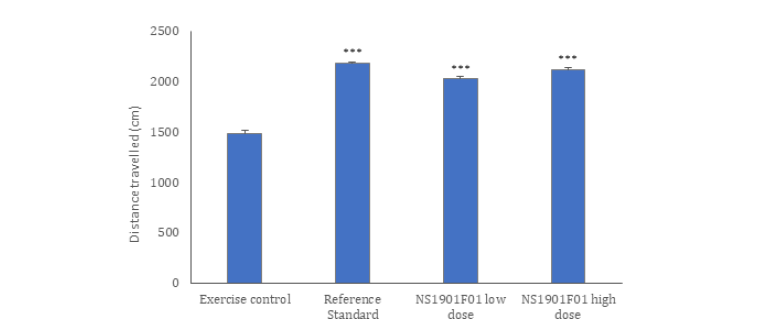
Figure 2:Effect of NS1901F01 on time spent in the shock zone following the 28-day exercise training period. Data are presented as mean±SEM (n=9 per group). Statistical significance was determined using one-way Analysis of Variance (ANOVA) followed by Dunnett’s multiple-comparison test. Statistical comparisons were performed between the exercise control group and the reference standard, NS1901F01 low and high dose groups. ***P<0.0001.
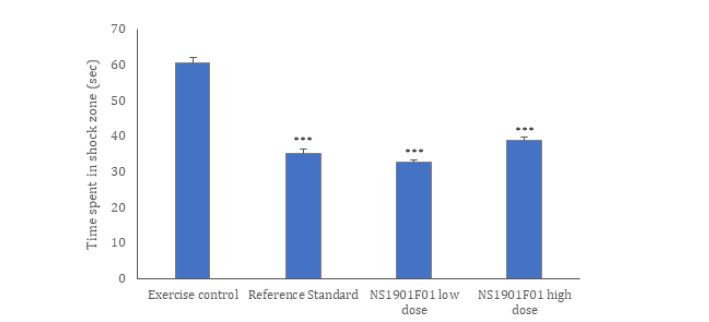
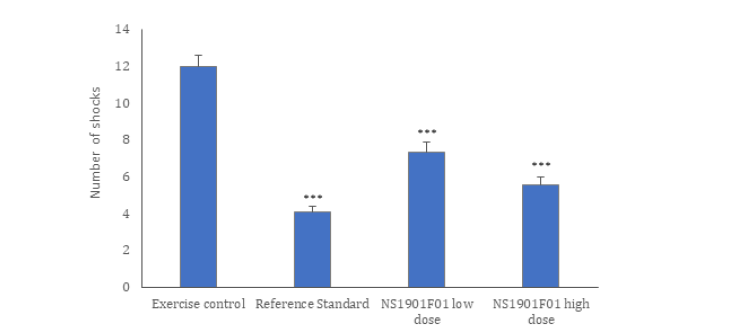
On Day 28, the exercise control group spent 60.67±1.51s in the shock zone, whereas animals receiving NS1901F01 low dose and high dose spent significantly less time in the shock zone, 36.11±1.13s and 38.78±1.12s, respectively (P<0.0001). The standard group showed a corresponding value of 35.33±1.05s. Relative to the exercise-control group, these findings represent reductions of approximately 40.5% and 36.1% with NS1901F01 low dose and high dose, respectively, and 41.7% with the standard treatment. A similar pattern was observed for the number of shocks received during treadmill exercise (Figure 3). On Day 28, the exercise-control group received 12.00±0.63 shocks, compared with 7.33±0.57 and 5.56±0.45 shocks in the NS1901F01 low dose and high dose groups, respectively. The standard group received 4.11±0.29 shocks. Compared with the exercise-control group, NS1901F01 low dose and high dose reduced the number of shocks by approximately 39.0% and 53.7%, respectively, while the standard treatment produced a reduction of approximately 65.8%. All treatment groups showed statistically significant differences compared with the exercise control group (P<0.0001).
Figure 3:Effect of NS1901F01 on the number of shocks received during treadmill endurance testing in mice. Data are presented as mean±SEM (n=9 per group). Statistical significance was determined using one-way Analysis of Variance (ANOVA) followed by Dunnett’s multiple-comparison test. Statistical comparisons were performed between the exercise control group and the reference standard, NS1901F01 low and high dose groups. ***P<0.0001.
Effects of NS1901F01 on forelimb grip endurance
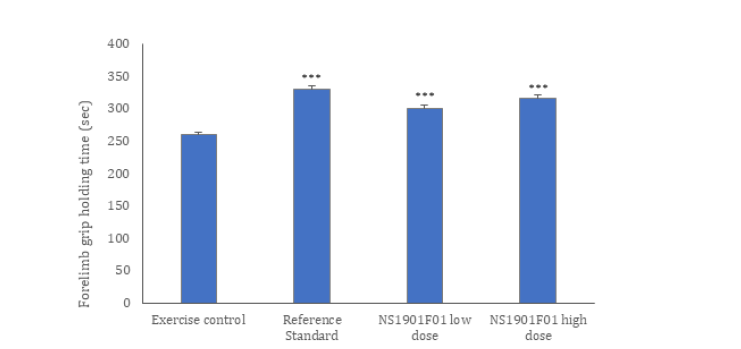
NS1901F01 supplementation also enhanced grip endurance following 28 days of treatment (Figure 4). Baseline grip was comparable among the groups. On Day 28, the exercise control group exhibited a grip endurance of 260.11±3.91 s, whereas the NS1901F01 low dose and high dose groups exhibited values of 299.89±6.01 and 316.78±4.62 s, respectively. These values represented increases of approximately 15.3% and 21.8%, respectively, relative to the exercise control group. The standard group demonstrated a grip endurance of 331.04±5.46 s, corresponding to an approximately 27.3% increase relative to the exercise control group. The differences between the treatment groups and the exercise control group were statistically significant (P<0.0001). Overall, 28 days of NS1901F01 supplementation resulted in improvements in treadmill endurance and grip endurance, accompanied by reductions in time spent in the shock zone and the number of shocks received during treadmill exercise. The high dose group showed greater improvements for several functional and muscle weight parameters, although dose-response relationships were not consistent across all endpoints.
Figure 4:Effect of NS1901F01 on forelimb grip endurance in exercised mice. Data are presented as mean±SEM (n=9 per group). Statistical significance was determined using one-way Analysis of Variance (ANOVA) followed by Dunnett’s multiple-comparison test. Statistical comparisons were performed between the exercise control group and the reference standard, NS1901F01 low and high dose groups. ***P<0.0001.
Effect of NS1901F01 on organ and muscle weights
Following 28 days of treatment, no appreciable differences were observed in liver or heart weights among the experimental groups (Table 3). Liver and heart weights were comparable across the negative control, exercise control, reference standard, NS1901F01 low dose and high dose groups. In contrast, gastrocnemius and soleus muscle weights showed significant increases following treatment with the reference standard and NS1901F01. Gastrocnemius weight increased from 164.00±1.65mg in the exercise control group to 175.33±0.94mg in the reference standard group (P<0.0001), 168.67±0.44mg in the NS1901F01 low dose group (P<0.05), and 172.00±0.94mg in the NS1901F01 high dose group (P<0.0001). Similarly, soleus weight increased from 7.21±0.20mg in the exercise control group to 9.04±0.10mg in the reference standard group (P<0.0001), 7.74±0.09mg in the NS1901F01 low dose group (P<0.05), and 8.04±0.10mg in the NS1901F01 high dose group (P<0.0001). These findings indicate that NS1901F01 treatment was associated with increased muscle weights, particularly at the higher dose.
Table 3:Effect of NS1901F01 on organ weights in exercised mice.

Organ weights of the liver, heart, gastrocnemius, and soleus muscles were recorded at the end of the 28-day treatment and exercise period. Data are presented as mean±SEM (n=9 per group). Statistical significance was determined using one-way Analysis of Variance (ANOVA) followed by Dunnett’s multiple-comparison test. Statistical comparisons were performed between the exercise control group and the reference standard, NS1901F01 low and high dose groups. *P value<0.05; ***P<0.0001.
Effect of NS1901F01 on serum lipid profile and nitric oxide levels
The effects of NS1901F01 on serum lipid parameters and nitric oxide levels after 28 days are presented in Table 4. No statistically significant differences were observed in the measured biochemical parameters among the experimental groups at the end of the treatment period, indicating that NS1901F01 administration did not produce detectable alterations in the assessed liver and kidney function parameters. In contrast, Total Cholesterol (TC) was significantly reduced in the reference standard group (87.78±0.60 mg/dL; P<0.0001), NS1901F01 low dose group (94.56±1.13mg/ dL; P<0.05), and NS1901F01 high dose group (92.44±0.94mg/dL; P<0.001) compared with the exercise control group (99.00±1.31mg/ dL). A marked increase in serum nitric oxide levels was observed following treatment. Nitric oxide concentration increased from 9.47±0.13ng/mL in the exercise control group to 12.99±0.16ng/mL in the reference standard group (P<0.0001). NS1901F01 treatment increased nitric oxide levels to 12.57±0.12ng/mL at the low dose and 12.86±0.07ng/mL at the high dose, both showing significant increases (P<0.0001) compared with the exercise control group. The nitric oxide concentrations observed with both NS1901F01 doses were comparable to those of the reference standard group.
Table 4:Effect of NS1901F01 on serum lipid profile and nitric oxide levels in exercised mice.

Serum concentrations of Total Cholesterol (TC), Triglycerides (TG), High-Density Lipoprotein Cholesterol (HDL-C), Low- Density Lipoprotein Cholesterol (LDL-C), and Nitric Oxide (NO) levels were determined at the end of the 28-day treatment period. Data are presented as mean±SEM (n=9 per group). Statistical significance was determined using one-way Analysis of Variance (ANOVA) followed by Dunnett’s multiple-comparison test. Statistical comparisons were performed between the exercise control group vs Negative control group and exercise control group vs the reference standard, NS1901F01 low and high dose groups. *P value<0.05; **P value<0.001; ***P<0.0001.
General health and biochemical parameters
Throughout the 28-day treatment period, animals in the exercise control, reference standard, and NS1901F01 treated groups exhibited normal growth and maintained overall body weight progression. Food intake was increased in the exercise control and NS1901F01 treated groups, consistent with the increased physical activity associated with treadmill exercise; food intake in the NS1901F01 groups was comparable to that of the reference standard group. Blood glucose levels remained comparable among the experimental groups, with no statistically significant treatmentrelated changes observed. Likewise, the biochemical parameters assessed at the end of the treatment period did not show significant alterations attributable to NS1901F01 treatment. Together with the absence of significant changes in liver and heart weights, these findings indicate that 28-day administration of NS1901F01 at the tested doses did not produce evident adverse changes in the measured general health and biochemical parameters. Overall, NS1901F01 administration was associated with increased gastrocnemius and soleus muscle weights and a marked elevation in serum nitric oxide levels, while producing relatively limited changes in the serum lipid profile. The findings support further investigation of NS1901F01 in dedicated studies evaluating muscle adaptation, body composition, and lipid metabolism.
Acute oral toxicity study
No treatment-related mortality was observed following oral administration of NS1901F01 at 5000mg/kg bw. No clinical signs of toxicity were observed in any of the animals during the observation period. All animals treated at 5000mg/kg bw remained clinically normal throughout the study, with no treatment-related systemic or local signs observed at 0.5, 1, 2, 3, or 4h after dosing on Day 0 or during subsequent observation periods. At necropsy, no treatmentrelated external or internal gross abnormalities were detected in any of the animals.
Discussion
The present study demonstrates that 28 days of NS1901F01 supplementation improved exercise endurance and muscle function in treadmill trained Swiss albino mice. Both doses increased treadmill distance, reduced shock zone exposure and shock frequency, and improved forelimb grip endurance compared with the exercise control group. These effects were accompanied by increased serum nitric oxide concentrations and gastrocnemius and soleus muscle weights, providing preliminary in vivo evidence that NS1901F01, a nitrate standardized preparation derived from Amaranthus dubius and Amaranthus tricolor aerial parts, may support physical performance during repeated exercise. Endurance capacity depends on integrated muscle function, oxygen delivery, substrate utilization, mitochondrial ATP production, and fatigue resistance. Dietary nitrate is of particular interest because the nitrate-nitrite-nitric oxide pathway provides an alternative source of nitric oxide, especially under conditions of reduced oxygen availability and increased metabolic demand [1,3,8,20].
Nitrate supplementation has been reported to reduce the oxygen cost of exercise and improve exercise tolerance in selected conditions, although responses vary according to exercise modality, dose, training status, and population [21-25]. The 36.9% and 42.7% increases in treadmill distance observed with NS1901F01 are therefore consistent with previous evidence supporting nitrate associated improvements in exercise capacity. However, the magnitude of these effects should not be directly extrapolated to humans. The present treadmill protocol incorporated progressive speed increments and electrical stimulation; therefore, performance reflects both physiological capacity and behavioral persistence. Shock grid treadmill models can introduce stress and motivational components into endurance measurements [26,27]. The reduced shock zone exposure and shock frequency observed with NS1901F01 may indicate improved ability to sustain running during the exercise challenge, but these parameters should be considered supportive rather than independent measures of metabolic endurance.
The increase in serum nitric oxide levels provides a plausible mechanistic link to the observed performance effects. NS1901F01 contains 10% nitrate, which can be reduced sequentially to nitrite and nitric oxide. Increased nitric oxide levels availability may influence vascular tone, oxygen delivery, mitochondrial function, and muscle contractility [8,28,29]. In the present study, serum nitric oxide levels increased from 9.47ng/mL in the exercise control group to 12.57 and 12.86ng/mL following low and high dose NS1901F01 treatment, respectively. This finding is consistent with increased systemic nitric oxide related bioavailability. Nevertheless, serum nitric oxide measurements alone do not establish activation of the nitrate-nitrite-nitric oxide pathway within muscle. Because nitric oxide is short lived and assays may detect nitric oxide related metabolites rather than free nitric oxide, the present findings demonstrate an association rather than a causal mechanism. Plasma/tissue nitrate and nitrite, NOS activity, cyclic GMP signaling, and muscle specific nitric oxide pathways should be evaluated in future studies. One potential explanation for the improved endurance is enhanced exercise efficiency.
Dietary nitrate has been shown to reduce the oxygen requirement for a given workload and may improve mitochondrial oxidative phosphorylation efficiency [10,21]. Nitrate-derived nitric oxide may also influence mitochondrial respiration and ATP turnover. Although VO₂, mitochondrial respiration, ATP production, lactate, and substrate oxidation were not measured, the improved treadmill performance is compatible with these mechanisms. Future studies incorporating indirect calorimetry, VO₂, respiratory exchange ratio, mitochondrial respiration, and muscle energy metabolites would help determine whether NS1901F01 directly affects exercise efficiency or energy metabolism. NS1901F01 also improved forelimb grip endurance, with increases of approximately 15% and 22% at the low and high doses, respectively, compared with the exercise control group. Nitric oxide signaling can influence muscle excitation contraction coupling and contractile function. Dietary nitrate has been reported to increase intracellular calcium availability and force production in fast twitch muscle, while human studies indicate potential effects on muscle contractile properties [30-32].
Thus, the improved grip endurance may reflect enhanced muscle or neuromuscular function, although the present study cannot distinguish between these mechanisms. The increases in gastrocnemius and soleus weights, particularly at the high dose, provide additional evidence of an effect on muscle phenotype. However, exercise itself strongly promotes muscle adaptation, and the study cannot determine whether NS1901F01 independently promotes muscle growth or enhances exercise-induced remodeling. Absolute muscle weight also does not distinguish hypertrophy from changes in glycogen, hydration, connective tissue, or other components. As lean mass, muscle fiber cross sectional area, protein synthesis, and anabolic signaling were not assessed, the findings should not be interpreted as evidence of a muscle building or lean mass effect. Histology, body composition analysis, muscle protein synthesis, and mTORC1-related markers would provide stronger evidence in future studies. The effects of NS1901F01 were broadly comparable with those of the arginine reference treatment.
Because arginine serves as a substrate for the classical NOS pathway, the similar increases in exercise performance and serum nitric oxide levels are compatible with convergence on nitric oxide related physiological processes. However, the present study was not designed to establish equivalence or comparative efficacy between NS1901F01 and arginine; therefore, arginine should be considered a positive comparator rather than evidence of identical mechanisms. NS1901F01 also reduced total cholesterol, particularly at the high dose, although the study was primarily designed to evaluate exercise performance. Exercise itself can influence lipid metabolism, and food intake increased in the exercising groups. In the absence of pair feeding, body composition assessment, energy expenditure, hepatic lipid measurements, or cholesterol turnover markers, the contribution of NS1901F01 to the observed lipid changes remains uncertain. Accordingly, these findings should be considered hypothesis generating rather than evidence of a definitive lipid modulating effect. No meaningful treatment-related changes were observed in liver or kidney biochemical markers or liver and heart weights during the 28-day intervention.
Furthermore, a separate acute oral toxicity study showed no mortality, clinical toxicity, or gross pathological abnormalities following a single 5000mg/kg bw oral dose. The study followed the stepwise approach described in OECD Test Guideline 423 [19]. These findings provide preliminary evidence of tolerability under the tested conditions but do not establish long term safety. Extended repeated dose toxicity studies with hematological, biochemical, histopathological, and toxicokinetic evaluations are warranted. Several limitations should be acknowledged. The study included only male Swiss albino mice, limiting extrapolation to other populations. Electrical stimulation during treadmill testing may introduce behavioral and stress related influences. In addition, VO₂, lactate, glycogen utilization, mitochondrial function, ATP turnover, nitrate/nitrite concentrations, and tissue-specific nitric oxide signaling were not measured. Muscle weight increases were not supported by histological or body-composition analyses. Dietary nitrate and Sirtuin 1 (SIRT1) interact closely in regulating cellular metabolism, mitochondrial function and skeletal muscle. Exercise, Sirtuin 1 activators and low-calorie diets increase Sirtuin 1 activity with relevance to nitric oxide homeostasis, mitochondrial biogenesis and muscle, liver, heart, brain and kidney function.
Plasma Sirtuin 1 levels may need to be measured with relevance to the administration of NS1901F01 in these mice studies. Despite these limitations, the study incorporated repeated exercise training, two NS1901F01 doses, an active reference comparator, multiple functional endpoints, muscle measurements, biochemical assessments, and a separate acute toxicity evaluation. The concordance of improved treadmill performance and grip function with increased serum nitric oxide levels and muscle weights supports further investigation of NS1901F01 as a nitrate standardized botanical preparation for exercise performance. Future studies should integrate VO₂ and exercise-economy measurements, nitrate/nitrite kinetics, mitochondrial function, muscle histology, fiber-type analysis, calcium handling proteins, and molecular markers of muscle adaptation. Ultimately, randomized placebo-controlled human studies will be required to determine whether these preclinical findings translate to improved endurance, strength, or exercise recovery.
Conclusion
28-day administration of NS1901F01 improved treadmill endurance and forelimb muscle function in trained Swiss albino mice, as evidenced by increased running distance and grip endurance and reduced shock zone exposure and shock frequency. These functional improvements were accompanied by increased serum nitric oxide levels and muscle weights, suggesting that enhanced nitric oxide related signaling and muscle adaptation may contribute to the observed effects. A single oral dose of 5000mg/ kg bw produced no treatment-related mortality, clinical signs of toxicity, or gross pathological abnormalities during the 14-day observation period. Although these findings support the potential of NS1901F01 as a nitrate standardized botanical preparation for improving exercise endurance and muscle function, the underlying mechanisms and translational relevance require confirmation through studies incorporating direct measures of exercise metabolism, nitrate/nitrite bioavailability, mitochondrial function, muscle adaptation, and controlled human clinical trials [33-36].
Acknowledgement
The authors gratefully acknowledge Radiant Research Services Pvt. Ltd. and Vipragen Biosciences Pvt. Ltd., for their contributions to this study.
Conflict of Interest
The authors declare that they have no conflicts of interest related to this work.
Author Contributions
Conceptualization and preclinical studies: Sameer Kamalakar
Akolkar.
Manuscript writing: Mohan Gowda C M
Extraction and Analytical: Madhukumar M.S.
Manuscript review: Anirudh Ranga
Competing Interests
Sameer Kamalakar Akolkar, Madhukumar M S, Anirudh Ranga, Mohan Gowda C M, are employed with Natural and Essential Oils Private Limited, Mysuru, Karnataka, India. This does not alter our adherence to Advances in Complementary and Alternative Medicine policies on sharing data and materials.
Funding
The study was sponsored by Natural & Essential Oils Pvt. Ltd., Mysuru, India.
References
- Jones AM (2014) Dietary nitrate supplementation and exercise performance. Sports Med 44 Suppl 1(Suppl 1): S35-45.
- Jones AM, Ferguson SK, Bailey SJ, Vanhatalo A, Poole DC (2016) Fiber-type specific effects of dietary nitrate. Exerc Sport Sci Rev 44(2): 53-60.
- Lundberg JO, Carlstrom M, Weitzberg E (2018) Metabolic effects of dietary nitrate in health and disease. Cell Metab 28(1): 9-22.
- Lundberg JO, Weitzberg E, Gladwin MT (2008) The nitrate-nitrite-nitric oxide pathway in physiology and therapeutics. Nat Rev Drug Discov 7(2): 156-167.
- Larsen FJ, Weitzberg E, Lundberg JO, Ekblom B (2007) Effects of dietary nitrate on oxygen cost during exercise. Acta Physiol (Oxf) 191(1): 59-66.
- Bailey SJ, Fulford J, Vanhatalo A, Winyard PG, Blackwell JR, et al. (2010) Dietary nitrate supplementation enhances muscle contractile efficiency during knee-extensor exercise in humans. J Appl Physiol 109(1): 135-148.
- Poon ETC, Iu JCK, Sum WMK, Wong PS, Lo KKH, et al. (2025) Dietary nitrate supplementation and exercise performance: an umbrella review of 20 published systematic reviews with meta-analyses. Sports Med 55(5): 1213-1231.
- McMahon NF, Leveritt MD, Pavey TG (2017) The effect of dietary nitrate supplementation on endurance exercise performance in healthy adults: A systematic review and meta-analysis. Sports Med 47(4): 735-756.
- Senefeld JW, Wiggins CC, Regimbal RJ, Dominelli PB, Baker SE, et al. (2020) Ergogenic effect of nitrate supplementation: a systematic review and meta-analysis. Med Sci Sports Exerc 52(10): 2250-2261.
- Larsen FJ, Schiffer TA, Borniquel S, Sahlin K, Ekblom B, et al. (2011) Dietary inorganic nitrate improves mitochondrial efficiency in humans. Cell Metab 13(2): 149-159.
- Esen O, Dobbin N, Callaghan MJ (2023) The effect of dietary nitrate on the contractile properties of human skeletal-muscle: A systematic review and meta-analysis. J Am Nutr Assoc 42(4): 327-338.
- Alvares TS, Oliveira GV, Souza MV, Junior CAC, Murias JM (2022) Effect of dietary nitrate ingestion on muscular performance: A systematic review and meta-analysis of randomized controlled trials. Crit Rev Food Sci Nutr 62(19): 5284-5306.
- Coggan AR, Hirshman MF, McLean BD, Price TB (2018) Muscle power: Nitrate supplementation and skeletal-muscle function. Med Sci Sports Exerc 50(1): 1-10.
- Tan R, Lincoln IG, Paniagua KK, Foster JM, Wideen LE, et al. (2025) The effect of dietary nitrate supplementation on resistance exercise performance: A dose-response investigation. Eur J Appl Physiol 125(10): 2869-2883.
- Preechaworapun A, Taweemanoonn S, Juntee T (2015) Rapid and simultaneous measurement of nitrate and nitrite in vegetables by High Performance Liquid Chromatography. J Sci Humanit Soc Sci 16(1): 40-49.
- Takeshita H, Yamamoto K, Nozato S, Inagaki T, Tsuchimochi H, et al. (2017) Modified forelimb grip strength test detects aging-associated physiological decline in skeletal-muscle function in male mice. Sci Rep 7: 42323.
- Dougherty JP, Springer DA, Gershengorn MC (2016) The treadmill fatigue test: A simple, high-throughput assay of fatigue-like behavior for the mouse. J Vis Exp (111): 54052.
- Castro B, Kuang S (2017) Evaluation of muscle performance in mice by treadmill exhaustion test and whole-limb grip strength assay. Bio Protoc 7(8): e2237.
- OECD (2002) Test No. 423: Acute Oral Toxicity-Acute Toxic Class Method. OECD Guidelines for the Testing of Chemicals, Section 4. OECD Publishing, Paris.
- Bailey SJ, Winyard P, Vanhatalo A, Blackwell JR, Dimenna FJ, et al. (2009) Dietary nitrate supplementation reduces the O2 cost of low-intensity exercise and enhances tolerance to high-intensity exercise in humans. J Appl Physiol 107(4): 1144-1155.
- Lansley KE, Winyard PG, Fulford J, Vanhatalo A, Bailey SJ, et al. (2011) Dietary nitrate supplementation reduces the O2 cost of walking and running: A placebo-controlled study. J Appl Physiol 110(3): 591-600.
- Jones AM, Thompson C, Wylie LJ, Vanhatalo A (2018) Dietary nitrate and physical performance. Annu Rev Nutr 38: 303-328.
- Hoon MW, Johnson NA, Chapman PG, Burke LM (2013) The effect of nitrate supplementation on exercise performance in healthy individuals: A systematic review and meta-analysis. Int J Sport Nutr Exerc Metab 23(5): 522-532.
- Walle GPVD, Vukovich MD (2018) The effect of nitrate supplementation on exercise tolerance and performance: A systematic review and meta-analysis. J Strength Cond Res 32(6): 1796-1808.
- Gao C, Gupta S, Adli T, Hou W, Coolsaet R, et al. (2021) The effects of dietary nitrate supplementation on endurance exercise performance and cardiorespiratory measures in healthy adults: A systematic review and meta-analysis. J Int Soc Sports Nutr 18(1): 55.
- Kenjale AA, Ham KL, Stabler T, Robbins JL, Johnson JL, et al. (2011) Dietary nitrate supplementation enhances exercise performance in healthy volunteers. J Appl Physiol 110(6): 1582-1591.
- Conner JD, Wolden-Hanson T, Quinn LS (2014) Assessment of murine exercise endurance without the use of a shock grid: An alternative to forced exercise. J Vis Exp (90): e51846.
- Knab AM, Bowen RS, Hamilton AT, King GA, Turner MJ, et al. (2009) Repeatability of exercise behaviors in mice. Physiol Behav 98(4): 433-440.
- Coggan AR, Peterson LR (2018) Dietary nitrate enhances the contractile properties of human skeletal-muscle. Exerc Sport Sci Rev 46(4): 254-261.
- Hernandez A, Schiffer TA, Ivarsson N, Cheng AJ, Bruton JD, et al. (2012) Dietary nitrate increases tetanic [Ca²⁺]i and contractile force in mouse fast-twitch muscle. J Physiol 590(15): 3575-3583.
- Haider G, Folland JP (2014) Nitrate supplementation enhances the contractile properties of human skeletal-muscle. Med Sci Sports Exerc 46(12): 2234-2243.
- Affourtit C, Bailey SJ, Jones AM, Smallwood MJ, Winyard PG (2015) On the mechanism by which dietary nitrate improves human skeletal-muscle function. Front Physiol 6: 211.
- Martins IJ (2016) Anti-aging genes improve appetite regulation and reverse cell senescence and apoptosis in global populations. Advances in Aging Research 5(1): 9-26.
- Martins IJ (2017) Single gene inactivation with implications to diabetes and multiple organ dysfunction syndrome. Journal of Clinical Epigenetics 3(3): 24.
- Brunetta HS, Petrick HL, Momken I, Handy RM, Pignanelli C, et al. (2022) Nitrate consumption preserves HFD-induced skeletal muscle mitochondrial ADP sensitivity and lysine acetylation: A potential role for SIRT1. Redox Biol 52: 102307.
- Martins IJ (2018) Sirtuin 1, a diagnostic protein marker and its relevance to chronic disease and therapeutic drug interventions. EC Pharmacology and Toxicology 6.4: 209-215.
© 2026 Sameer Kamalakar Akolkar. This is an open access article distributed under the terms of the Creative Commons Attribution License , which permits unrestricted use, distribution, and build upon your work non-commercially.
Editor In Chief







.jpg)































Signup for Newsletter

Quick Links
 Editorial Board Registrations
 Submit your Article
 Best Paper of the Volume
 Reprints
 Refer a Friend
 Advertise With Us
Our Recent Edition
Top Editors




.jpg)

















.bmp)
.jpg)
.png)
.jpg)













.jpg)






.png)

.png)




.png)




Financial Support

Sponsors

Latest e-Books

Latest Video

 a Creative Commons Attribution 4.0 International License. Based on a work at www.crimsonpublishers.com.
Best viewed in

 | Above IE 9.0 version