

- About Us
- Information
-

The Author ensures that the research has been conducted responsibly and ethically with adherence to all relevant regulations. read more..
- For Authors
- For Reviewer
- Manuscript Guidelines
- Membership
- Publication Ethics
-
- Journals
- Reprints
- e-Books
- Videos
- Policies
- Contact Us
 COVID-19
- Submissions



Full Text
Advances in Complementary & Alternative medicine
Therapeutic Potential of Scorpion Venoms Components: Bioactive Peptides and their Pharmacological Submissions
Nadjia Bekkari* and Fatima Laraba Djebari
USTHB, Faculty of Biological Sciences, Laboratory of cellular and Molecular Biology, Algeria
*Corresponding author:Nadjia Bekkari, USTHB, Faculty of Biological Sciences, Laboratory of cellular and Molecular Biology, Algeria
Submission: August 10, 2026;Published: September 01, 2026

ISSN: 2637-7802 Volume 9 Issue 3
Abstract
Scorpion venoms constitute a rich, complex pool of biologically active mixtures, including neurotoxins, enzymes, lipids, biogenic amines, Non-Disulfide-Bridged Peptides (NDBPs), and Disulfide-Bridged Peptides (DBPs). While traditionally studies focused on their toxicity, recent research highlights the significant therapeutic potential of purified scorpion venom molecules across multiple medical domains. This review outlines the functional characterization and pharmacological activities of diverse scorpion identified peptides, emphasizing their broad-spectrum applications as antibacterial, antifungal, antimalarial, antiviral, and antitumor agents. Key antimicrobial peptides, such as scorpine, Pandinins, Meucines, and Opistoporins, demonstrate potent efficacy against multidrug-resistant bacterial strains, human fungal pathogens (Candida and Aspergillus spp.), and parasitic infections (Plasmodium falciparum and P. berghei). Furthermore, specific neurotoxins show therapeutic utility in oncology; notably, Chlorotoxin (ChTx) from Leiurus quinquestriatus selectively targets Matrix Metalloproteinase-2 (MMP-2) and upregulated chloride Channel Complexes (ClC-3) on glioma cells without binding to healthy tissue. Collectively, these findings underscore the translational promise of scorpion venomics as a valuable source for novel drug discovery and targeted therapeutic interventions.
Keywords:Scorpion venoms; Bioactive peptides; Antimicrobial; Antitumor; Therapeutics
Introduction
Scorpion venoms contain numerous biologically active substances, such as neurotoxins active on ion channels, enzymes, nucleotides, lipids, mucoproteins, biogenic amines, glycosaminoglycans, histamine, as well as other molecules that have not yet been identified [1-5]. Plentiful molecules endowed with biological activities have been purified from scorpion venoms, including antibacterial, antifungal, antiviral, antimalarial, antitumor, and immunomodulatory activities. Furthermore, a strong structure/function relationship has been explored in many research and point the role of cysteine residues and disulfide bond linkages in the creation of different structures and molecular architectures [6]. The present short review on peptides or scorpion venom components shows a summary of these natural bioactive molecules.
Antibacterial peptides
More than 40 peptides have been purified from the venoms of various scorpion species. These peptides endowed with antimicrobial activity are either NDBP or DBP peptides with a short or long peptide chain. Antibacterial activity was found in the venoms of Hadrurus aztecus, Isometrus maculatus, and Tityus discrepans, demonstrating an effect on Salmonella typhi, Klebsiella pneumoniae, Enterococcus cloacae, and Bacillus subtilis [7-9]. In addition to their toxic and anti-insect effects, other activities have been highlighted. This is the case for BmK IT-AP, an anti-insect toxin isolated from the venom of Buthus martensi Karsch, which exhibits an analgesic effect in mice. Another Analgesic Peptide, BmK (AGAP), was also purified from the venom of Buthus martensi Karsch; it exhibits an analgesic effect on visceral pain and antitumor activity against E. ascites cells and S-180 fibrosarcomas [2,10].
Antifungal peptides
Fungi such as Candida, Cryptococcus, and Aspergillus fumigatus form a group of pathogens that affect health. Infections caused by these germs range from mucosal infections to invasive aspergillosis infections [11]. Just like bacteria, these fungi develop resistance to antifungals. Several peptides purified from scorpion venoms exhibit antifungal activity, such as Opistoporin 1 (purified from the venom of Opistophthalmus carinatus) and parabutoporin (purified from the venom of Parabuthus schlechteri), which inhibit 50% of the growth of Saccharomyces cerevisiae at 2nM [12]. Pandinine 2, purified from the venom of Pandinus imperator, exhibits activity against Candida albicans with a MIC of 19.1mM [13]. Meucine 18, purified from the venom of Mesobuthus eupeus, has activity against Aspergillus fumigatus, Candida albicans, and Saccharomyces cerevisiae with lethal doses of 8.3, 25.1, and 10.9mM, respectively [13,14].
Antimalarial peptides
Morbidity and mortality due to malaria caused by the parasite Plasmodium falciparum remain a public health problem, especially in the Saharan regions of Africa and Southeast Asia [15]. A peptide named scorpine-the first peptide isolated from the venom of the scorpion Pandinus imperator-exhibits antibacterial activity and a potent inhibitory effect on the oocyte stages and gametes of Plasmodium berghei at a dose of 70mM [10,16]. Two other NDBP peptides with antimalarial activity have been identified, cloned from cDNA obtained from the venom of Mesobuthus eupeus: meucine 24 and meucine 25. These two molecules are capable of inhibiting the development of Plasmodium berghei oocytes at concentrations of 10 and 20mM. A significant reduction in the parasite density of Plasmodium falciparum within erythrocytes was observed 48hours post-treatment with a 10mM dose of these peptides [17].
Antiviral peptides
The emergence of viral infections represents a major complication in human health. Few scorpion peptides possess antiviral activity. The first peptide purified from the venom of Heterometrus petersii, Hp1090, inhibited the growth of hepatitis C in vitro with an IC50 of 5 and 13mM; this peptide inhibits the amplification of HCV RNA in Huh7.5.1 cells [18]. Another peptide, initially showing antimicrobial activity, was also found to possess antiviral potency against SARS coronavirus (EC50 of 7.12mM) and against influenza A (H5N1) with an EC50 of 1.03 mM [4].
Analgesic peptides
Neurotoxins from scorpion venoms are targeting mainly Voltage Gated Channels (VGC) like VGSC for sodium, VGPC for potassium and VGCC for calcium which explain pain felt after scorpion envenoming. The blockers targeting VGSCs and activators targeting VGPCs could be a useful to treat pain. Comprehensive studies on biochemical properties and structural forms revealed different channels subtypes which have opened a convenient alternative to block specifically these channels with highly specific peptides. These subtypes are represented by some of them like Kv 1.1, Kv 1.2., Kv 2.1, Kv 2.2, Cav 2.1, Cav 2.2, Nav 1.1, Nav 1.3, Nav 1.6, Nav 1.7, Nav 1.8, Nav 1.9, the last three ones are more involved in pain, these subtypes Peptides characterised from scorpion venom showed an analgesic effect. Molecular studies and research provide an explanation and presented a list of these peptides. BmK AGAP the most effective one could blockade the Nav 1.4, Nav 1.5, Nav 1.7, Nav 1.8., Makatoxin 3 could blockade the Nav 1.7.
Anticancer peptides
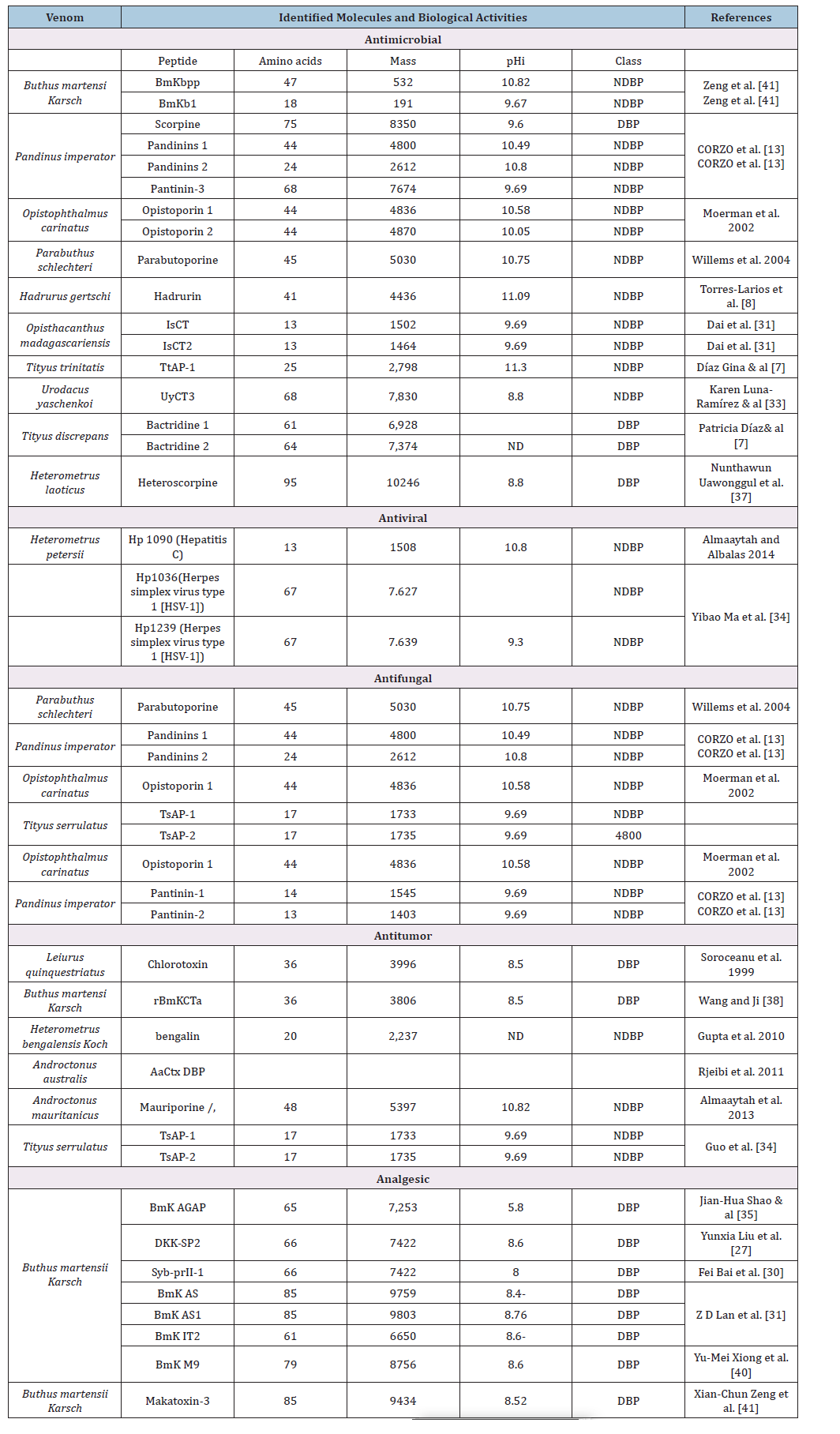
Antitumor activity has been reported in the composition of several scorpion venoms. This is the case for peptides isolated from the venoms of Androctonus crassicauda (Acra3) and Tityus discrepans (neopladinel 1 and 2), which present antitumor activity on a cell line (BC3H1) and on the SKBR3 cell line (breast cancer cell), respectively [19,20]. An antiproliferative activity of Indian black scorpion venom on U937 and K562 leukemic cells has also been reported, involving the mitochondrial pathway and the inhibition of HSP proteins. Chlorotoxin (ChTx) is the first chlorotoxin purified from the venom of Leiurus quinquestriatus. This toxin binds to chloride channels expressed specifically on human glioma and astrocytoma cells, but does not bind to normal human cells, including neurons [21-24]. ChTx inhibits chloride channels through its binding to the metalloproteinase MMP-2. This chlorotoxin induces the endocytosis of MMP-2 along with the channel (ClC-3, a subtype of chloride channel upregulated on glioma membranes), causing the depletion of these chloride channels in the glioma [25,26]. On the other hand, the study by Liu and collaborators [27] shows the inhibitory effect of ChTx on the migration of STTG1 and U251-MG cells, but the inhibition of chloride channels is not solely responsible for this inhibition. Another recent study shows that a “liposome complex carrying ChTx” significantly inhibits the growth of 4T1 cells derived from a breast tumor in BALB/c mice [28] (Table 1).
Table 1:Summary table of toxins and molecules purified from scorpion venoms endowed with biological activities.
Conclusion
Scorpion venoms represent a vast and largely untapped bioresource of highly specific molecules with immense pharmacological potential [29-36]. Far beyond their traditional classification as hazardous toxins, purified scorpion peptides, ranging from short and long non-disulfide-bridged peptides to specialized ion channel blockers demonstrate potent, multi-targeted biological activities. Their demonstrated efficacy against resistant bacterial pathogens, invasive fungal strains, viral proliferation, and parasitic life stages highlights their promise in combating emerging infectious diseases [37-42]. Furthermore, the high selectivity of specific toxins like Chlorotoxin for malignant tumour cells coupled with their ability to spare healthy tissues, covers the way for highly targeted oncological therapies and precision drug delivery systems. As advances in venomics, peptide synthesis, and biotechnology continue to overcome challenges related to yield and toxicity, scorpion venom components are uniquely positioned to serve as critical lead compounds for next-generation biopharmaceuticals and targeted therapeutics.
References
- Rochat H, Rochat C, Miranda F, Lissitzky S, Edman P (1970) The amino acid sequence of neurotoxin I of Androctonus australis European Journal of Biochemistry 17(2): 262-266.
- Guan R, Wang CG, Wang M, Wang DC (2001) A depressant insect toxin with a novel analgesic effect from scorpion Buthus martensii Karsch. Biochimica et Biophysica Acta 1549(1): 9-18.
- Niv AY, Zlotkin E (1979) Comparative studies on venom obtained from individual scorpions by natural stings. Toxicon 17(5): 435-446.
- Li Q, Zhao Z, Zhou D, Chen Y, Hong W, et al. (2011) Virucidal activity of a scorpion venom peptide variant mucroporin-M1 against measles, SARS-CoV and influenza H5N1 viruses. Peptides 32(7): 1518-1525.
- Zhao R, Zhang XY, Yang J, Weng CC, Jiang LL, et al. (2008) Anticonvulsant effect of BmK IT2, a sodium channel-specific neurotoxin, in rat models of epilepsy. British Journal of Pharmacology 154(5): 1116-1124.
- Wang M, Li H, Li S, Guo Y, Xu Y, et al. (2026) Scorpion venom peptides: From structural scaffolds to therapeutic applications-A focus on antioxidant mechanisms and translational perspectives. Antioxidants 15(6): 747.
- Díaz P, D'Suze G, Salazar V, Sevcik C, Shannon JD, et al. (2009) Antibacterial activity of six novel peptides from Tityus discrepans scorpion venom. A fluorescent probe study of microbial membrane Na+ permeability changes. Toxicon 54(6): 802-817.
- Larios AT, Gurrola GB, Zamudio FZ, Possani LD (2000) Hadrurin, a new antimicrobial peptide from the venom of the scorpion Hadrurus aztecus. European Journal of Biochemistry 267(16): 5023-5031.
- Zhao Z, Ma Y, Dai C, Zhao R, Li S, et al. (2009) Imcroporin, a new cationic antimicrobial peptide from the venom of the scorpion Isometrus maculatus. Antimicrobial Agents and Chemotherapy 53(8): 3472-3477.
- Rajendra W, Armugam A, Jeyaseelan K (2004) Neuroprotection and peptide toxins. Brain Research Reviews 45(2): 125-141.
- Sternberg S (1994) The emerging fungal threat. Science 266(5191): 1632-1634.
- Murphy A, Kavanagh K (1999) Emergence of Saccharomyces cerevisiae as a human pathogen: Implications for biotechnology. Enzyme and Microbial Technology 25(1999): 551-557.
- Corzo G, Escoubas P, Villegas E, Barnham KJ, He W, et al. (2001) Characterization of unique amphipathic antimicrobial peptides from venom of the scorpion Pandinus imperator. Biochemical Journal 359(1): 35-45.
- Gao B, Sherman P, Luo L, Bowie J, Zhu S (2009) Structural and functional characterization of two genetically related meucin peptides highlights evolutionary divergence and convergence in antimicrobial peptides. The FASEB Journal 23(4): 1230-1245.
- Murray CJ, Rosenfeld LC, Lim SS, Andrews KG, Foreman KJ, et al. (2012) Global malaria mortality between 1980 and 2010: A systematic analysis. The Lancet 379(9814): 413-431.
- Conde R, Zamudio FZ, Rodriguez MH, Possani LD (2000) Scorpine, an anti-malaria and anti-bacterial agent purified from scorpion venom. FEBS Letters 471(2-3): 165-168.
- Gao B, Xu J, Rodriguez MDC, Mendoza HL, Rivas RH, et al. (2010) Characterization of two linear cationic antimalarial peptides in the scorpion Mesobuthus eupeus. Biochimie 92(4): 350-359.
- Yan R, Zhao Z, He Y, Wu Y, Cao Z, et al. (2011) A new natural α-helical peptide from the venom of the scorpion Heterometrus petersii kills HCV. Peptides 32(1): 11-19.
- Caliskan F, Quintero-Hernández V, Cassulini RR, Valderrama FIC, Corzo G, et al. (2013) Molecular cloning and biochemical characterization of the first Na (+)-channel alpha-type toxin peptide (Acra4) from Androctonus crassicauda scorpion venom. Biochimie 95(6): 1216-1222.
- D'Suze G, Rosales A, Salazar V, Sevcik C (2010) Apoptogenic peptides from Tityus discrepans scorpion venom acting against the SKBR3 breast cancer cell line. Toxicon 56(8): 1497-1505.
- DeBin JA, Strichartz GR (1991) Chloride channel inhibition by the venom of the scorpion Leiurus quinquestriatus. Toxicon 29(11): 1403-1408.
- Lyons SA, O'Neal J, Sontheimer H (2002) Chlorotoxin, a scorpion-derived peptide, specifically binds to gliomas and tumors of neuroectodermal origin. Glia 39(2): 162-173.
- Ullrich N, Gillespie GY, Sontheimer H (1996) Human astrocytoma cells express a unique chloride current. Neuro Report 7(5): 1020-1024.
- Ullrich N, Sontheimer H (1996) Biophysical and pharmacological characterization of chloride currents in human astrocytoma cells. American Journal of Physiology-Cell Physiology 270(5 Pt 1): C1511-C1521.
- Deshane J, Garner CC, Sontheimer H (2003) Chlorotoxin inhibits glioma cell invasion via matrix metalloproteinase-2. Journal of Biological Chemistry 278(6): 4135-4144.
- Mamelak AN, Jacoby DB (2007) Targeted delivery of antitumoral therapy to glioma and other malignancies with synthetic chlorotoxin (TM-601). Expert Opinion on Drug Delivery 4(2): 175-186.
- Liu Y, Li Y, Zhu Y, Zhang L, Ji J, et al. (2021) Study of anti-inflammatory and analgesic activity of scorpion toxins DKK-SP1/2 from scorpion Buthus martensii Karsch (BmK). Toxins 13(7): 498.
- Qin C, He B, Dai W, Zhang H, Wang X, et al. (2014) Inhibition of metastatic tumor growth and metastasis via targeting metastatic breast cancer by chlorotoxin-modified liposomes. Molecular Pharmaceutics 11(10): 3233-3241.
- Amen RA, Essmat RA, Farid A, Rahman MAA, El SAA, et al. (2025) Scorpion venom as a natural peptide source for innovative therapeutic solutions: A comprehensive review of its potential in emerging medical frontiers. Toxicon 268: 108603.
- Bai F, Song Y, Cao Y, Ban M, Zhang Z, et al. (2022) Scorpion neurotoxin Syb-prII-1 exerts analgesic effect through Nav1.8 channel and MAPKs pathway. International Journal of Molecular Sciences 23(13): 7065.
- Lan ZD, Dai L, Zhuo XL, Feng JC, Xu K, et al. (1999) Gene cloning and sequencing of BmK AS and BmK AS-1, two novel neurotoxins from the scorpion Buthus martensii Karsch. Toxicon 37(6): 815-823.
- Lui VCH, Lung SSS, Pu JKS, Hung KN, Leung GKK (2010) Invasion of human glioma cells is regulated by multiple chloride channels including ClC-3. Anticancer Research 30(11): 4515-4524.
- Ramírez KL, Hernández VQ, Jaimes LV, Batista CVF, Winkel KD, et al. (2013) Characterization of the venom from the Australian scorpion Urodacus yaschenkoi: Molecular mass analysis of components, cDNA sequences and peptides with antimicrobial activity. Toxicon 63: 44-54.
- Ma Y, Zhao Y, Zhao R, Zhang W, He Y, et al. (2010) Molecular diversity of toxic components from the scorpion Heterometrus petersii venom revealed by proteomic and transcriptome analysis. Proteomics 10(13): 2471-2485.
- Shao JH, Cui Y, Zhao MY, Wu CF, Liu YF, et al. (2014) Purification, characterization, and bioactivity of a new analgesic-antitumor peptide from Chinese scorpion Buthus martensii Karsch. Peptides 53: 89-96.
- Stümpel F, Kucera T, Bazotte R, Püschel G (1996) Loss of regulation by sympathetic hepatic nerves of liver metabolism and haemodynamics in chronically streptozotocin-diabetic rats. Diabetologia 39(2): 161-165.
- Uawonggul N, Thammasirirak S, Chaveerach A, Arkaravichien T, Bunyatratchata W, et al. (2007) Purification and characterization of Heteroscorpine-1 (HS-1) toxin from Heterometrus laoticus scorpion venom. Toxicon 49(1): 19-29.
- Wang WX, Ji YH (2005) Scorpion venom induces glioma cell apoptosis in vivo and inhibits glioma tumor growth in vitro. Journal of Neuro-Oncology 73(1): 1-7.
- Xin K, Sun R, Xiao W, Lu W, Sun C, et al. (2025) Short peptides from Asian scorpions: Bioactive molecules with promising therapeutic potential. Toxins 17(3): 114.
- Xiong YM, Ling MH, Zhao T, Wang DC, Chi CW (1997) The CDNA and genomic DNA sequences of a mammalian neurotoxin from the scorpion Buthus martensii Karsch. Toxicon 35(7): 1025-1031.
- Zeng XC, Li WX, Zhu SY, Peng F, Zhu ZH, et al. (2001) Molecular cloning and sequence analysis of cDNAs encoding a β-toxin-like peptide and two MkTx I homologues from scorpion Buthus martensii Karsch. Toxicon 39(2-3): 225-232.
- Zhao R, Weng CC, Feng Q, Zhang XY, Li YL, et al. (2011) Anticonvulsant activity of BmK AS, a sodium channel site 4-specific modulator. Epilepsy & Behavior 20(2): 267-276.
© 2026 Nadjia Bekkari. This is an open access article distributed under the terms of the Creative Commons Attribution License , which permits unrestricted use, distribution, and build upon your work non-commercially.
Editor In Chief







.jpg)































Signup for Newsletter

Quick Links
 Editorial Board Registrations
 Submit your Article
 Best Paper of the Volume
 Reprints
 Refer a Friend
 Advertise With Us
Our Recent Edition

.jpg)



Top Editors




.jpg)

















.bmp)
.jpg)
.png)
.jpg)













.jpg)






.png)

.png)




.png)




Financial Support

Sponsors

Latest e-Books

Latest Video

 a Creative Commons Attribution 4.0 International License. Based on a work at www.crimsonpublishers.com.
Best viewed in
a Creative Commons Attribution 4.0 International License. Based on a work at www.crimsonpublishers.com.
Best viewed in 
 | Above IE 9.0 version