

- About Us
- Information
-

The Author ensures that the research has been conducted responsibly and ethically with adherence to all relevant regulations. read more..
- For Authors
- For Reviewer
- Manuscript Guidelines
- Membership
- Publication Ethics
-
- Journals
- Reprints
- e-Books
- Videos
- Policies
- Contact Us
 COVID-19
- Submissions



Full Text
Advances in Complementary & Alternative medicine
Embodiment of Centering: A Qualitative Case Study of a Narrative Focused Tai Chi Chuan Program for Inner City Youth
Zibin Guo1*, Christine Benz Smith2 and Laurie Meschke3
1 Department of Sociology, Anthropology, and Geography, University of Tennessee, Chattanooga, USA
2 College of Nursing, University of Tennessee, Chattanooga, USA
3 School of Public Health, University of Tennessee, USA
*Corresponding author:Zibin Guo, Department of Sociology, Anthropology, and Geography, University of Tennessee at Chattanooga, 615 McCallie Avenue, Chattanooga, USA
Submission: August 11, 2026;Published: August 27, 2026

ISSN: 2637-7802 Volume 9 Issue 3
Abstract
Mind-body practices such as Tai Chi Chuan have demonstrated benefits for psychological resilience, yet little research has explored their application among early adolescent, high risk urban populations. This qualitative case study examines the implementation and evaluation of an adaptive, narrative focused Tai Chi Chuan program implemented during a summer camp at a boys & girls club in the Southeastern United States. Drawing on field observations and focus groups, the study explores how youth engaged with and perceived Tai Chi metaphors, embodied movement principles, and emotional cultivation concepts. Findings suggest that metaphor focused Tai Chi instruction can foster engagement, focus, calmness, and social cohesion among vulnerable youth.
Keywords:Inner-city youth; Adaptive Tai Chi; Embodied learning; Narrative approach; Metaphor/ similes; Emotion cultivation; Mind & body empowerment
Introduction
Across the United States and globally, substantial numbers of inner-city adolescents endure high levels of psychological distress due to sustained exposure to street violence, high levels of trauma, structural poverty, racial segregation, and structural inequalities [1-5]. These conditions not only undermine their general wellbeing but force them to use anger and aggression as adaptive responses to express their chronic trauma and cope with their social environmental challenges [6-10]. Fowler et al. [11] synthesis of 114 studies demonstrates that repeated exposure to neighborhood violence embeds distress into daily routines, reshaping emotional responses and impairing youths’ capacity for effective regulation. Such embodied disruptions can persist into adulthood, influencing long term physical, emotional, and social outcomes [12-16]. Given these risks, developing interventions that cultivate emotional resilience and support psychological and physical wellbeing among vulnerable youth remains a critical public health priority. Tai Chi Chuan, rooted in the same philosophical traditions as traditional Chinese Medicine, has emerged as a widely practiced mind-body healing practice worldwide. The therapeutic effect of Tai Chi practice arises from the distinctive qualities of its movements.
The slow, coordinated, circular, rhythmic movements and deep breathing promote the body’s relaxation response and help decrease stress-related arousal [17]. Research increasingly supports Tai Chi’s benefits for youth, including reductions in distress and improvements in resilience [18-23]. Yet few studies have examined Tai Chi’s impact among inner city adolescents or explored how embodied, metaphor supported instruction may foster sustainable cognitive learning. This qualitative case study addresses this gap by examining the implementation and evaluation of an adaptive Tai Chi Chuan program designed for inner city youth in an urban setting in the Southeastern United States. The analysis draws on field observations and focusses groups to explore how the youth interpreted Tai Chi concepts, engaged with metaphor-based instruction, and perceived the application of these movement principles to everyday life.
Case Presentation
The study was conducted during the summer of 2017 at a boys & girls club serving more than 100 campers aged 7-14, 99% of whom were minority youth from low-income families living in high-risk neighborhoods. Many campers faced daily exposure to violence, instability, and emotional stress. This Tai Chi project was part of a three-year HRSA funded initiative led by a multidisciplinary project team at the University of Tennessee Chattanooga. The project aimed to develop community based experiential learning strategies that support health knowledge and emotional resilience across the lifespan.
Developing an adaptive Tai Chi program
To develop a Tai Chi program suitable for this youth population, the project team met with boys & girls club staff and camp counselors to better understand the characteristics and needs of the youth population they serve. Counselors reported that many youths frequently embodied negative emotions through physical engagement and expression of anger in dealing with social conflicts. Many enjoyed fast paced physical activities. Some had prior experience with martial arts such as Karate or Taekwondo, and many were drawn to martial arts like movements influenced by action films. Based on these discussions, the Tai Chi instructor and project team designed a short four movement Tai Chi Chuan sequence combining two Yang style movements with two Chen style movements. The Yang style offered slow, graceful, flowing movements, while the Chen style introduced dynamic, fast expressed energy. This blend aimed to provide youth with an embodied experience of the central ideas in Tai Chi power grows from a calm mind and gentle body movement, and the power in Tai Chi is defined by the ability to embrace and become gracefully transforming external forces such as negative emotions through controlled, circular, calm, and intentional movement and energy [24].
Program implementation
The eight-week program was implemented at the boys & girls club in the summer of 2017. Twenty-five camp participants, comprising 14 females and 11 males, aged 7 to 14, participated in the program. Each session was 30 minutes long and was conducted once a month.
Narrative and metaphor focused pedagogy: Tai Chi movements are inherently symbolic (Goden rooster sands on one leg, yield and redirect, e.g.). Since they are symbolic representations of natural and structural principles of movement (flowing water, rooted like a tree, e.g.), natural element-focused metaphorical instruction can effectively shape embodied practice and somatic transformation [25,26], transforming complex concepts and ideas into embodied knowledge and cognition. Considering the age and physical and psychological characteristics of these young campers, the team therefore developed a metaphor-based narrative instruction to support embodied learning. During program implementation, the instructor used metaphors such as “stand like a tree,” “yield like bamboo,” and “flow like water” to help youth connect movement with emotional concepts through mental imagery.
These metaphors were intended to make slow, gentle movements meaningful, accessible, and empowering, fostering a body nature connection that could provide an embodied experience of the effectiveness and importance of flowing with calmness. In addition, the instructor also provided movement-meaning-focused narratives and metaphors/similes when leading the group learning and practice of each of the four movements to provide embodied and experiential understanding of how slow and gentle movements could still create beauty and power in any circumstances when one’s mind and body are in sync. The following are the specific narrative focuses for each of the four movements.
Move 1. Golden Rooster Stands on One Leg
Narrative focus: Standing on one leg (facing challenges) is the source of graceful, powerful upper-body movement.
Move 2. Flying Arrow Shoots the Moon
Narrative focus: When one is centered (sit like a mountain), a calming, focused mind can make one’s body become a powerful bow sending the arrow to reach the target (goal), no matter the distance.
Move 3. Kicking while Standing on One Leg
Narrative focus: When one is rooted mentally and physically, standing on one leg (facing challenges) can be a source of power.
Move 4. Push the mountain
Narrative focus: When one is calm, rooted, and centered, the power she/he generates by embracing challenges can push a mountain away (overcoming).
Data Collection
Field observation notes
In the pre-program implementation meetings with the camper counselors, we learned that keeping the youths’ attention during group activities can be challenging, especially for the Tai Chi program, in which the nature of body movements is so different from the physical activities the youths are accustomed to. To better understand how the youths reacted to and participated in this program, a university student majoring in exercise science served as a participatory observer to observe how participation in the 8-week narrative-focused Tai Chi program affected 1) the pattern of youth attention; 2) the observed behavioral changes reflecting youth’s interest in this program; and 3) the pattern of group interaction during their participation.
A brief survey
Two weeks after completion of the 8-week Tai Chi program, a program evaluation team conducted a program evaluation at the Boys and Girls Club. Ten young participants, 6 boys and 4 girls, volunteered to participate in the evaluation activities. They all completed a short survey documenting their session attendance.
Focus group
After completing a brief survey, the 10 youths were divided into two groups by sex, one male and one female group, and each participated in an approximately 45-minute focus group discussion. The objectives of the focus group were: (1) to assess (recall) participants’ identification of the Tai Chi concepts or statements that the instructor incorporated in the 8-week Tai Chi classes, (2) to learn participants’ understanding and prioritization of these concepts they selected, and, (3) to explore how they perceived the importance of these selected concepts applicable to their daily life.
Findings
Field observations: The summarized field observation notes from the student observer clearly demonstrate a progressive change in patterns of program participation among these youths, from early, less enthusiastic interest to curiosity, and later showed confident participation and appreciation.
Early engagement and curiosity: “During the first session, youth initially displayed polite but reserved interest. As the instructor demonstrated the four-movement form, their reactions shifted dramatically” “They became enthralled in his movements and were so focused on his demonstration that they jumped when he punched for ‘Flying Arrow Shoots the Moon.’” “Girls, initially less enthusiastic, became increasingly engaged, asking questions and even sharing dance movements with the instructor. Their initiative signaled growing interest and comfort.”
Confidence, Focus, and Social Support: “During the final session, youth performed the Tai Chi sequence independently or in pairs. Girls demonstrated strong mutual support, while boys showed marked improvement in focus and organization” “More of the boys watched and paid attention to what the other boys in their group were doing, and they took their demonstrations very seriously.” “At the session’s end, all boys shook hands with the instructors, reflecting increased confidence and respectful engagement.”
Survey Results: The evaluation participants ranged in age from 11 to 15 years (mean=12.7). Overall, the participants had attended an average of 6.9 sessions, ranging from 4-8.
Focus group findings: The number of concepts provided by each group ranged from 11-13 (Table 1). As illustrated in Table 1, the concepts by sex revealed that the girls’ and boys’ groups are very similar, allowing for slight variation in phrasing. In discussing how they interpret and view the importance of these concepts, the girls’ focus group placed an emphasis on self-defense and being calm. The boys’ focus group prioritized focusing and controlling their emotions. While both groups discussed the idea of being calm, “calm” may have held different definitions for the girls and boys. The girls used the idea of being calm as a method of “re-centering oneself,” or helping them feel tranquil. With the boys, feelings of calm were associated with “courage,” “facing one’s fears,” and not “freaking out.” The boys further elaborated with reference to “still,” “concentrate,” and that “water has power.” Even though the sense of being able to control one’s emotions was present in both discussions, this concept may have served as a stronger channel for the boys’ emotions than the girls’ group.
Table 1:Tai Chi concepts recalled in two focus groups.
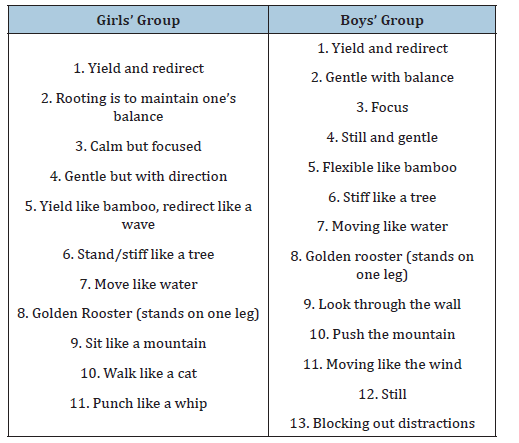
Youth were then asked to identify the top three phrases/ concepts they perceived as important to everyday life (Table 2). For the girls’ group, “Flow like water” was selected by everyone; the second one was “yield and redirect,” selected by 3 out of 4 girls. Both “Yield like bamboo” and “Punch like a Whip” received two votes each. When the evaluation team asked why they thought “Flow like water” was the most important theme for everyday life, all four girls agreed that this simile helped them stay calm throughout the day or whenever they got stressed. Discussion for “Yield and redirect” and “Punch like a whip” both showed the theme of self-defense and being able to redirect a person’s attack to protect oneself. For the boys’ group, “Deflect distractions” received all six votes; “Focus” and “Golden Rooster stand on one leg” each received five votes. The boys’ discussions for “Deflect distractions” and “Focus” were essentially the same as the girls. Both focus groups had reallife applications in avoiding violence, focusing on school/home responsibilities, and having courage.
Table 2:Concepts applicable to everyday life.

# of Participants: Girls’ group = 4; Boys’ Group=6
Discussion
The findings from this narrative focused Tai Chi intervention illustrate the potential of an embodied, metaphor-supported movement practice to meaningfully engage inner city youth and support the development of emotion recognition and regulation skills. Data generated from field observations and focus group discussions revealed several themes that highlight both the feasibility and the promise of integrating the “Embodiment of Centering Approach” to apply Tai Chi as a tool of self-empowerment for vulnerable populations, including the inner-city youth. First, the program successfully captured youths’ attention and sustained their engagement, even among participants initially hesitant or unfamiliar with slow, intentional movement practices. As the observer noted, youth began the first session “show[ing] a polite interest” but quickly became “enthralled” by the instructor’s demonstration, reacting with surprise and excitement when he performed the Chen style punch. This shift suggests that blending slow Yang style movements with dynamic Chen style expressions effectively appealed to youth accustomed to fast paced activities and martial arts imagery. Second, the metaphor based instructional approach may play a central role in shaping youths’ cognitive and emotional engagement by connecting their movement to natural elements.
Youth not only remembered metaphors such as “stand like a tree,” “yield like bamboo,” and “flow like water”; they also interpreted their importance, prioritized them, and applied them to daily life. Girls unanimously selected “flow like water” as the most important concept, explaining that it helped them “stay calm throughout the day or whenever they got stressed.” Boys emphasized “blocking out distractions” and “focus,” linking these ideas to avoiding violence, fulfilling school and family responsibilities, and maintaining courage. These interpretations demonstrate that metaphors served as accessible cognitive anchors, enabling youth to translate abstract Tai Chi principles into concrete strategies for emotion cultivation. Third, participation in this program appeared to foster social cohesion, confidence, and mutual support. When asked to demonstrate what they learned in front of the class at the last session of the program, girls performed in pairs, “very supportive of each other,” while boys demonstrated impressive “organization and focus,” watching one another closely and taking their demonstrations “very seriously.” As the observer also noted that at the end of the last session of this program, “all the boys shook our hands and thanked us as they left,” this respectful and appreciative gesture may suggest that embodied practice may have contributed to improved self-presentation and social behavior.
Conclusion
This qualitative case study demonstrates that an adaptive, narrative‑focused Tai Chi Chuan program, developed based on the characteristics and needs of inner-city youth, can serve as an effective option for engaging youth and supporting their development of emotional resilience through embodied learning. Over eight weeks of program implementation, youth progressed from initial curiosity to later confident, engaged participation, suggesting that the blended Yang-Chen movement sequence paired with metaphor‑rich instruction-effectively bridged the gap between slow, intentional movement practices and the fast‑paced, martialarts- manifested movements familiar to this population. The use of narrative- and metaphor-based pedagogy played a central role in fostering participants’ embodied engagement in learning.
Youth not only recalled metaphors such as “flow like water,” “stand like a tree,” and “yield like bamboo,” but also interpreted their meanings in the context of their real‑life challenges. Girls emphasized calmness, tranquility, and self‑defense, while boys highlighted focus, courage, and emotional control, suggesting the potential benefits of applying this pedagogy as accessible cognitive anchors for emotion recognition and regulation. Participation also appeared to foster social cohesion and positive behavioral shifts. Youth demonstrated increased organization, peer support, and respectful engagement. These observations suggest that embodied practices may contribute not only to individual emotional regulation but also to improved interpersonal dynamics within group settings. However, this project also had several limitations, including the small sample size, voluntary participation, exclusive reliance on qualitative data, and absence of long‑term follow‑up.
Future research examining the effects of a Tai Chi intervention on metaphor‑supported movement practice-and on the development of emotion recognition and regulation skills in inner‑city youthshould incorporate mixed‑methods designs, larger and more diverse samples, comparisons between youth from similar urban environments and those living in rural or suburban areas, and longitudinal assessments to evaluate sustained behavioral change. Additionally, peripheral biomarkers, such as plasma‑based measurements, may help capture physiological and psychological changes that are not immediately observable through behavior [26]. Despite these limitations, this case study contributes to the emerging literature on culturally/socially adaptive mind–body interventions for vulnerable youth. The results of this case indicate that Tai Chi Chuan, when thoughtfully modified and narratively engaged, can resonate deeply with inner-city youth through embodied learning and provide them with both physical practice and a metaphorical toolkit for remedying stress, cultivating calmness, and strengthening emotional self‑efficacy.
Acknowledgement
This project was made possible through the collaboration and dedication of many individuals and organizations. We extend our deepest appreciation to the Chattanooga Boys & Girls Club for their partnership, logistical support, and commitment to creating a safe and enriching environment for youth participants. We are sincerely grateful to the young campers whose enthusiasm, openness, and embodied engagement brought this study to life. We thank all project team members for their knowledge, time, participation, and commitment, which ensured the successful completion of this study. We also acknowledge the contributions of Candace Dunham, the project field observer, whose detailed field notes enriched the qualitative analysis. We thank Mark Harvey, whose detailed and thoughtful coordination skills made this project move smoothly like water. This work was supported by the Health Resources and Services Administration (HRSA) through a three-year grant (HRSA- 14-066) focused on developing community based interprofessional experiential learning strategies to improve health outcomes across the lifespan. We gratefully acknowledge this funding, which made the program and evaluation possible. This project was approved by the IRB Committee of the University of Tennessee Chattanooga (UTC IRB #14-173) prior to its start.
Conflict of Interest
The authors declare no conflicts of interest related to the research, authorship, or publication of this manuscript. No financial, personal, or professional relationships influenced the conduct or reporting of this study.
References
- Pykett J, Campbell N, Fenton SJ, Gagen E, Lavis A, et al. (2023) Urban precarity and youth mental health: An interpretive scoping review of emerging approaches. Social Science & Medicine 320: 115619.
- American psychological association (2024) Effects of poverty, hunger and homelessness on children and youth.
- Centers for disease control and prevention (2024) About youth violence | Youth violence prevention.
- Mayer Y, Slone M (2024) Inner-city Youth’s mental health: The relations between resource loss, stressful life events, and psychological distress. International Journal of Adolescence and Youth 29(1).
- Mathisen FS (2025) ‘Violence is completely normal’: Managing violence through narrative normalization. British Journal of Criminology 65(1): 37-53.
- Baron SW (1999) Street youths and substance use: The role of background, street lifestyle, and economic factors. Youth & Society 31(1): 3-26.
- McKay MM, Lynn CJ, Bannon WM (2005) Understanding inner city child mental health need and trauma exposure: Implications for preparing urban service providers. American Journal of Orthopsychiatry 75(2): 201-210.
- Karandinos G, Hart LK, Castrillo FM, Bourgois P (2014) The moral economy of violence in the US inner city. Current Anthropology 55(1): 1-22.
- Darnell D, Flaster A, Hendricks K, Kerbrat A, Comtois KA (2019) Adolescent clinical populations and associations between trauma and behavioral and emotional problems. Psychological Trauma 11(3): 266-273.
- Gregory H, Horton C, Walker QD, Edwards YV (2026) Wired for the city: Adolescent emotional regulation and development in high-density urban schools-strengths, challenges, and the architecture of adaptive resilience. Open Journal of Social Sciences 14(6): 81-106.
- Fowler PJ, Tompsett CJ, Braciszewski JM, Tiura AJJ, Baltes BB (2009) Community violence: A meta-analysis on the effect of exposure and mental health outcomes of children and adolescents. Development and Psychopathology 21(1): 227-259.
- Felitti VJ, Anda RF, Nordenberg D, Williamson DF, Spitz AM, et al. (1998) Relationship of childhood abuse and household dysfunction to many of the leading causes of death in adults: The Adverse Childhood Experiences (ACE) study. American Journal of Preventive Medicine 14(4): 245-258.
- Mersky JP, Topitzes J, Reynolds AJ (2013) Impacts of adverse childhood experiences on health, mental health, and substance use in early adulthood: A cohort study of an urban, minority sample in the U.S. Child Abuse & Neglect 37(11): 917-925.
- Liming KW, Grube WA (2018) Wellbeing outcomes for children exposed to multiple adverse experiences in early childhood: A systematic review. Child & Adolescent Social Work Journal 35(4): 317-335.
- Villalta L, Smith P, Hickin N, Stringaris A (2018) Emotion regulation difficulties in traumatized youth: A meta-analysis and conceptual review. European Child & Adolescent Psychiatry 27(4): 527-544.
- Giovanelli A, Reynolds AJ (2021) Adverse childhood experiences in a low-income black cohort: The importance of context. Preventive Medicine 148: 106557.
- Huston P, McFarlane B (2016) Health benefits of tai chi: What is the evidence? Canadian Family Physician 62(11): 881-890.
- Waechter RL, Wekerle C (2015) Promoting resilience among maltreated youth using meditation, yoga, Tai Chi and Qigong: A scoping review of the literature. Child & Adolescent Social Work Journal 32(1): 17-31.
- Zhang J, Qin S, Zhou Y, Meng L, Su H, et al. (2018) A randomized controlled trial of mindfulness-based Tai Chi Chuan for subthreshold depression adolescents. Neuropsychiatric Disease and Treatment 14: 2313-2321.
- Liu X, Li R, Cui J, Liu F, Smith L, et al. (2021) The effects of Tai Chi and qigong exercise on psychological status in adolescents: A systematic review and meta-analysis. Frontiers in Psychology 12: 746975.
- Neal AM (2021) Somatic interventions to improve self‐regulation in children and adolescents. Journal of Child and Adolescent Psychiatric Nursing 34(3): 171-180.
- Yang D, Wang X (2025) The influence and mechanism of Taichi Chuan on improving mental health in adolescents: The chained mediating effect of meaning in life and psychological resilience. Acta Psychol (Amst) 255: 104932.
- Craik L, Quadt L, Garner M, Pfeifer G (2026) Interoception and emotion regulation in children and adolescents: A systematic literature review. European Review of Applied Psychology 76(3): 101164.
- Xiujie M, Jennings G (2021) “Hang the flesh off the bones”: Cultivating an “ideal body” in Taijiquan and Neigong. International Journal of Environment Research and Public Health 18(9): 4417.
- Koziol A, Dipl IA, München F (2025) The art of balance: Exploring analogies in Taiji forms and tensegrity structures. Journal of Taiji Science 4(1): 25-39.
- Martins IJ (2018) Early diagnosis and nutritional treatment stabilize neuropsychiatric disorders. Global Journal of Medical Research 18(A1): 1-7.
© 2026 Zibin Guo. This is an open access article distributed under the terms of the Creative Commons Attribution License , which permits unrestricted use, distribution, and build upon your work non-commercially.
Editor In Chief




.jpg)





























Signup for Newsletter

Quick Links
 Editorial Board Registrations
 Submit your Article
 Best Paper of the Volume
 Reprints
 Refer a Friend
 Advertise With Us
Our Recent Edition
.jpg)


Top Editors



.jpg)
















.bmp)
.jpg)
.png)
.jpg)













.jpg)





.png)

.png)



.png)




Financial Support

Sponsors

Latest e-Books

Latest Video

 a Creative Commons Attribution 4.0 International License. Based on a work at www.crimsonpublishers.com.
Best viewed in
a Creative Commons Attribution 4.0 International License. Based on a work at www.crimsonpublishers.com.
Best viewed in 
 | Above IE 9.0 version